
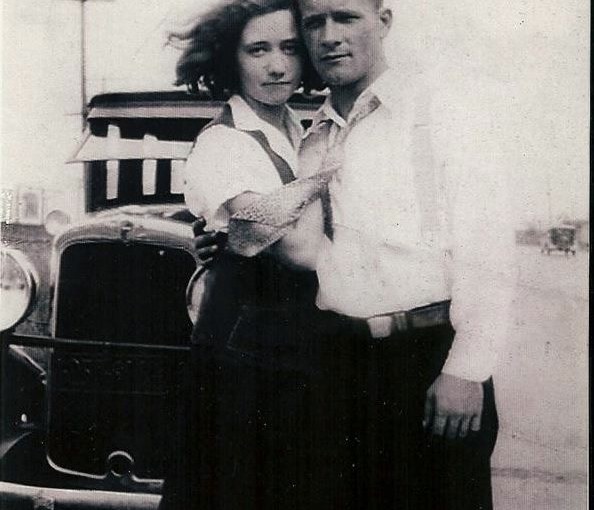
Eileen Kelly Murphy:
My Mom
It was the spring 1927 when my mother discovered she was adopted. Her mother had gone down the street to the dry goods store and while she was gone, a restless Eileen decided to bake. The house they lived in then was the same one I grew up in years later, so in my mind’s eye I can see her in the small kitchen with the morning sun pouring in the east window and shadows dancing on the icebox across the room. She said it was a glorious morning.
My mother must have pulled the recipe box off the icebox and laid it on the table covered with an brightly colored oilskin cloth. Her story is that as she pulled out the recipes something caught her eye, something in an official looking brown envelope.
Maybe that’s they way it happened, but I have my doubts. I think she was, as many that age has been known to do, snooping around my grandparents private papers. Maybe she even suspected something . . . maybe deep down she knew.
However it happened, that brisk spring morning was when she stumbled across the papers that told her she was not really the daughter of Patrick and Hannah Kelly – – – but that she had come from a place called St. Joseph’s Home for the Friendless.
She felt as if a hundred thousand volts of electricity went right through her. Knowing her, I imagine she felt faint. Always the dramatic one, I see her stumbling across the kitchen with the morning sun that moments before was a source of joy and energy now becoming a blinding light, one that she could not tolerate. In my mind’s eye I see her retreat to the tiny bathroom in the center of the house. I see her sit on the commode shaking. What I do not see is her telling her mother what she found.
When Hannah came home, Eileen was back in the kitchen pulling out flour, sugar and everything she needed to project normalcy. Nothing was said. It took years for the “secret” to be discussed between them.
But in that spring of 1927, to Eileen, everything had changed. It was as if her whole idyllic life changed in a single minute. To her, she was no longer the cherished only child of the Kelly’s. Now she perceived that every slight, every discipline she had ever received was because she was not their own, it was because she came from place called St. Joseph’s Home for the Friendless, it was because she was adopted.
My mother became obsessed with finding who she “really” was, where she had come from and finding her “real” parents. Interestingly, her obsession led her to my dad, and eventually, her early marriage to him.
Shortly before finding those traumatic papers, my mom had met my dad. She was only a freshman at Mercy High School when, standing on a corner of 79th and Prairie with her girlfriends, a young man ten years her senior drove up and offered her and the others a ride. They took it.
Art Murphy was Paul Newman-handsome with strikingly blue eyes and a quick Irish wit. He was first-generation Irish, the oldest of eight and knew a pretty girl when he saw one. Eileen was petite, pretty with a stylish short bob and a delicate features. When Art saw Eileen, he knew he wanted to get to know her better.
Because of the age difference, the relationship may have never progressed. But my mother was vulnerable and needy after her unsettling discovery and Art Murphy gave her what she desperately needed: he gave attention.
We aren’t exactly sure about the details of her birth, although we have some hints. But we do know that she and two older sisters were put in an orphanage when she was about six months old. The name of it was St. Joseph’s Home for the Friendless. Who would want to come from a place with a name like that?
I don’t know anything about the conditions of the Home. It could have been a wonderful, caring place although research on such places at that time led me to doubt that it was much more than a warehouse for orphans. But no matter the actual conditions of the home, the name alone is enough to scar someone for life in my opinion.
St. Joseph’s Home for the Friendless was built during the Civil War as a hospital for injured soldiers. So by the time my mother arrived there in 1914 or 1915 it was already pretty much out of date. It was, and still is, a red brick eight-story building located at 735 East 35th Street in Chicago. I’m told the children could see boats on the lake from its windows. But of course my mother would have been too young to see much of anything.
She had no memories of her time there, but later learned from her oldest sister that she was kept in a crib in a nursery with rows of other babies likewise in cribs. Her sister, Loretta, then about five, would sneak past the nuns each day just to see my mom and hold her hand. Loretta had been accustomed to taking care of the baby, then named Anna Belle White, and was traumatized when one day she arrived in the nursery only to see my mother’s crib empty. As Loretta told it many years later, she screamed and cried but the nuns were offered little comfort and no explanation.
The Kelly’s, Patrick and Hannah, were from the west coast of Ireland; he from Clare and she from Limerick. They were good people; they were kind, hard working, stable and loving.
They were childless and took her into their home as their own. They renamed her Eileen Mary Kelly and proceeded to shower her with all the love they had stored up waiting and wanting a baby of their own.
They raised her as their own, never telling her she was not of their flesh and blood. Patrick was a union organizer and Hannah was, like most, if not all women in the early 1900’s, a stay-at-home mother.
At that time, the Kelly’s lived in a neighborhood that is now known in Chicago as “Englewood.” Now it is worn down, poor and overrun with gangs fighting and shooting each other and anyone else who gets in their way. When my grandparents moved there in the beginning of the 20th century, it was mostly farmland and open prairie.. New brick houses, mostly the famous “Chicago bungalows” were beginning to be built for the newly arrived Irish and Italian immigrants. The men were mostly laborers, factory workers, or worked in the nearby stockyards killing cattle.
The Kelly’s weren’t rich. But since they had only one child – – in the days of large families – – they weren’t struggling as much as most in their blue-collar neighborhood. Hence, they were able to give their little girl more than her peers.
For instance, if she got a doll for Christmas it came with a wardrobe of clothes with matching outfits for my mother, all sewn by my grandmother. She had the American Doll phenomenon 75 years before it came on the national scene.
It seemed Eileen had everything. The unconditional love of two good people and all the material things she needed or wanted. Then, one day at the age of 14, in that sun-filled kitchen, the bottom fell out. Nothing was the same after the age of 14 for Eileen Mary Kelly, formerly Anna Belle White.
Discovery of her adaptation deeply and irrevocably changed her life and, eventually, the lives of all who were close to her. For the day Eileen discovered she wasn’t the beloved biological daughter of the Kelly’s her world shattered.

 Growing up in Chicago in the '50's
Jeff, How unfortunate that your Mom made this discovery at such a vulnerable age. It must have filled her with many conflicting feelings. And when you think that she married your Dad only a year or so later, it makes you wonder if she was trying to “leave” her life parents (vs. birth parents) the way she might has fantasized that she had been left. And it must have been so sad for the Kellys, who thought of her as their “real” daughter, who they loved and tried to do so much for and did not think of her as adopted. It is wonderful that she was eventually reunited with her sisters. Can’t wait to hear that part of the story! I have come to believe, over these many years, that we are where we are supposed to be to learn or do what is our soul’s journey – and we can’t always know what is for better or worse – until much, much later.
Your cuz, Sharon P.S. John told me the story of a man he worked with who was the only child of adoptive parents, who were did much for him but were not affectionate (in his eyes) so he went on a search for his “real” parents. What he found made he so grateful for the parents who raised him and he saw them in a whole new light. Sometimes, our Guardian Angels are not who we expect.
LikeLike
I want to hear more about the 5 year old sister. How tragic.
LikeLiked by 1 person