September 2015
To my grandchildren:
As the 14th anniversary of the World Trade Center atrocity approaches, I thought I would share with you the small part I played in our nation’s response to it. At the same time I hope you will learn more about the people directly affected by this despicable act of cowardliness and some of my reaction to it. But before I begin, let me explain how I got happened to get there – – –
I was the founding director of the Victim/Witness Assistance Program at the Cook County State’s Attorney Office under Richard M. Daley in the 1980’s. During that time, I become active in the National Organization for Victim Assistance and eventually served on its Board of Directors.
By 2001, I was no longer with the SAO and had resigned from NOVA’s Board. But after the plane hit the towers on September 11 and watching the devastation it caused, I called NOVA asking if they were involved in the WTC response and if they needed volunteers. They were involved and they were happy to have more volunteers.. That’s how I ended up on a plane to New York in October of 2001. I was happy to be able to volunteer and help with the response to the events of September 11, 2001.
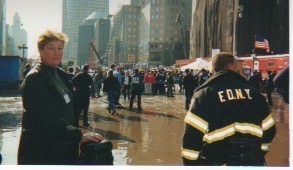
My role was small, but I had the honor of watching and working with the first responders: the firemen and police working on ground zero and the construction workers trying so valiantly to pull bodies from the rubble. And I had the gut-wrenching experience of helping the families and loved ones of those who died. It was an privilege to be a part – although a very small parties – of our country’s response to what happened.
Crisis Intervention Counseling
One of the roles I was assigned was to coordinate the response of the NOVA crisis workers who were coming in from all over the country. I didn’t do the counseling. My role, among other things, was to create the relationships with other agencies and service groups so that our volunteer counselors could provide the needed help.
To be eligible to be a crisis worker and counsel victims, the crisis workers had to have gone through a vigorous training program and been certified in crisis intervention by NOVA. Their professions were varied – they included school principals and teachers, police personnel, counselors, social workers, psychologists, and victim advocates.
These crisis workers were an important part of the work of the the NOVA 9/11 response effort in Manhattan. One important part of my job was to reach out to and provide service to groups requesting Group Crisis Intervention sessions (GCI).
Many of the calls we received were from businesses that were either located in or near the WTC and thus had employees who witnessed first-hand the horror of that day. Other calls come from residents of condo or apartment buildings near the WTC who were beginning to realize they needed help and requested CGI sessions.
I did, however, sometimes screen those who come to us. One of those was a 30-something man who called one day and told me he was attending a meeting in the federal building across the street from the WTC on the morning of 9/11. He said he was gazing dreamily out the window and in his words:
“ . . . . my boss was talking on and on in a monotone voice and I was gazing out the window. . . and suddenly a plane came out of nowhere and I saw it hit one of the towers and it completely disappeared into it. . . . I couldn’t believe it . . . I couldn’t understand it . . . and on top of it my boss kept talking and I couldn’t think. I could hear his voice but I kept looking at the hole in the WTC and the smoke and the bodies flying. Then finally someone yelled to get out so we all got up and started to run and we ran all the way down the stairs to the street. When we got down it was chaos. I ran all the way to the river.”
Another day in the office I received a call from a woman looking for counseling for an entire family whose father was killed in the WTC. He had been a chef in the Windows of the World (which was the restaurant on the top floor of one of the buildings) and left five children behind when he died, ages 4, 7, 10, 16, and 17. The mother of the oldest two children had died years ago and he had remarried. It was his second wife on the line. The first two children had now lost both biological parents. To add to the dreadfulness of the situation, the seventeen year old attended a school near the WTC and was running for his life when he turned to see his father’s building collapse.
Another of my roles was to establish contacts with and offer assistance to businesses and individuals who were not in the WTC but who were directly affected nonetheless. For example, there was a nationally known trading firm whose corporate offices were several blocks away. They, of course were evacuated immediately and many of them witnessed the horror of people jumping. One their top executives now wears gym shoes everywhere in case he has to run away as he did that day.
Ground Zero
Another of my roles was to try to establish a connection with and services for those working at ground zero. I was fortunate that, through contacts made with the fire department, I was able to secure a trailer right next to ground zero. That meant some of our counselors could be in close proximity to the construction workers who worked around the clock pulling remains out of the rubble.
It’s not always easy getting construction workers to talk to a counselor – – -so one of their the superiors suggested I walk around on site and talk with them as they worked so they could get to know me and feel comfortable and maybe I could get some ideas from them. It was a good idea but that meant going onto ground zero. Words cannot describe how I felt. It was hallowed ground. No one was allowed onto ground zero without special clearance. I was awed to be allowed on to that scared place.
It was difficult for me to be there… I think it was difficult for everyone who was there. Despite the heavy equipment and hundreds of workers, it was an eerily quiet, solemn place. There was a reverence about it and all who walked on its ground. There was no fooling around, no loud talking, no swearing, none of the usual noises or raised voices you’d hear at a construction site.
As I walked around I tried to imagine the towers as they were, the thousands of people, the lives lost and it was just overwhelming. Good lord, I just wanted to cry. The sights and smell, especially the smell, will stay with me until the day I die.
To go on ground zero I had to purchase a pair of construction boots. I wore them as I walked on that ground and then put them away. Never wore them again. The dirt from that awful site is still in them today. I want them next to my casket when I die to remind everyone of those who died and those who loved them. And to remind everyone of how we all felt after it happened.
I did talk to some men and women working the site and took their advice. To help get the workers through our doors, they suggested making it appealing by putting in TVs, cots, food, coffee and phones in the trailer for their use. Once the workers were in, the counselors had a better chance of approaching them and helping them talk about the things they saw in their work on ground zero looking for bodies.
The Family Assistance Center
In addition to conducting the GCIs, NOVA also played an important role at the “Family Assistance Center” set up by the state of New Jersey at Liberty State Park. This facility served families and survivors from New Jersey and Pennsylvania and was located directly across the river from ground zero. Another Family Assistance Center for New York families was located in Upper Manhattan.
Liberty State Park was actually an abandoned train station that the state quickly converted into what became a wonderfully organized space designed to provide — in one place — all the services needed by the families of those killed. New Jersey did a remarkable job of making this place into a warm and inviting place for those who hurt so badly. Practically overnight the main building was reconstructed to include:
• an interdenominational chapel,
• a room with numerous computers and telephones that allowed victims to contact loved ones anywhere in the world,
• a dining room with round the clock hot meals,
• counseling,
• quiet rooms for sleeping,
• child care, and
• memory boards all around the premises.
Outside of the main building were trailers that housed agencies that assisted families with all the paperwork they need to get through that terrible time. For example — as terrible as it was for them – the mandatory first step for survivors was to get a death certificate. Without a death certificate a family could not even collect on a life insurance policy they might have much less be eligible for other services. So the first trailer they were directed to was the FEMA trailer. FEMA provided all the necessary paperwork to get a death certificate.
Once they got the death certificate they could begin the process of applying for other benefits such as help with mortgage payments, long-term counseling, emergency food, job placement assistance (for those that now need to work),etc.
Liberty State Park Family Assistance Center also served as one of the locations from which the families of the deceased could leave to visit the World Trade Center site to pay their respects. Visiting ground zero was very important for most families. It was where their loved one died and being there, seeing it up close, first hand, even as horrible as it was, seemed to help get them some small measure of relief.
Only immediate family members were allowed to register for this special visit but they could make requests to include individuals they deem special to the deceased. For example, a roommate of a victim could have been included at the request of the family.
When a family arrived to visit ground zero, they were assigned a special liaison (who also was a trained crisis worker) to accompany them and ensure the day went as smoothly as possible. They were invited for coffee and and then attended a group session in the chapel where a coordinator explained the logistics for the visit and tried to prepare them for what they would see at ground zero. They were provided with hard hats, goggles and masks. The hard hat were mandatory; the other items are used as needed.
Most families brought some sort of memento to leave such as bouquets of flowers, notes, letters or photos. I’ve seen wives and husbands bring copes of their marriage certificates and leave them behind.
Buses took the families to the ferry for the trip to the WTC site. State police and volunteers surrounded them as they entered the site to shield them from the photographers and maintain their privacy. A platform was set up from which the families could view the wreckage and say their prayers and farewells. A section was designated for them to leave their mementos
My first day at Liberty State Park Family Assistance Center was a Saturday and one which will be imprinted in my mind forever. Apparently the some remains of the victims had been collected, cremated and were now being delivered to the Family Assistance Center for distribution to the families the next day. Those of us present were asked to join the Salvation Army in forming an honor guard as the remains were brought in.
It was a cool and windy early morning autumn day and there weren’t many of us on site yet, maybe forty or fifty of us. We spontaneously formed two lines. As I looked around, we were all colors, all ages, both sexes all united in our grief and all struggling to grasp the enormity of the situation. A cold wind was blowing, a flag was waving wildly in the strong wind, and we were singing “God Bless America” as the ashes of nearly 5,000 men and women were being carried past us in several flag draped boxes. Police and fire personnel escorted them with Irish bagpipes leading the way.
As I held my hand over my heart and sang songs I’d probably sung hundreds of times, the words “God bless America” and “does the flag still wave or the land of the free and the home of the brave . . “ took on a new, deeper meaning. I remember looking at the others across from me, tears running down their faces then I realized mine was tear stained too. There may have been ashes in those boxes but what was in our minds, mine at least,were the families of those victims. The faces of the children, the wives and husbands, the mothers and fathers, the sisters and brothers, the best friends, all those gone and all those left behind. I felt the grief, the tears . . . . the unfathomable emptiness.
As we small band of Americans stood together saluting these ordinary people who lost their lives so horrifically, so suddenly and without warning for reasons that didn’t make any sense, I believe we came to understand, in a very profound way, that understanding, acceptance, helping, caring for and loving one another should be our way of life – should take up all our energies. What may have seemed a naïve way to live before 9/11 will – – if we have learned anything – – should be our way of life now.
I spent a lot of time that afternoon looking at the memory boards. They were filled with seven weeks worth of notes, photos and the deepest, feelings and anguish of hundreds of people. I watched as other family members came in and wrote their own notes, stapled photos, and letters to the boards and came to realize that this was really very important to them. I guess it provided them a forum to share the life of their lost loved one and ensure that others know about the real lives he or she led and how much they were loved. Once I realized the importance of these writings to the families, it became almost a mission to read as many as possible. Two stick out: one from a ten year old girl who wrote a neatly scripted letter on sheet of notebook paper. In it she apologized to her father for not saying goodnight and giving him a kiss on September 10th. She promised to always love the Yankees and take care of her little brother. Her dad worked for Cantor Fitzgerald.
The other were long notes I saw being written by a middle aged woman. The woman spent a lot of time writing and crying: then went to get a stapler and attached photos of an attractive young-looking white haired woman. The note from what turned out to be her devastated sister read, in part ”I call your cell everyday to hear your voice . I send you emails I know you’ll never read and I’ll never get a response. I just want you to know how I feel so I write to you . . . I know you’ll be with us in spirit at Amanda’s state concert and Joel’s graduation in June.”
My last night in New York,I walked down to the site of the WTC one last time. Television couldn’t begin to pick up the devastation – – how broken and nasty the twisted metal was nor the sickening was smell in the air. Emotionally it was impossible to grasp how so many ives – – – that were now gone – – – once lived walked on these same streets around the site.
As I walked, I stumbled across an Irish pub a only block away from the ground zero. All of the streets near the site were barricaded, but for some reason that particular street had a small, narrow passage-way leading to the pub so that it could stay open. It was the only sign of life for blocks. As I walked towards it, I could hear music and the raised voices of those inside.
As I got closer listening to the noises of gaiety coming from the pub, I envisioned many of the young people who died on 9/11 filling this same street on evenings after work happy and talking on their way to this very bar. And after all I had seen and experienced during the previous weeks, it was strange to enter the pub and suddenly see so many people laughing and talking and enjoying life. At first it didn’t seem right. It didn’t seem appropriate. It seemed so wrong to be happy in the very shadow of so much death.
But as I stood there for awhile watching, I realized that it was right and it was appropriate to have fun and celebrate with one another.
So dear grandchildren, my advise to you from my experiences after 9/11:
Life is indeed precious and you must value it everyday, every minute. Love and value each other and all those you love. And don’t stop with just those you love. Treat everyone you meet with kindness and respect. Remember to share with one another – –
• Share laughter,
• Share fun,
• Share good times,
• Help in bad times ,
• Wipe each other tears,
• Always, always be there for one another,
• Love one another.
Copyright EMD 2015

 Growing up in Chicago in the '50's
What a great description It should last for generations.It was the first time I cried about 9/11
LikeLiked by 1 person
Wonderful, Eileen!
LikeLike