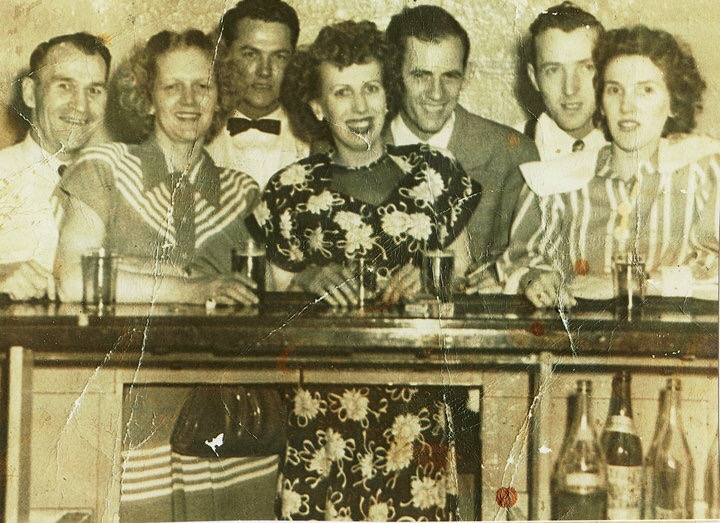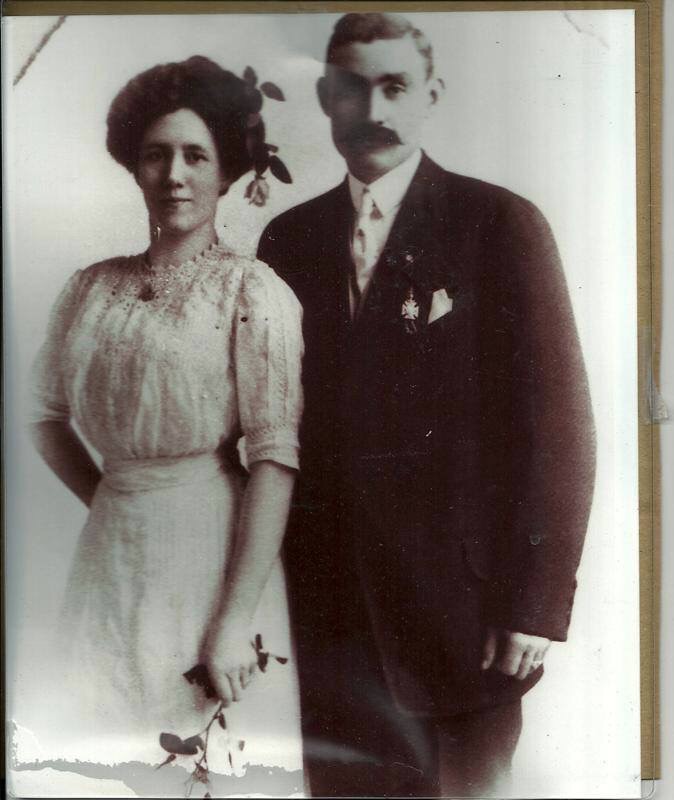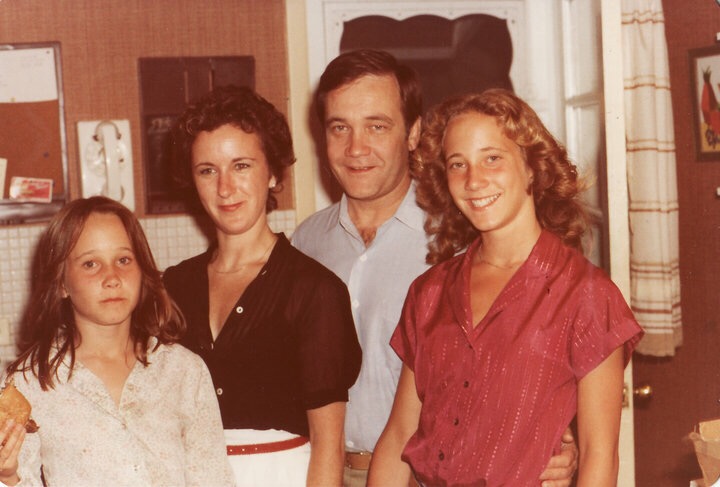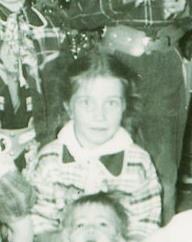
The beginning . . . .

My parents never put the Christmas tree up.  Santa brought it on Christmas eve.  

My mother loved Christmas and all its many traditions from time I can first remember until the day she died. When I was little, she’d expend enormous amounts of time and effort decorating our house every bit as gaily as Mr. Fezziwig’s office in the Christmas Carol. And as my siblings and I had children of our own, when she could have legitimately sat back and let us do the work, she would throw elaborate Santa parties complete with tables of full of food and drink, a roaring fire in fireplace and the big man making an appearance after dark – usually with several bags full of toys.

Back in the 1950’s, when I was little and we lived on 73rd and Marshfield, the month of December would be spent deep in Christmas decorating and cooking.  LIghts went up outside and my dad would stuggle to arrange a life size manager in front of the bushes.  My mom would spent the month making fruitcakes. After cooking them, she would wrap each cake in a cloth soaked in whiskey and store them in dark corner the pantry for a few weeks. Why this important whiskey-soaking step I don’t know because I never asked. The fruitcakes were heavy and – in my mind – god-awful tasting things that would have been better used as doorstops.   But she loved them and apparently so did her friends and family – – or at least they told her they did. So I hope they meant it because each and every year they would get one delivered to their house by my dad on Christmas Eve. Whether they ate them or used them to stop the door from banging shut remains a mystery.

The month of December may have been busy with preparation . . but nothing compared to Christmas Eve in my house.  My mother would be up early and, after going to mass, come home and hit the kitchen.  We kids knew that this was not a day to try to sleep in (if there ever was such a day in her house).  We had to be up by the time my mother walked though the door or we’d hear the pots and pans banging in the kitchen as she pulled them out… a sure sign that we’d better be out by her side soon or risk hearing her screaming our name in her high-pitched voice — soon followed by her throwing open our bedroom doors and administrating what can only be described as a few well executed whacks to the side of our head.

By the time I’d reach the kitchen, she’d already be measuring flour and sugar and yelling at me to get out the eggs and yeast to make the cinnamon rolls that we’d have for breakfast on Christmas morning.  Jackie might be yelled at to vacuum the rugs and polish the furniture and Tommy to clean the bedrooms.  My dad was alway told to clean the bathroom and, because the dog stayed down there, wash the basement floor  My older brothers would have to shovel the sidewalk (it always snowed on Christmas when I was a kid…. at least in my memory it did), wash the floors, and sent on all sorts of errands.

My poor dad, it seemed, ran in circles trying to keep up. As the only girl still home, I’d spend the entire of day in the kitchen helping with the preparations for the big Christmas dinner. My grandma’s potato stuffing had to be made and ready to go in the bird early the next day. Pumpkin, chocolate and apple pies rotated in and out of the oven and vegtables were cut and washed. It all seems so straightforward but believe me, it wasn’t. Chaos doesn’t begin to describe the condition of the kitchen. My mother didn’t believe in cleaning up one mess before we started on another. So, the flour from the pie dough would be all over the counter (and floor) as I tried to cut the beans or mash the potatoes for the dressing, the pot needed to cook the pudding would still be full of potato-water scum, potato skins lay in the sink and usually two or three pie crusts would be forgotten in the oven and burned. The end of the day cleanup was a nightmare.

Finally, after the cooking was done (and I was bone tired) we’d moved to the living room to get ready for Santa.  When we were still little the stockings were hung by the chimney with care. . . Okay, so at our house they weren’t fancy stockings purchased at Marshall Field’s, they were my dad’s old black work sox’s hung by safety pins from a string across the fake fireplace. But to us, this was Christmas.  It meant Santa would be here soon.

After awhile we’d have taken our baths and come out in our pajamas and robes ready to join my parents by the piano and, as my mother played Christmas Carols, we’d sing on the top of our lungs.  Someone was always goofing off and my mom always yelling and/or smacking someone but we got through it.  Finally we’d have to go to bed and the long night would start for my parents.

You see the thing I remember the most about Christmas is that the tree never went up until Santa brought it on Christmas Eve.  It was magical.

We’d go to bed with living room bare and unremarkable and wake to a magic-filled room with a glistening, tinsel laden, light- blinking Christmas tree and a room full of brightly wrapped gifts; I especially remember the year there were three gleaming Schwann bikes with bows on them waiting for us. It was an amazing site to wake to as a kid. How my parents managed those bikes I don’t know   They didn’t have much in those days.   Not too many years before the bikes arrived, my big Christmas gift was a recycled doll.   I guess my mom thought I wouldn’t recognize it with a new wig and new clothes.  But I did. My dad was a street car driver at the time and I still remember wondering why I’d gotten my old doll in new cloths while clutching it in one hand and holding dad’s hand in the other while going with him to the CTA Car Barns at 69th and Ashland to pick up his check.

But I digress.   I don’t know how my parents did it but even after working hard all day they would keep going putting up the tree, wrapping gifts, putting together and arranging toys     . . . . and that was only the start. After a full day of work and a full night of playing Santa, they always made midnight mass, usually a two hour ordeal in those days. After mass, they’d come home and cook a full breakfast of bacon and eggs for the two of them and my older siblings (who had made a mandatory appearance at midnight mass with them).

When they were done with their breakfast Santa would come. My dad would go outside our bedroom window and ring sleigh bells while my mom would be inside yelling, “I think Santa Claus has come.” We, the three youngest  – –  Jack, Tom and I  – – would stumble out of our rooms rubbing our eyes and opening them in wonder to the fairytale spectacle that they had prepared for us.
image
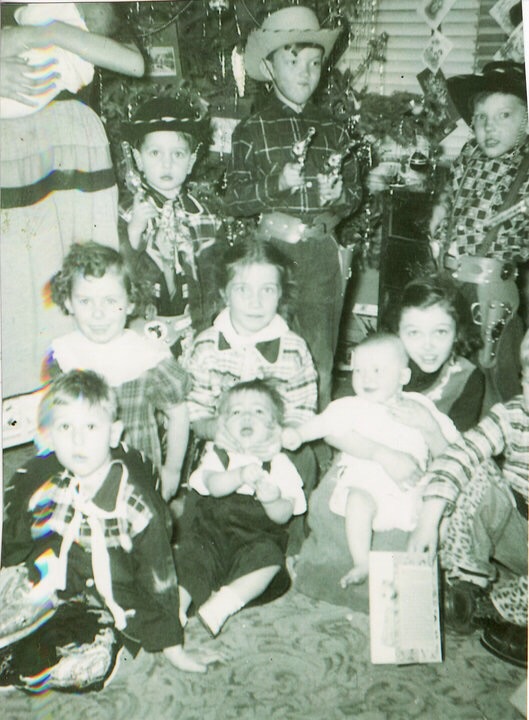
Christmas with the Murphy cousins: I’m sitting in the middle holding my brother Tom’s head up, Sharon is next to me on the right and Nancy is on my left. It looks like George and Jimmy behind with the cowboy hats but can’t say who the others are.

The Hammock, the Trees and the Boxcar

“Freud said that life is all about being able to love and to work. And I think it is about those things. But it’s also about play. Play can bring back the past, but even if it doesn’t, play is now; play is fun.  More than ever, I have the feeling that all of what we do that counts is just love and work and play.
― Alan Alda, “Never Have Your Dog Stuffed: And Other Things I’ve Learned”

There are small movies that occasionally wind through my brain. . . . small little replays of childhood events long ago.  I guess Alan Alda would not be surprised to learn that most  of those childhood memories have to do with play.

I remember:

. . . . the old, badly torn green army hammock which hung from hooks pounded into two old trees way in the back of our yard. I don’t know where the hammock came from, maybe one of my uncles brought it home from the war.  But it seemed that it always was there.  On hot summer days with nothing to do, my brother Jackie and I would just sit in it and lazily swing back and forth, dragging our worn-out shoes in the dust which had accumulated beneath it over the years.  (My grandparents, who lived in the attic flat above us, were meticulous gardeners and for years our yard was their hobby and their pride.  After my mother’s eight kids, however, I’m afraid they must have given up.  Our yard was a yard accustomed to rough play and the dust under the old hammock was proof of that.  Grandpa Kelly eventually established a small garden in a prairie across the alley and north of us).

The hammock had a mosquito netting which you could zip around and over you.  Sometimes, if I wanted to disappear for a while, I’d go out back and zip it around me and lay perfectly still so no one would know I was there.  I loved the isolation and quiet of that little self-made cocoon; I’d lay perfectly still and look high above at the leaves swaying in the trees let my mind wander.  Sometimes I’d think about the books I’d read.  For a long time I was hooked on Tom Dooley’s books. Tom Dooley was a doctor who, after serving in the U.S. Navy, stayed and worked in Vietnam and Laos.  As a girl I was so moved by his bravery and humanitarian efforts to help those in need, I wanted desperately to become and doctor and join him in Southeast Asia to fight disease and poverty.  I’d lay in that hammock and imagine myself deep in the jungles of Laos fighting off bugs and dangerous animals to tend to the sick and dying.  Eventually my poor grades in subjects like Chemistry burst that daydream and Dr. Dooley had to do without me at his side.

Other times the old hammock was a lively place where Jackie and I would swing each other as high as we could and fight over whose turn it was to use it.  Once or twice I sat in it with Johnny M. who lived down the street and on whom I had my first schoolgirl crush.  We’d just sit.  I don’t think we even talked and certainly didn’t  hold hands, but it was wonderful just the same.

I remember, too, the old large trees from which the hammock hung.  One was a Maple and the other a Key of Heaven.  They were great climbing trees and climb we did.  My mother would sometimes sit in a lawn chair and watch while my little brothers, Jackie and Tommy and I climbed.  If one of us stopped because we were so high we were afraid, she’d yell that one of the others was higher than we were.  “Look where Tommy got to, Jeffie!  Isn’t he great?”  Thereby implying I was lacking somehow.  So I’d go for it… scared or not, I had to go higher.

Another memory is of the day before my First Holy Communion.  It was 1955 and I was in third grade at St. Justin’s.  My class had spent the entire third grade preparing for this most special day.  I had a beautiful white dress, shoes, soxes and veil all laid out and waiting until mass early the next morning.

But this was Saturday and Saturdays were for playing.  Especially one of the first bright sunny days of Spring.  So my big brother, Mickey, decided he would make a boxcar for me.  He found two old planks of wood and nailed rollerskate wheels to the bottom of them, then laid them out parallel to one another and joined them with two more pieces of wood crisscross on the back.  Finally he somehow rigged a back to it with more old wood and I was ready to go. There was no steering mechanism and no brakes but that didn’t bother us. He’d push me as fast as he could down Marshfield Avenue and all I had to do was hang on and not fall off.  . Which I managed to do the first few times down the block.  But flying down the street on two sliver-filled old planks of wood nailed to old rusty roller skates by a fourteen year old boy was destined to end baldly.

The sidewalk on Marshfield was rough but the many cracks weren’t that bad . . .  until the end of the block right in front of Carlin’s house.  Every kid on the block knew to be careful in front of Carlin’s because of the two large bumps in the sidewalk.  We’d always slow down on our bikes or risk taking a tumble.  I wish I had just taken a tumble. It was about the fifth time down the street and we were both overly confident in our ability to get that old crate to the end of the block.  Mickey pushed extra hard and I went flying down the street and hit those two bumps faster than the old wood and rusty nails could take.  The whole thing fell apart and the two planks under me went flying in different directions, leaving me still propelled forward only now I was on the seat of my pants… literally.  My behind became my boxcar; I must have gone three feet or more on my butt.  When I got up I could hardly walk my rear end felt as if it was on fire.

Not wanting to get Mickey – –  or me for that matter – –  in trouble I didn’t tell my mom.  I went into the bathroom and tried to assess the damage.  It was bad: long, rough, angry red scratches were imprinted on my butt.  I was nine and didn’t know what to do.  Finally my solution was to pad my derriere with extra underwear to ease the pain when I sat.  Crazy but it seemed logical to me at the time.  And to a certain extent, it worked.

There are so many beautiful photographs of me on my First Communion Day.  I look so angelic and innocent.  Only I knew that some of those so-called angelic looks smiling out at the camera that day really were a cover for the pain I was feeling in parts too embarrassing for a nine-year-old to meantion.

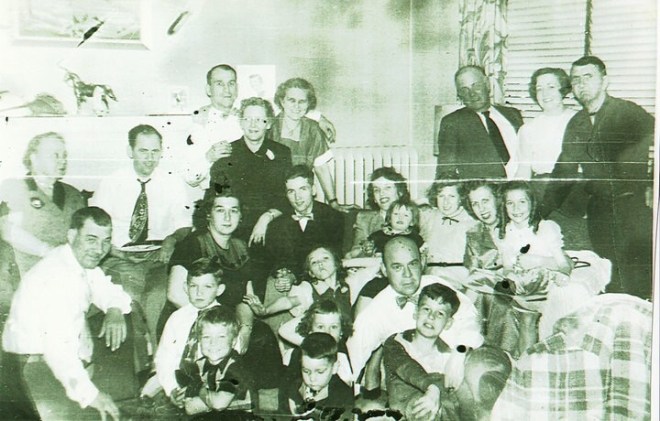
Murphy Parties

image

“Don’t forget to include the parties your parent’s had in their basement,” came in an email from my cousin Sharon after reading one of  my blogs.

Ah yes, the parties in my parent’s basement.  They were legendary . . . . .

First off, our basement was just a basement…. no plastered ceiling, no knotty pine walls (as was popular for finished basements in the 50’s).  The old coal-burning furnace once took up a large chunk of the south wall (it was replaced sometime in the 50s by smaller but still pretty big gas furnace)  and the laundry tubs, washer and dryer occupied the southeast corner.   Poured concrete walls were whitewashed, the concrete floor was painted green, and water, heating, electrical and disposal pipes hung from the ceiling or ran down the side walls.  But when my parents fixed it up for a party it was transformed into something magical.

Christmas lights and gayly colored paper lanterns were strung from the pipes, card tables were set up and covered in old mismatched table cloths my mother had accumulated over the years, and candles pushed into old Chianti bottles adored each table.  A sheet, hung on a clothesline, hid the furnace and the laundry tubs overflowed with pop and beer covered in ice.  More old table cloths covered the washer and dryer which served as the bar cluttered with bottles of whiskey, wine, ginger ale, and more.

But as transformed  as our basement became under my mother’s watchful eye, it wasn’t the bright lights or the flickering candles that made the parties so memorable nor was it the cast of characters who came down the basement stairs at the appointed time.  It was my father’s special drink ( he called it “punch”) coupled with my mother’s ability to get everyone to drink it early and often

Art’s punch – – –  and I strongly recommend no one try this – – – was composed of 1 bottle of southern comfort, 2 bottles of cheap champagne, and 2 bottles of ginger ale.  It was lethal.  It tasted like fruit punch, which of course made it more lethal.

Did I say the cast of characters did not add to the memorability of the parties?  Not entirely true.  What was true, perhaps, is that the punch enhanced each of their particularities even more than usual.  Take George Mair for example.  George lived across the street from us on Marshfield.  Married to Bernice, they had 12 children.  That alone could make a man a little crazy.  Give a father of 12 children my dad’s punch and see him dance.  I exaggerate . . . George never danced that I recall.  But his already booming voice tended to get louder and louder and louder . . .  until the entire basement, and maybe the people in the next parish over, knew exactly what was on his mind.

George may not have danced but plenty of the others did.  Occasionally my mother even hired square dance callers.  That was fun to watch!   Most of the couples were Irish and had learned to dance the Irish way . . .  standing ram-rod straight, arms stuck to their side.  I would watch them with amazement as they attempted the “dosie-doe” and “allemande left” or “circle to the right” or “promenade around.”  Lots of bodies bouncing up and down, many hitting the overhead pipes, and crashing into each other as they promenaded around their circle.  It was the 50s when most men wore white dress shirts and after a while the top buttons became undone, the sleeves were rolled up while sweat poured down their faces.

Surprisingly, many became quite good at it and the last few times my mother had the callers many of the men came with plaid scarves around their necks and the women came with full skirts good for swinging during the promenade.

As the night wore on, the party would move upstairs to where the old piano was located and my Uncle Ed, who never took a lesson in his life and only played on the black keys, would belt out any song requested.  As Edward’s fingers hit the keys  you could swear the piano could get up and dance.  And dance they did… dance and sing.  We lived in a Chicago bungalow so the rooms were small, but that didn’t stop the partiers, especially my aunts and uncles.  Uncle Steve would grap Aunt Vera  and Uncle Turk might grab Aunt Virginia and off they’d go swinging and swaying around the dining room.  My mother would start singing (badly) and eventually the entire party was singing with her.  My dad would stand back laughing and cracking jokes with his little sister, my Aunt Doris.

Did I mention my brothers, sister and cousins?  We were always there too.  Cousins were never left at home with a sitter.  (By the time I was nine years old, my five older siblings had all gone off and joined the seminary or convent so it was my two little brothers, Jackie and Tommy, who ran around outside with me and our cousins.  (If the older ones were home, they were ususally out with friends or in the basement with the adults).

As the adults talked, sang, ate, and laughed, we ran around the neighborhood playing.  It was safe in those days, even after dark.  We’d play softball in the middle of the street (using the four corners of the intersection as home-plate and first, second and third base), climb one of the large trees in our backyard, swing in the hammock or, after dark, we’d play a mean game of hide and seek.  Hide and seek was easier in those days before high voltage street lights; we didn’t have to go far to hide.  The lights on our street were far apart and so dim that we could lay anywhere on the ground and not be seen.


Steve, Vera, Jimmy, Virgina, Edward, Turk and Doris

As the night wore on we would graviate back inside.  Usually, if the adults weren’t dancing and singing, they’d be telling stories and laughing.  I guess what I remember the most about those parties was the laughter.  My dad’s family seemed to have an innate sense of humor and ability to laugh.  They could find humor not only in the obvious, but often in that which might have otherwise been painful.  They were hard-working, easy-going and, for the most part, always tried to look on the bright side of a situation.

Ninety-four year old Aunt Doris, the youngest, is the only one left today.  Doris embodies all that was good about the Murphy’s: great humor, good nature, accepting, quick to forgive (well, maybe not forget but then no one is perfect). I cling to Doris and don’t want to lose her as we have the others.  But even as I value the time we have with Doris, I know it’s not possible to have her here forever.  So my hope is that those of us in my generation have learned from those that have gone before us and that we take that good-natured determination and humor and try our best to leave those characteristics  – – and happy memories – –  for our children, as our parents did for us.

And hope that our children play it forward.

© pending Eileen Murphy Donnersberger

Grandma Kelly

Grandma & Grandpa Kelly

Both of my mother’s parents, Hannah and Patrick Kelly, came from the west of Ireland. Patrick Kelly from a little town in  Co. Claire called Kilmilhil and Hannah Hanrahan from Banogue, a village in Co. Limerick.   Hannah left the poverty of Ireland in 1899 to build a new life in the New World. She ended up in Chicago and soon got a job as a housekeeper for the wealthy Hirsh family who owned a furrier company. Hannah, who was only 16 or 17 years old,  lived in the 3rd floor maids quarters of their mansion in the Hyde Park/Kenwood neighborhood of Chicago’s south side.  My grandmother was the first of her family to leave Ireland.

Working long hours and saving all her earnings, eventually Hannah was able to pay for the passage to America for her sister, Kit.  Together Hannah and Kit worked and saved until, one by one, all the Hanrahan siblings came to Chicago; Tom, Annie, Nell, Kit and John.  Eventually, their father and mother, Tom & Ann, joined them.

Kit married Michael O’Keefe and had identical twin sons, Michael and Jack. Jack, the only one of the two to marr and who had served in WWII, was killed on his first wedding anniversary.  He was an elevated train conductor and his train ran head-on into another train.  He was killed instantly.  His wife, parents and twin were waiting for him to get off of work and join them for mass and breakfast to celebrate the anniversary.  When he didn’t show, his identical twin went to the train station to look for him.  When he got there another conductor spotted him and exclaimed, “Jack, my God, I thought you were killed this morning!”  That’s how Michael found out his brother was gone.  Jack’s wife was pregnant and delivered a healthy baby boy shortly after her husband’s death.  The son never married and neither did his Uncle Michael.

Nell married a wonderful Irishman by the name of Ed Hartigan.  My recollections of Aunt Nell and Uncle Ed was visiting them in their apartment which, I believe, was over a garage on a corner somewhere near 69th & Halstead.  Older and childless by the time I came along, Ed would sit in his chair with a pipe in this hand while Nell served  up tea and biscuits for my mother and me.  It all seemed so gentile; Nell always used her best china and the table was covered with an Irish lace cloth.  They treated me like I was the most wonderful little girl in the world — to them I was beautiful, well-behaved and smart. So naturally I’d be the first one in the car when my mom announced a visit to the Hartigan’s.

Other than my grandmother, Kit and Nell,  none of the other Hanrahan siblings married.  In 1918 when he was 36 years old, John, a post office worker, fell off the back of a truck and died. Mary died of either TB or the flu (we are unsure which one)  the following year; she was only 30 years of age.  Tom and Annie lived together until old age but neither married.

The mother  of the Hanrahan  clan  died in 1918  just a couple of months before her son fell off the truck and died. We have no record of when Tom, the father, died but I remember my mother talking about him.  Apparently he was blind in his old age; it is speculation but it could have been diabetes.

They are all buried in adjoining lots in Mount Olivet cemetery on Chicago’s south side.

I know the spot well. After my grandma Kelly died, in 1949, my grandpa Kelly would often take me on the streetcar to visit her grave.    He would pack a lunch and we would take three streetcars  to get there,  walk several blocks through the cemetery to the grave, and then sit and have a picnic  at her gravesite.   Now Mount Olivet  cemetery is  in the middle of the very populated Mount Greenwood neighborhood  surrounded by traffic, homes, parks, churches, commercial buildings …  in other words a very busy urban environment.   In 1949/ the early 50s it was in the countryside, or at least that’s what it seemed to my four or five or six-year-old self. My grandpa had a cousin who lived just outside the cemetery. We would often stop at her house for tea before or after our visit with grandma.   I don’t recall her name but I remember her as a tall older woman, with white hair and a large lump in the middle of her throat.    I always was fascinated by that lump but noone ever explained me what it was  and I thought it would be impolite to ask. I now realize it was probably a goiter.

A Goiter is a growth in the thyroid gland at the base of the front side of the neck just below the Adam’s apple.   It can be attributed to not  enough iodine in the diet.  Back in the early 50’s there was nothing  medicine could do to treat it. So this poor woman walked around with a large protrusion in the front of her neck — which  was a fascinating to my six-year-old self.

© pending Eileen Murphy Donnersberger

Mickey

It was early autumn, sunny with large cumulus clouds in the morning sky, pleasantly cool with a slight breeze off the lake. It was mid-morning and i was heading to my second day of a memoir writing class at the University of Chicago’s riverfront campus.

I was happy because of the beautiful day and happy to be starting on a project that had long interested me. It was a good day in class; I felt I learned a lot about writing a memoir and was anxious to use the skills and format taught: scene, story, reflection.

During class, my bother Patrick texted me to say that his son and my brother Tom’s son had both passed the bar exam. I was elated and slipped out of class to call and congratulate them.

As I left the building after class I noticed another call from Patrick. I waited to call him from the car. When I did, no answer. That was odd. Now I was on Fairbanks heading south. The day was still glorious and sunny with lots of beautiful clouds in the sky. Suddenly the phone rang. With that call the day became dark, the sun disappeared, and the clouds turned grey.

“Mickey’s dead” he said, his voice cracking. “What?” It didn’t register, I must have heard wrong. “What?!” I screamed incredulously into the phone. Without looking for traffic, I made an immediate U-turn and headed north, towards Mickey’s condo. “He’s dead. I just found him. He’s been dead awhile. I’m here alone with him.”

Michael, or “Mickey” as we still called him, was one of my older brothers. He was just before me, so he was the fifth of eight and I was the sixth. There was five years between us.

When I was little I remember watching Mickey sitting at his desk on the back porch counting his paper route money. The pennies would go in piles of ten, then the nickels, then the dimes and finally the quarters. In those days there were far more pennies than anything else. I think the morning paper was only 4 cents. Mickey got his first paper route when he was only nine or ten years old. . . and he continued to work hard his whole life.

He worked hard in school too. I can still see him at that same desk studying, pouring over his books. When I struggled in school, Mickey took me to his back porch desk and taught me how to take one assignment at a time and not to stress. He also showed me how to nail wood planks together and add roller skates to make a boxcar. Then he would push me fast down the street. Now he was gone?

Today my knees are beginning to fail me; sometimes it’s painful to walk. Running, I had thought, was in my past. But when I jumped out of the car across the street from Mickey’s condo, I ran. The doorman saw me coming and quickly and kindly opened the door and ushered me to elevator.

When I exited the elevator it became sadly irrevocably true. Mickey’s daughter, my grown niece, mother of three, had just arrived. Patrick would not let her into the condo. She was crying, . . no, it was more like primmoral screaming. She saw me and collapsed into my arms. I’ve never been hugged like that. She was dead weight. I had to hold her up. She was crying, long guttural cries. She was begging God to change this.

  
Michael, his wife and two of his daughters, Tracy is on his right. 

I held her close and, stupidly told her it would be all right. “No it won’t.,” her reply came from somewhere deep inside of her. “No it won’t. It won’t ever be right again. I don’t know if I can get through this. I can’t do this. I can’t do this again. He’s all I had left.”

She was right about that. Her sister, just two years older, had died just as unexpectedly a year previous. Almost exactly a year before this very date. Tracy was Mickey’s oldest. She and Courtney were born less than two years apart while he was still in night school earning his law degree and working days as an undercover IRS agent.

Mickey, Courtney and my whole family had gone through the unbelievable pain, and heartbreak of Tracy’s death October 6, 2011. Today was October 1 a year later.  Now we were hit in the stomach again.

What was going through my mind as I held my niece was that I longed to see my brother. I couldn’t leave her of course, but what I really wanted the most was to fly into his condo and grab him by the shoulders and wake him up. “What the hell is wrong with you?” I’d shout. “Scaring us like that.” Mickey was always joking, he was known for his sense of humor. But this, this was not funny

Suddenly (or was it gradually?) the hall filled with my brothers, my sister, in-laws, nieces, and nephews. Everyone seemed to get there with lightening speed. My husband arrived and enveloped me in his arms.

The police finally left. “It was a natural death,” they said. “You can call the funeral home to pick up the body.” “The body!?” my mind reeled. “What body? That’s my brother.”

While waiting for the funeral home, we, the family, slowly entered that place in which my brother drew his last breath. First the siblings, spouses, then the nieces and nephews hesitatingly entered. Patrick was right it wasn’t a pretty sight. If there is a word for what I saw and what I felt, I really don’t know what it would be: shock, grief, sorrow, horror, sadness, anguish, heartache, pain, misery . . . none of them seem adequate. Even all those words together don’t begin to sum it up; the death was too sudden, the scene too awful, the grief and shock too great.

The body on the floor wasn’t Michael, yet it was. He looked so small lying on the floor. A few wisps of his still-dark hair were sticking out above the white muslin cloth with which the paramedics had covered him. Someone, I don’t know who, slowly pulled back the cloth. That cold, hard, lifeless, rock-like imagine of my big brother who worked so hard his whole life, who helped me learn to study, will never leave me.

The following days are a blur. Wake and funeral arrangements were made and held. Hundreds, maybe more, came and offered their condolences. Stories were told of Michael, how he helped so many people in his life, his jokes were repeated.

But as we lost Mickey, he gave us a gift: a gift of love. . the love we all share but seldom acknowledge.

My nieces lost their dad; their children lost their grandpa. We lost our brother, our uncle, cousin, and nephew. But what we did not lose was our love for one another. We clung to and supported each other throughout. We, the remaining siblings, were the pallbearers. As we carried Michael James Murphy down the church aisle and physically out of our lives I believe that each of us was remembering the good times: the parties in my parents basement, the graduations, weddings, births of our children, the fun times, the laugher which was so much a part of our lives together.

As we put his casket in the hearse and it drove slowly away taking our brother from us for the last time we hugged and we cried. We also told one another how much we love each other. We still have that. Mickey helped us to remember.

Thank you, Michael. Rest in peace until we meet again.

The Prairie

The house I grew up in also was the house in which my mother was raised: 7311 S. Marshfield in Chicago.  When my grandparents (Patrick and Hannah Kelly) brought it in 1923 it was at the far south boundaries of Chicago.  The streetcar lines ended at 74th street and beyond that was miles of the good old midwest prairie.  I don’t have any photos of the house at that time, but I imagine that was still a lot of the open space — prairies – – around their home too.

Even when I was growing up there, almost a half century later, we still played in the “prairies” that dotted our neighborhood.  Our favorite prairie was between our alley and Ashland Avenue just a little south of our house.  The neighborhood kids played baseball there so often that the high prairie grass finally gave way to an imperfect diamond on which to run the bases.  It wasn’t anything like the baseball diamonds my grandchildren play on today  – – –  with fences and an actual pitchers mound and a warm-up cage  – – – but we thought it was wonderful.  We organized our own games, no adults monitored us or, if I’m to be truthful, even cared that we played.

Our parents were too busy working.   Our dads usually put in long hours at backbreaking jobs and our mothers were busy with household chores.   Heck, just keeping our clothes clean was hard work:  they washed clothes in roller-wash machines and hung them to dry on clothesline strung crisscross around the yard (no electric dryers in those days).  There were no wrinkle-free fabrics yet either so our mom’s spent a lot of time over a hot ironing board.  One of my favorite memories (until I became old enough to help hang the clothes) was seeing the clean clothes blowing in the wind on a beautiful summer’s day.  Don’t get me wrong, hanging clothes was hard work and not always a beautiful sight.  Like when it started to rain and they had to be taken down quickly . . or during the winter when they were hung in the damp dark basement.

But let’s get back to the prairie.  Another memory of the Ashland Avenue prairie is the time some of us kids decided we wanted a  “secret” clubhouse. So my little brother Jackie,  Bernadette Clark, Pat Carlon,  Judy  and her sister Barbara Mair,   Judy Cobb, Stevie Madden, Donna Jolliet,  Johnny  Gallagher and a few others confiscated some shovels and dug a long tunnel under the high grass and then dug out a small space  – – probably about a foot or so underground – – that we called “our clubroom.”  We furnished it with a small old rug someone found and held many secret meetings there.  We had to crawl into it and couldn’t stand.. heck we even had to hunch over just to sit.  But it was our’s and the adults didn’t know about it.

Until they did. Then a lot of us got into a heap of trouble; moms yelling we could have been buried alive and dads running out to the prairie to fill it in.  That was the end of our secret clubhouse . . .  until we found another one ….

© Eileen Murphy Donnersberger

My Name

IMG_2060

After writing this blog for a couple of days I realize that perhaps I should explain my name. Those of you reading this who don’t know me probably think I’m a male. But the truth is I’m a female.  My baptismal name is Eileen. The full name  given to me at the baptismal font is Eileen Johanna Frances.   Apparently there was some dispute between my parents about which one of those three names I would be called. The solution was that I was called by my initials – – EJF – – for the first year of my life. Finally  my oldest brother and Godfather, Joe, came up with the name Jef by mixing up my initials    The name stuck so  I became Jef – with one “f.”   Most commonly I was known as Jeffie.    To this day my family and closest and oldest friends call me by that name.   So do others whom I consider close.

As my children began having children of their own, I would tell them that  no matter what the sex they could call  their baby Jeffie after me.  No one took me up on it 🙂

A Blizzard and Me

 It was 1951. I was five years old, in kindergarten and walking home alone from school in a blinding snowstorm which had turned into a blizzard . My school wasn’t close. It was a mile away from home. Bundled in a bulky snowsuit, an oversized scarf, a wool hat pulled down as far as I could manage and still see, and unlined rubber boots, I was cold, covered in snow and having a difficult time navigating the huge snow drifts accumulating all around me on the un- shovelled sidewalks. But I don’t remember being afraid. Mostly I remember being cold and feeling I wasn’t making much progress towards home. So I did what my five-year-old brain considered to be the most logical thing to do: I hid.

Why my mother choose to send me to school that day has always been a mystery to me. I attended afternoon kindergarten and it was already snowing heavily when she sent me off alone at noontime. My next-door neighbor and best friend’s mother kept her home. When I went to call her for school her mother answered the door to tell me the snow was too heavy and it was too cold to have Agnes walk all the way to school. I wasn’t quite sure why it was too much for Agnes and not for me. But off I went . . . alone.

IMG_0160

I hid in a stairwell. Actually it was a broken down stairway leading to a small square of cracked, pitted cement that served as an entranceway to what we now call “a garden apartment.’’ Then it was called a basement apartment. It was still cold down there and there was some snow but at least I was out of the blinding wind and bitter cold. I don’ remember if I felt safe but I was snug and a bit warmer. I sat and watched as the snow continued unabated and then became mesmerised as the snow turned to sleet. The sleet added an icy glimmer to the snow and clung to everything in sight – – tree branches, bushes, cars – – turning my working class neighbourhood into a beautiful twinkling wonderland.

I had seven siblings: five older, two younger. Back at home the older ones began arriving from their school. (As a kindergartener I attended the “public school” while they were all in the local Catholic school). After awhile I suppose my mother finally missed me. With all those kids I guess it was easy to lose count of who was home and who wasn’t but finally the alarm bells went off in her head. “Where is Jeffie!” was shouted up and down Marshfield Avenue. Neighbor’s doors were pounded on and a frantic cry went out: “We can’t find our little sister,” and “ Has anyone seen Jeffie?”

How they ever found me in that dark tunnel of a stairwell I was in, I never determined. And I don’t really recall which of my six brothers found me. I think it was either Joe or Mickey but I’m really not sure. I do remember that it was very dark when I was pulled out and put on a sled for the long ride home.

It didn’t seem traumatic at the time, but it does stand out as one of the most vivid memories of my early childhood. Did it make me frightened, afraid of being alone? In the short term maybe but in the long haul I believe it made me stronger, make me realize that I could not only survive but could do so using my own wits.

© Eileen Murphy Donnersberger

4:00 am

Its four in the morning and I can’t sleep.  I don’t remember not being able to sleep as a kid.  Well, to be honest that’s not completely true.  Hot summer nights would find me laying awake, sticky with perspiration, with my head at the bottom of the bed facing the one window in the room trying to catch a breeze which, more often than not, never came.  There was no air conditioning in the 50’s – at least not in our house, or even in our neighborhood for that matter.  My room was small, barely big enough for the bed and a dresser.  Although my parents managed to squeeze a small desk in a corner so I could study. . .  but my study habits, or lack thereof, are a story for another time.

There were three bedrooms in the house, an interesting situation for a family of eight kids and two parents.  My mom and dad occupied the “front” bedroom which was bit larger that the two “back” bedrooms.  I shared last of the back bedrooms first with my sister, until she left home when I was nine, and then with my younger brother Jackie.  When I got to be of a certain age, Jackie was moved out and I had a bedroom all to myself.  I bet I was the only one in the family who ever did.  My brothers slept wherever they could find space.  I remember a bedroom of sorts set up in the unfinished basement (with sheets strung on clothes lines to mark off their “room”) and another in the enclosed, but unheated, back porch.  Although after my dad got a second job they were able to insulate and heat the porch.  My brother, Mickey, bragged that he slept in every room in the house, including the pantry.  That was true.  My parents set a cot up under the shelves for him.

But I’ve digressed.  Hot summer night always were an issue when it came to sleeping. Especially hot, humid nights which is Chicago’s speciality.  If it got really bad, my parents would pull out the lawn chairs – –  the kind with the multicolored plastic straps running criss cross – –  put them in the middle of the yard and they’d lay on the two chairs while the rest of us threw sheets on the grass to try to sleep.  It was just too stuffy in the house.  Despite the heat it could be pretty nifty out there at times. If we get any breeze at all,  I would lay there and listen to the leaves rustling in the wind.   It was a lullaby that helped me fall asleep. After my dad got a second job we got a window air conditioner in the dining/living room and more often that not, that’s were you’d find me on a hot night.  Maybe all of this is why, to this day, I like to sleep in an ice cold room.  Even in the winter I turn the heat down and open the windows.  Drives my husband crazy but now I can tell him I figured out why I do it.

© Eileen Murphy Donnersberger

The beginning . . . .

Now I’m sitting here wondering what to write about so I guess I’ll start at the beginning . . . .

Born in Chicago, one of eight: the sixth of eight to be exact, and only the second girl. Actually, I was also the last girl born to my parents. We had six boys and two girls; the two girls were born ten years apart.

As I mentioned, I was the sixth of eight but after the oldest five were born, there was a five year gap before my parents had more children. The gap was never explained but as a result I was the youngest of the oldest five . . . . and the oldest of the youngest three. So to be accurate, I am a middle child but also an oldest child. A shrink sure would have a lot of fun with me!

Did I mention we were Irish Catholic? Very Irish Catholic… and we lived in a very Irish Catholic neighborhood of Chicago. Those were in the days when there were very clear demarcations between ethic groups in Chicago. For example, the Irish in our neighborhood all lived south of 70th Street and the Italians all lived north of it. There was some cross over. My parents, for a while, lived in the Italian side of 70th street, but mainly because there was cheaper housing available there. They soon moved back to 73rd street and were surrounded by old-country or first generation Irish. But my mother liked to shop in the Italian grocery stores on 69th street because they had spices and cheeses the Irish stores didn’t carry and probably didn’t even know about. And as a kids we never missed the Feast of the Assumption at the Italian church, Our Lady of Mount Carmel. Mass was followed by a procession of men carrying a huge statue of the Blessed Virgin Mary on a float through the neighborhood. Old county Italians would stuff dollar bills and coins on the float with the BVM and the old ladies would raise their rosaries in prayer as she passed by.  The procession ended in the church parking lot where a garish, brightly lite, carnival was ready to go. The carnival would last all night with the adults talking or playing bingo and drinking wine or, in the case of the Irish, beer… while we kids ran wild.

But it wasn’t all rosy all the time between the two ethic groups. Both the Irish and Italians were tough, blue-collar, working class people. Our fathers were pipe fitters and laborers, street car drivers and stockyard workers. They came home from work bone-tired and dirty. The wealthier Irish – – police and firemen – – lived south of the tracks at 75th street.

The kids in our hood could be a little rough around the edges, as they say today. There were often fights between the “groups’ from both sides of 70th street. The 69th Street Loafers (Italian) and the Irish kids (they weren’t as organized as the Italians, I guess, because I don’t recall them having a name) would occasionally go at it with their fists. But the most anyone got hurt was black eye or diminished ego. After a time, knives became involved in some of the fights though. A vivid memory of mine is seeing my oldest brother, Joe (who at the time was studying to be a social worker) running out of the house to help intervene when he heard there was a fight at 70th street and a knife had been drawn. I guess he wanted to put his new found social work skills to work. But he was a smallish, skinny kid and my parents were terrified. All hell broke out in our house as they sent my other brothers after him. I don’t remember any more than that but I guess it all turned out okay as they all got up for school the next day.