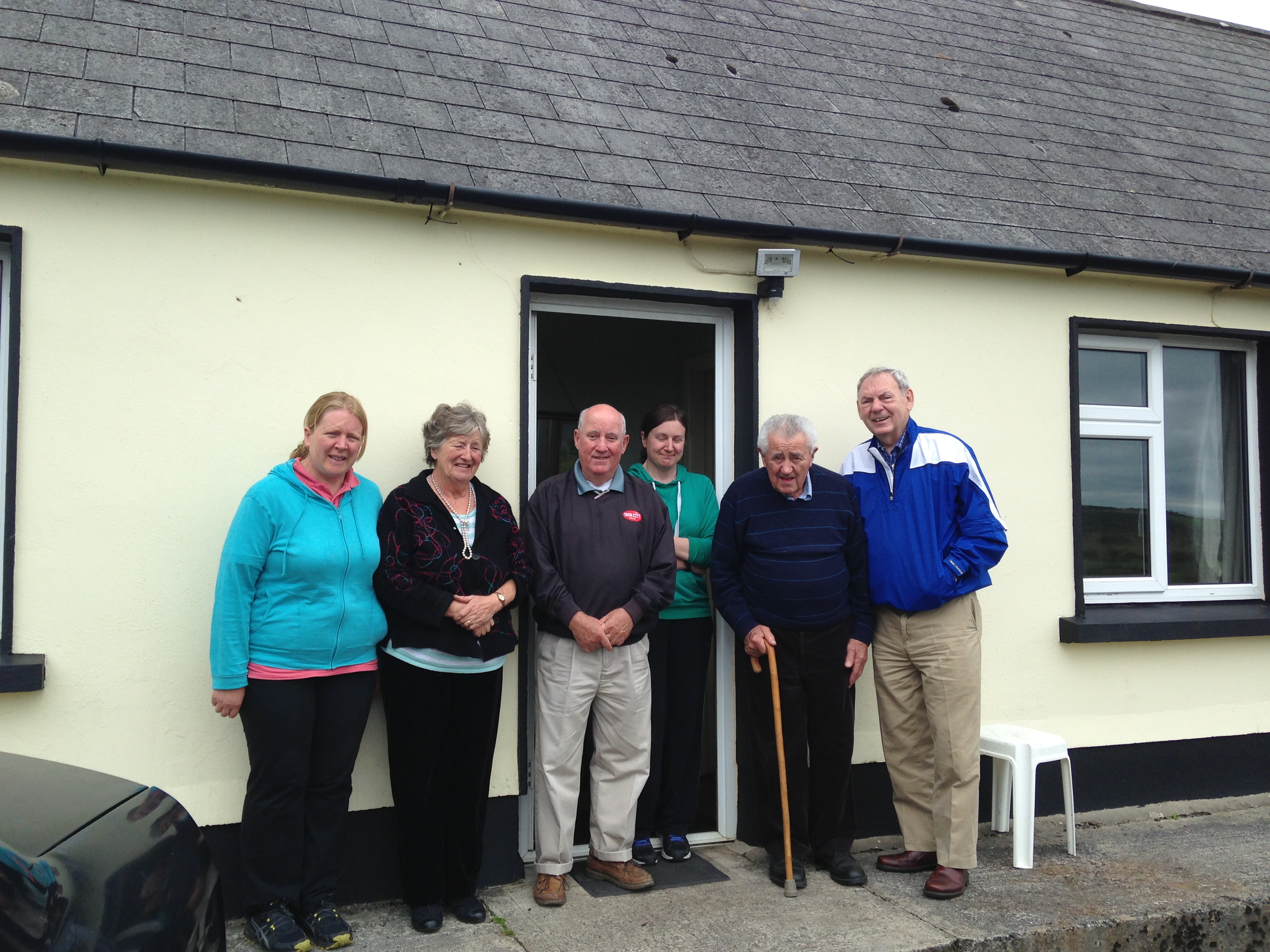
The beginning . . . .

Tips for Ireland: installment 1


IMG_0662
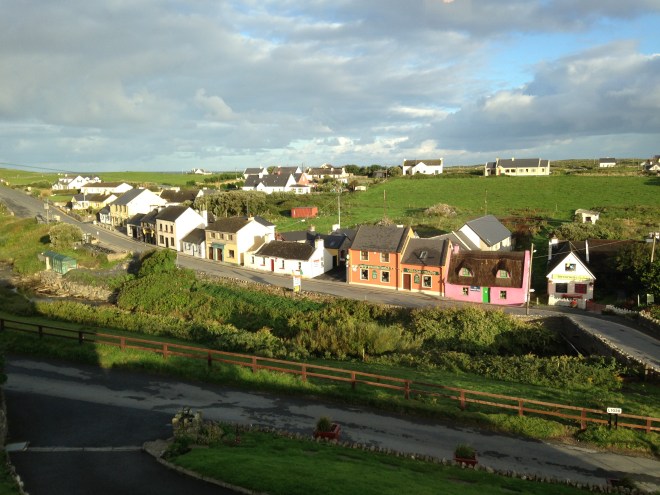
Doolin, Co. Limerick


Despite having the last name of Murphy, three grandparents with heavy Irish accents and growing up in the predominantly Irish Southside of Chicago – – or maybe because of it  – – I never had a desire to visit Ireland. But twenty years ago, after being required to accompanying my elderly mother on a trip to the home of our ancestors, much to my surprise, I fell in love with the “old country” the first time I set foot on its soil.

It was a feeling deep in my gut . . a feeling like I had finally come “home.”  I don’t know if it was the crazy two-hour drive on the wrong side of the road from Shannon to Killarney with my mother in the back seat frantically and repeatedly telling me to move to the other side of the road and my daughter and me in the front seat terrified yet thrilled to be navigating the narrow twisting roads in the dark or . . . .  if it was it the warm-hearted “welcome home!” greeting we received when we stopped in a little pub for directions.  Or maybe it was waking up the first morning to the wonderful and multiple shades of green outside my window and the sounds of gentle laughter coming from the kitchen below of our B & B.

All I know is that I was smitten.  No, more than that.  Time spent in Ireland seems to rejuvenate my soul.  Since that first visit, I’ve traveled Ireland numerous times: with family, with friends and with colleagues from work; but with each visit I always make sure I have time to be alone.  I need that time alone to  allow the tranquility of the countryside, the softness in the air, the mist from the sea, the laughter from people to soak into my pores, my soul, my psyche.

Well, now that I’ve declared my undying attachment to that little island, I’d like to share with you just a few of the places I like to go and things I like to do while visiting the land with which I’ve become enamored.   For what it’s worth here they are:

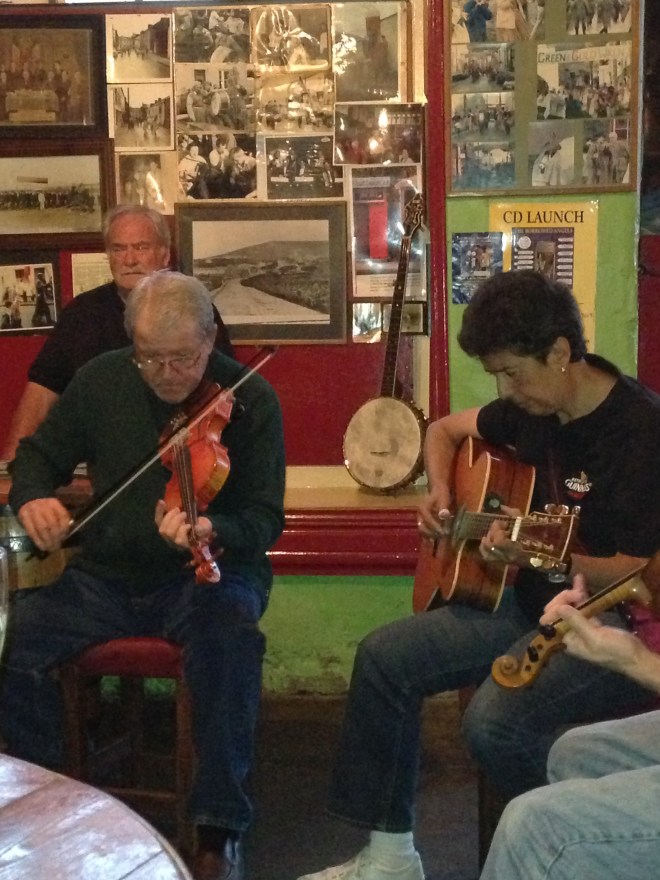
IMG_0630
O’Flahery’s Pub, Dingle


Dublin is an interesting city and full of historic sites, but I don’t usually go to Ireland to visit another big city.  I go to Ireland to soak in its amazing beauty, interact with its warm-hearted, witty people, reveal in its sometime lively and sometimes haunting traditional music and, of course, to visit its pubs.  In my experience, these are best found in the west of Ireland.

IMG_0538
My mother’s cousin, Paddy McCarthy’s Home

Two of my grandparents came from the west of Ireland and that’s where many of our relatives still live; so that  may have something to do with my love affair with the west coast of that lovely country.

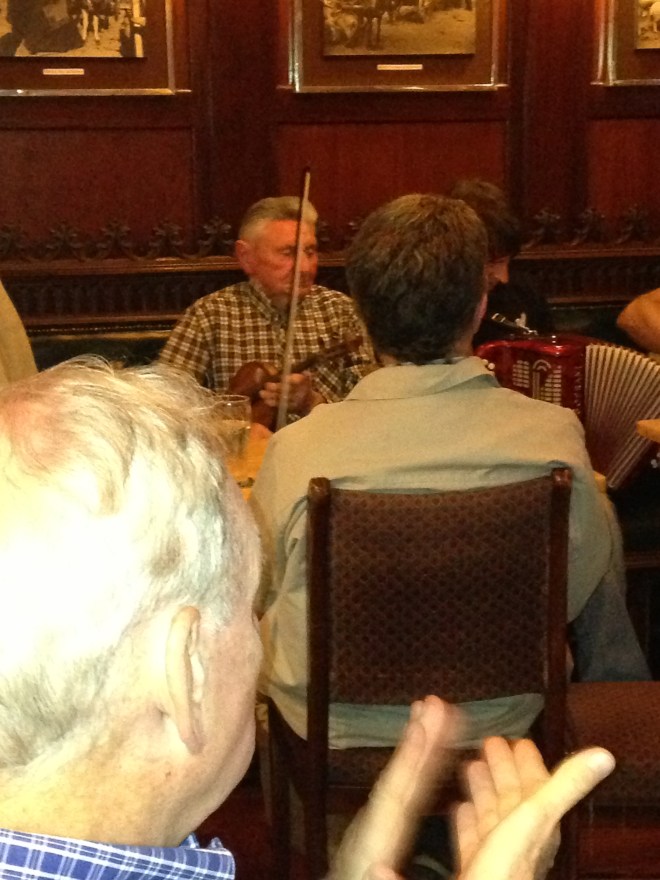
IMG_0526
A wonderful musician and a true gentleman: Paudie Gleeson, Killarney


After leaving Dublin, my first stop is usually Doolin in County Clare. I am sure that the Cliffs of Moher and driving through the Burren are already on your list of things to do. But one of the towns I would not miss is Doolin.  Known for the traditional music played in the local pubs, Doolin is situated right on the ocean. If you visit Doolin walk to the end of the road (the road that passes in front of the pubs) and stroll along the coastline. It’s rugged and beautiful. If you enjoy horseback riding nothing is more invigorating than an early morning a ride on the beach. There also are  a lot of nice hiking trails near Doolin. An exceptionally beautiful 12 mile hiking trail is right on the ocean between the Cliffs of Moher and Doolin.  If you are up for a long hike, start at the Cliffs and hike to Doolin and you’ll be rewarded with some of the most outstanding views in Ireland  – – with the sea on one side and the lush countryside on the other.  Then when you arrive in Doolin you can recuperate with a bite to eat, a pint, and maybe a little traditional music, at one of the many pubs.

Gus O’Connor’s Pub – located on the picturesque main street – is one of the most famous.  They offer traditional Irish music on the weekends and is a place you can bring the entire family. Children are welcome in pubs throughout Ireland. I would say that the pubs are for meals as well as a little libation. 😉


When in Doolin, we usually stay at the Seaview House B&B; its well situated on a hill that that overlooks the town and the sea. But there are many well-run B & B’s in Doolin and most within walking distance of the pubs.


The Aran Islands are off the coast of Claire and Limerick. In fact, one of the ferries leaves from Doolin. I believe another ferry leaves from Galway Bay.  If you go to the Aran Islands, pick a calm day as the crossing can be pretty rough if the seas are up— although it’s not a long journey.

IMG_0546
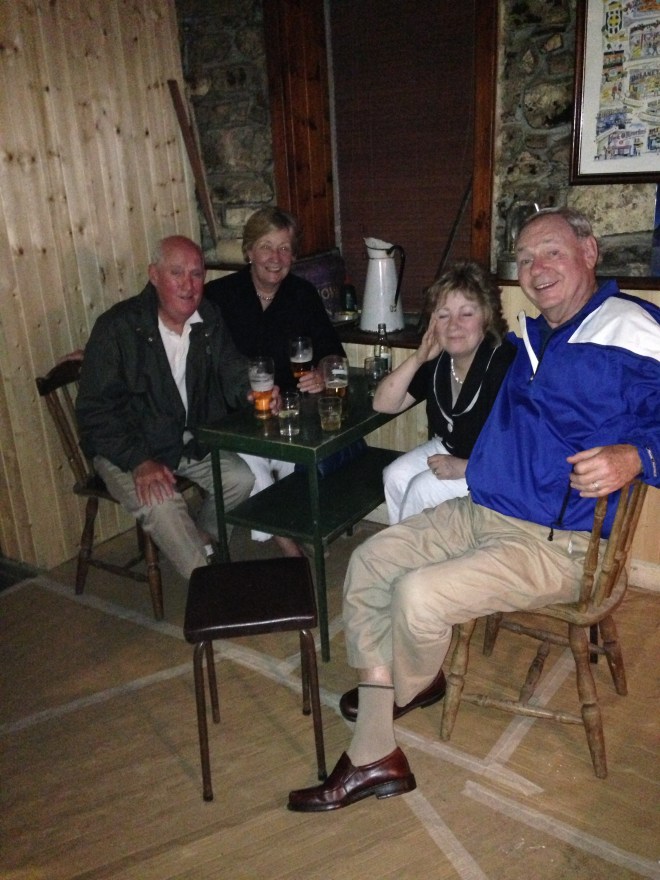
Local Pub, Banogue, Co. Limerick

I love the Aran Islands. They’re probably my most favorite place on earth. To me, the Irish  phrase “a terrible beauty” comes from what you see there.  It must be the rockiest place on earth; the islands are made up of limestone. There is mile after mile of stone walls and that, combined with the limestone and greenery is breathtakingly beautiful.


I visit the Aran Islands to hike, walk, or bike and take in the fresh sea air.  (Be warned, it’s quite hilly).  The largest of the Aran Islands and the one most visited is Inishmore (the two smaller ones are Inishmaan and Inisheer).  There are only about 1200 people who live year round on Inishmore and most speak Irish (but are fluent in English too).


You can also take a ride in one of those horse-drawn carriages with the tour guide who will take you to its many Celtic monuments and churches.  Before heading back to the mainland, stop for a pint, fish and chips and traditional music in one of their pubs.

. . . . . . . . . . . . . . to be continued…………………………………..

A Place Where Everyone Knows You


82221c670140bd22e0c6b62f70f04cf4 copy

My husband and I have a favorite neighborhood restaurant we like to visit.  It’s the kind of warm, homey place where everyone knows everyone else.  If they don’t know you, they know your neighbor, or your cousin, or your brother, or your first grade teacher. Start talking to the people in the next booth and there always seems to be a connection, sometimes it even goes back to the “old neighborhoods” or even the “old country.”  Somehow there is always a connection.

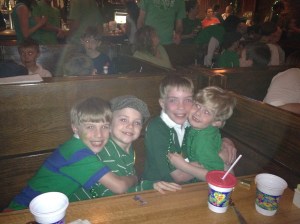
We go there so frequently; our kids like to joke that we have booth # 1 at Fox’s Beverly Pub.  Fox’s is a modest little restaurant on the Southside of Chicago that that is known for (despite billing itself as an “Irish American” Restaurant) its pizza.   The inside is a welcoming blend of exposed brink, well worn old wooden booths and dim lights.  Most of the wait staff has been there for years, most are related to one another and come from the neighborhood.    A small bar at one end is home to a small group of regulars. But in fact, the whole place is usually full of regulars.   Which is why we, like so many others, enjoy going there.

Local lore has it that Fox’s started out as a speakeasy during prohibition.   I’ve never been able to confirm that – but what I can confirm is that it was orginally owned by Al Compone’s sister …. reportedly as a deli.

Sometime in the 50’s or 60’s, Tom and Therese Fox’s owned a pizza place originally located on west 99th street close to the Rock Island railway station.   Tom, who grew up at 71st and May, was an apprentice electrician when he and his wife moved to the Beverly neighborhood in 1962.  In 1963 they brought and took over small carry-out pizza business at 9908 Walden Parkway.

At the same time, Al Capone’s youngest sister, Mafalda Capone Maritote, owned and operated the deli at 9956 South Western. In a story published in the Chicago Tribune on November 6, 1994 and written by Scott Broden, Tom Fox related that he and his wife knew Capone’s sister and would sometimes swap take out orders with her.

“On Sunday nights she’d call us up for a couple of pizzas, and she’d send us a dozen corned beef sandwiches,’ he said. Pizza and sandwiches had been traded for a couple of years when, in 1965, Fox got a phone call from Maritote.  ‘She said she wanted out and asked us to take over,’ Fox explained. ‘I said I couldn’t handle that much business, and she said, `Don’t worry, I’ll make you an offer you can’t refuse.’[1]

foxs-logo-new

Eventually Tom and Therese transformed the deli into a little restaurant and carry-out pizza place and renamed it Fox’s Beverly Pub.   They’ve subsequently opened several more restaurants, but to the people of Beverly there is only one Fox’s and it sits on the northwest corner of 100th and Western.

People who have raised their families and moved out of the area still return often for the pizza and, I believe, to see who they will run into.  Emily and Chris relocated downtown several years ago but are frequent visitors as are Holly and Bob who moved to the suburbs but can be seen eating there almost as often as the locals.  Some of the more loyal regulars even have gotten their name on Fox’s marquee when they died.  “We will miss you, Roger!” was one sad farewell posted.

Memories of times spent there often go back years.  I remember going to Fox’s during the blizzard in 1979.  The streets were impassable with the 29 inches of snow that had accumulated.  After hours of shoveling, we, along with a group of neighbors, tossed aside the snow removal equipment, hired babysitters for our then-still-little-ones, and trudged six blocks through deep snowdrifts to the warmth of the old wooden booths, hot pizza and cold beer offered by Fox’s.  There we met and partied with others from the neighborhood also seeking respite from the realities of Chicago’s bitter winter.

And then there are the characters that have frequented Fox’s over the years.  There was old Mr. Kelly who once worked for the CTA and whose lovely wife  was deceased.  He lived alone above a storefront insurance office several doors south of Fox’s.  Mr. Kelly, with head full of unruly snow-white hair, would eat there every night, sit and the same corner booth by the kitchen and order a cup of soup, a plain cheeseburger and a cup of coffee.  Mr. Kelly would stare down at the table while he ate but otherwise loved to talk to the wait staff.  He not only knew all of their names but their birthdays and other special occasions in the lives.  Mr. Kelly liked to go to the all-night adoration at St. Bernadette’s church (located several miles away) on Friday nights but didn’t drive.  So the waitresses would take turns dropping him there on their way home and he’d catch a ride back in the morning. All the workers at Fox’s made sure he was well cared for and, as he grew weaker with age, got home safely.

Other interesting patrons include re a married couple who can be seen at the bar almost any night of the week.  He’s a meek-looking man probably in his 60’s, just under 6’ and maybe 190 pounds.  He’s a bartender at the  Hilton hotel on Michigan Avenue.  His wife, on the other hand, is well over 6’  – – – maybe 6’6” – – – and built like a linebacker for the Chicago Bears with hands as large as Michael Jordan’s. She’s a psychologist who counts at least one of the waitresses amoung her clients.  Who rules in this relationship?  It’s the meek-looking bartender who seems to always insist on speaking for both of them.

Fox’s decorates for all the holidays but St. Patrick’s Day is the best.  And parade day would’t be complete without a stop at Fox’s for some corned beef and cabbage, a cold beer and a lot of traditional Irish music, Irish step-dancing by local school children and the Shannon Rovers playing the bagpipes.


My husband and I love running into neighborhood friends at Fox’s.  People we wouldn’t otherwise see anymore.  One is Maureen C, a retired CPS principal and a former Mercy nun who was in the convent with my sister and who carpooled with me when our boys were in preschool; our boys remain close friends.  She also is one of the funniest  – –  and nicest  – – people I know.

Now, in addition to consulting, Maureen teaches an adult education class on Irish History at the local college; because of her tremendous personality as well as her depth of knowledge, there always is waiting list to get into her class.  Maureen is at Fox’s most Monday nights with a friend and most Thursdays nights with her sister and niece.

Jack O, father of 13 who is now in a wheelchair, either hangs at the bar or, if with his wife, in one of the booths.  Jack came from the same old neighborhood as I did, St. Justin Martyr in West Englewood. My brother tells the story of how Jack’s older sister won a talent contest on the Morris B. Sacks radio program back in the ‘40’s.  His sister won with the help of the nuns at St. Justin’s.  They had every kid in the school fill out and mail in a post card voting for her.  It was probably the only time in history that a tap dancer won a talent contest on the radio.

One night in in particular stands out in my mind.  When my husband and I were courting we would often find ourselves at Fox’s late at night.  One cold, snowy January night we turned the paper placemat over and planned out our wedding.

The stories of Fox’s are endless  . . . . and maybe someday I will add to this brief ramblings about it.  But now, well, its Saturday night and we’re off to Fox’s!


[1] Chicago Tribune, 11/6/1995, Scott Broden

Our Moroccan Adventure

IMG_3118 IMG_3122


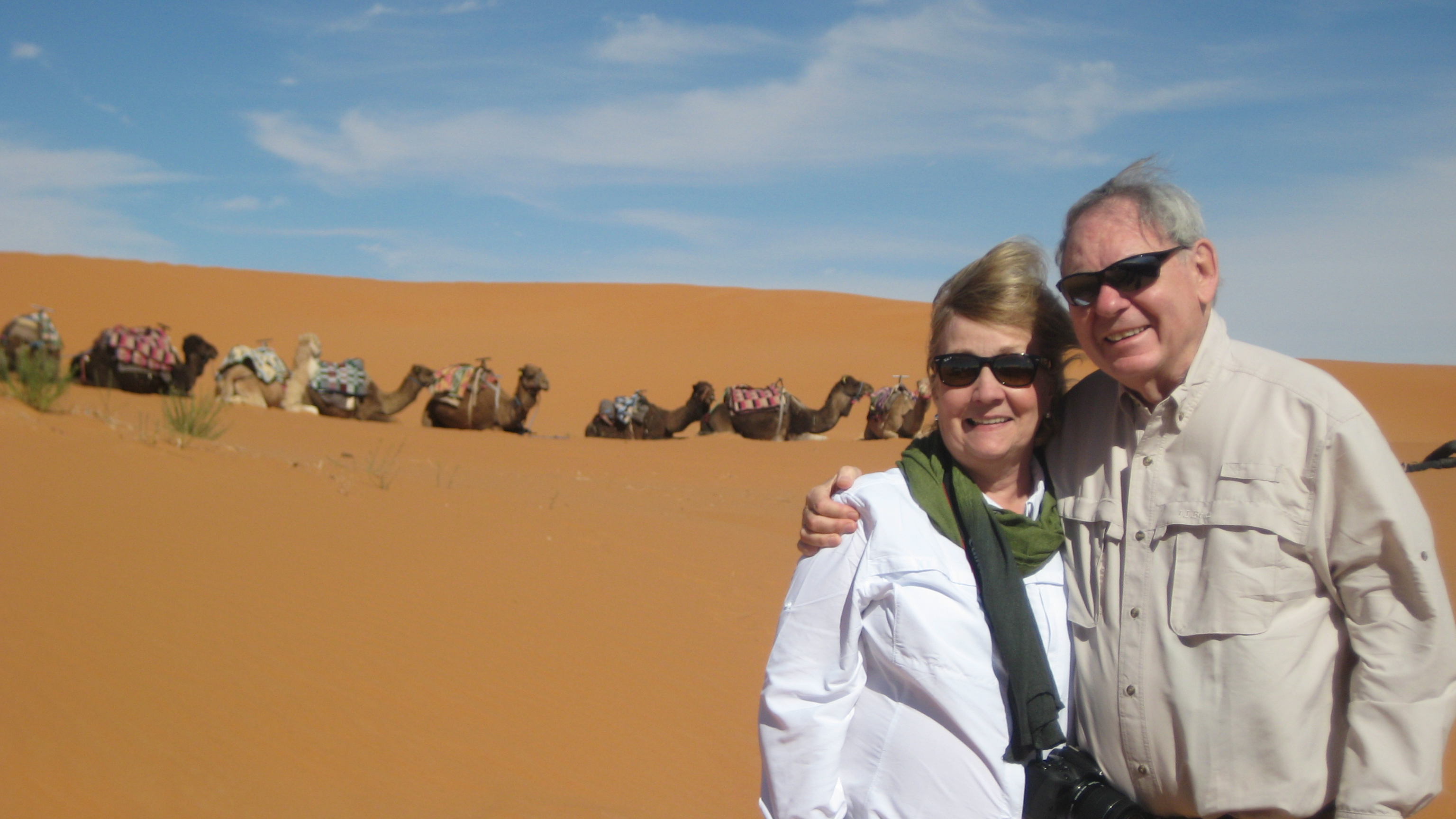
My sister called one hot summer’s day in 2014  asked if we’d like to join them on a trip to Morocco. Thinking she meant Monaco I readily agreed. Morocco, it turns out, is a long way from the glitz and glamour of Grace Kelly’s adapted country. But we enjoyed the medinas, the kasbahs, the desert – – and especially the people – –  far more than we would have ever anticipated!

Morocco (for those who can’t place the country) is in Northern Africa across the Straits of Gibraltar from the Costa del Sol in Spain. A developing country, it is 98% Muslim. Maybe best known as the setting for the movie Casablanca (although the movie itself was shot in Hollywood, not Morocco), it is boarded on the north by the Mediterranean Sea, on the west by the Atlantic Ocean and to the east by Algeria. To the south is an African country called Mauritania. In addition to its beautiful coastal areas, Morocco is characterized by rugged mountain interiors and large portions of the Sahara desert. And we visited them all! Traveling for sixteen days, we spent time wandering the old Medinas and Kasbahs in towns such as Tangier, Fez, Tienghir and Marrakesh.

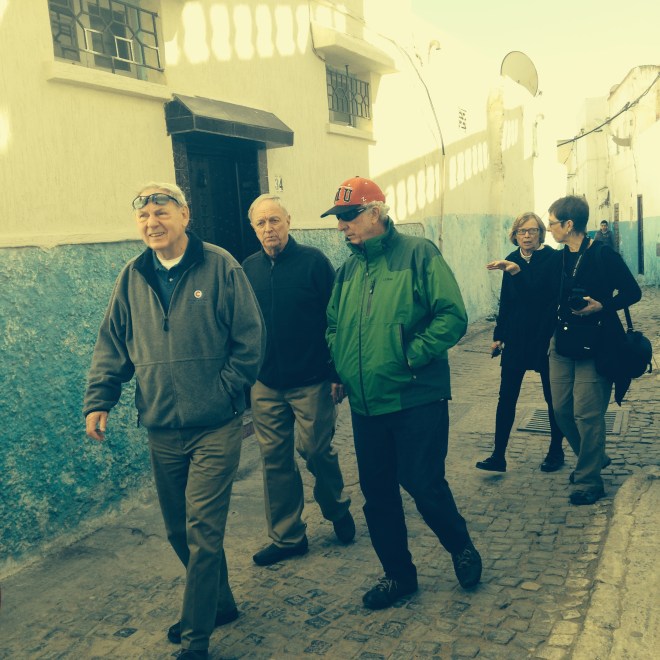
Medinas, for us city-folks who live in the 21st century, are centuries-old walled sections of a city that contain numerous narrow and maze-like streets… if you could call them streets. They are more like small lanes; once in a Medina it’s easy to get lost and difficult to find your way out unless you have a guide. People still live and work in the Medinas.  Kasbah’s are the market areas within the Medinas. With stalls full of goods the Kasbahs are bustling with shoppers.

IMG_2082

Since refrigeration is scarce, shopping for food is a daily event for woman. Men own and run most shops. The “shops” are not what we would recognize as a shop or store. Rather they are a series of small stalls on the sides of the narrow lanes which can be owned or rented. Women make their bread daily and most (without ovens of their own) take it to a local baker to be cooked. The baker’s oven is a large hole in the brick wall. He keeps wood burning on the sides so he can slip loaves of bread in the middle.

But what impressed us the most, what captured our hearts, our souls and our imaginations, were the people of Morocco. They were warm, welcoming and very, very kind.

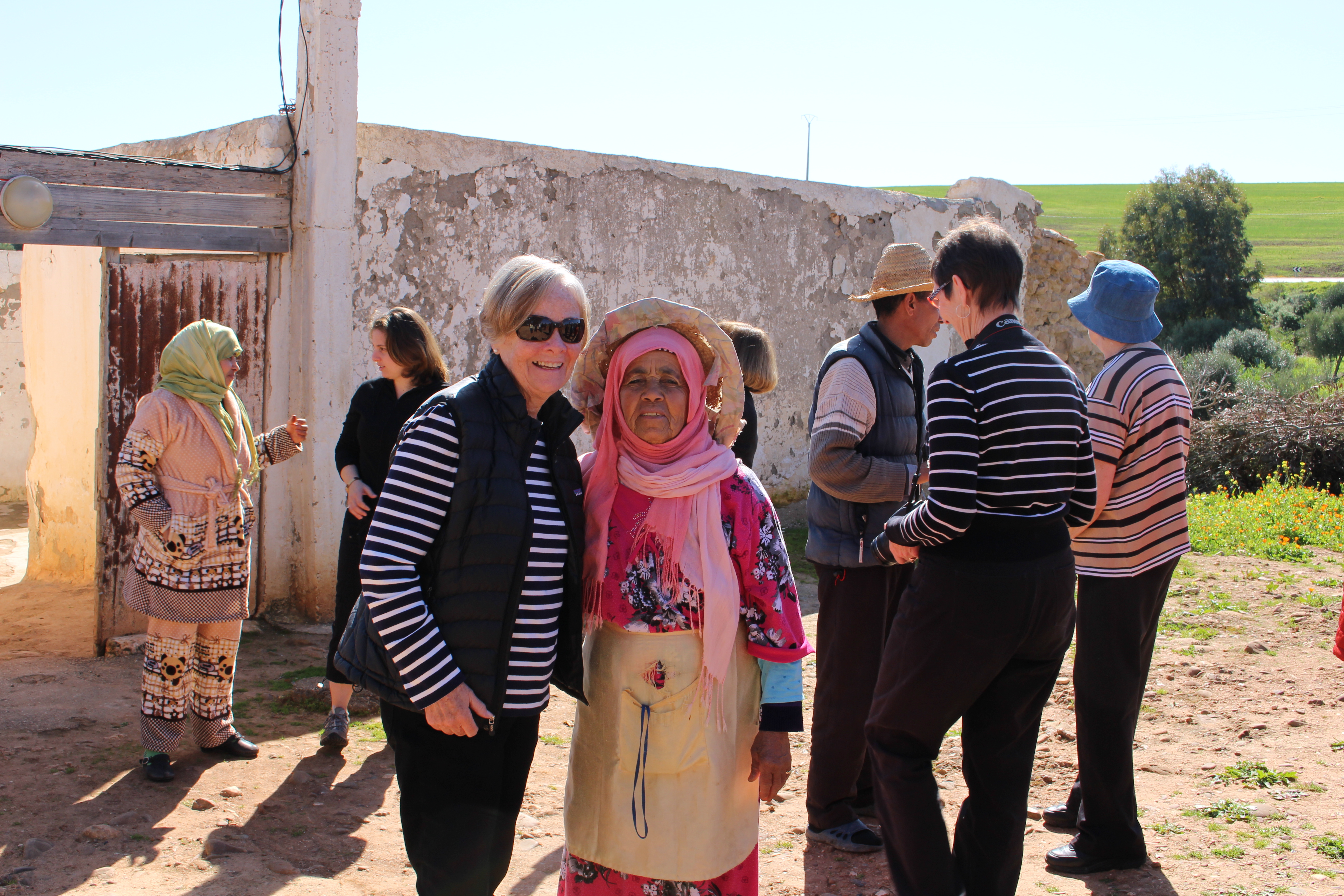
For example, we traveled to the mid-Atlas Mountains where met a Berber family. Members of the family were on the side of the road selling chickens and when we stopped to talk with them they invited us into their home.

The older grandma, who was watching the little children, welcomed us with a huge, warm smile. With a great deal of pride she showed us around their humble home and even offered to make scramble eggs for us. After retrieving fresh eggs from the hens she she invited us into her kitchen and enlisted the help of some of our group to help cook the eggs. They didn’t have much by our standards, but what they had they wanted to share.

IMG_0239

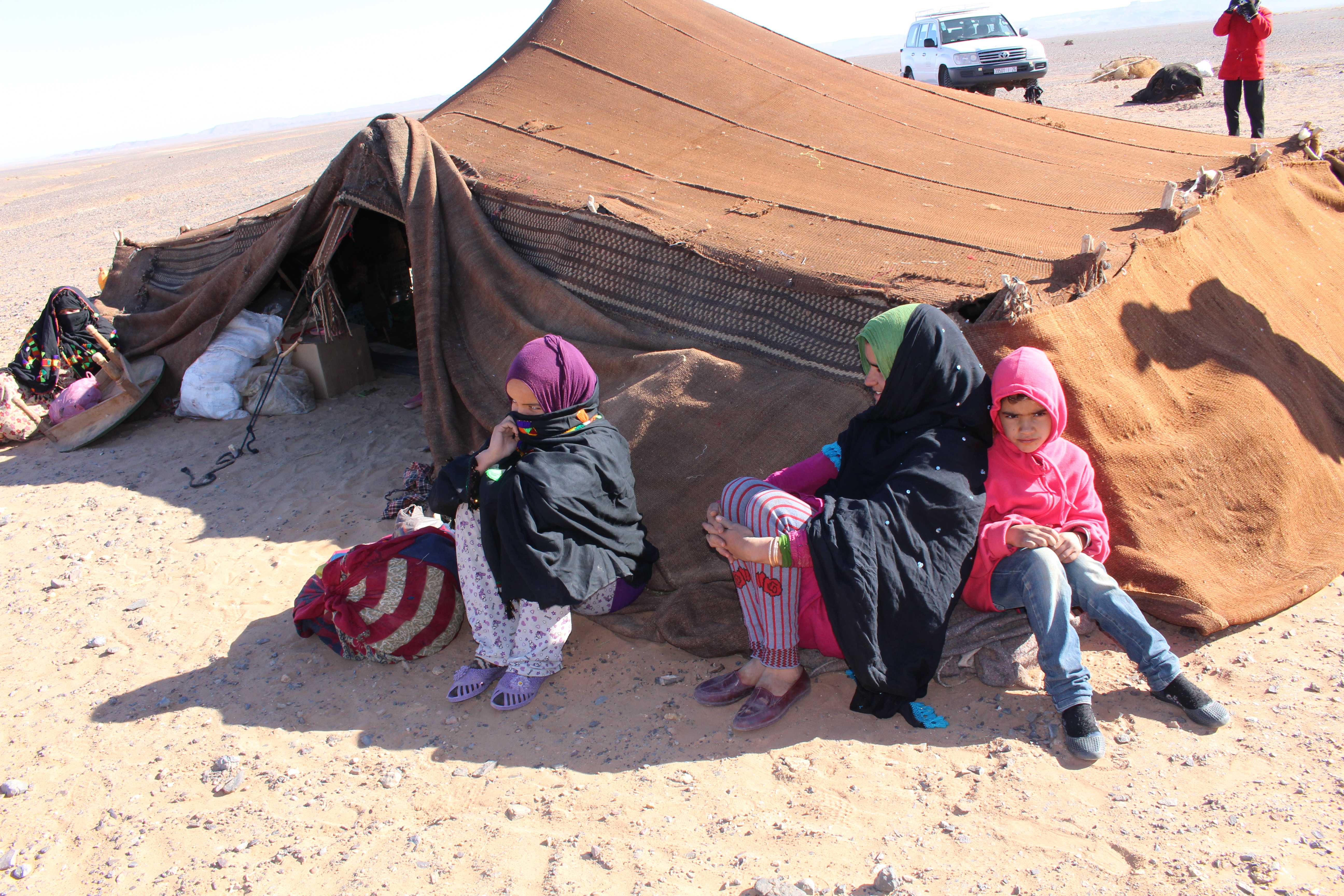
Down the road, our travel guide took us to visit another Berber family; this one a semi-nomadic family. The men were at the market that day while the women tended the children and the animals. The semi- nomadic families relocate twice a year so their homes are a bit more substantial than the nomads who move about every 3 – 4 months. Once again we were invited into their home and through a translator were able to ask them questions. The dwelling they lived in is completely dismantled when they leave and the wooden logs on the ceiling are taken with to use at another location.


For thousands of years, the Berber nomads and semi- nomadic families have been living by moving when the food supply for their animals run out in a given location. Their animals can include goats, sheep, hens, roasters, mules, dogs and camels.

IMG_0894

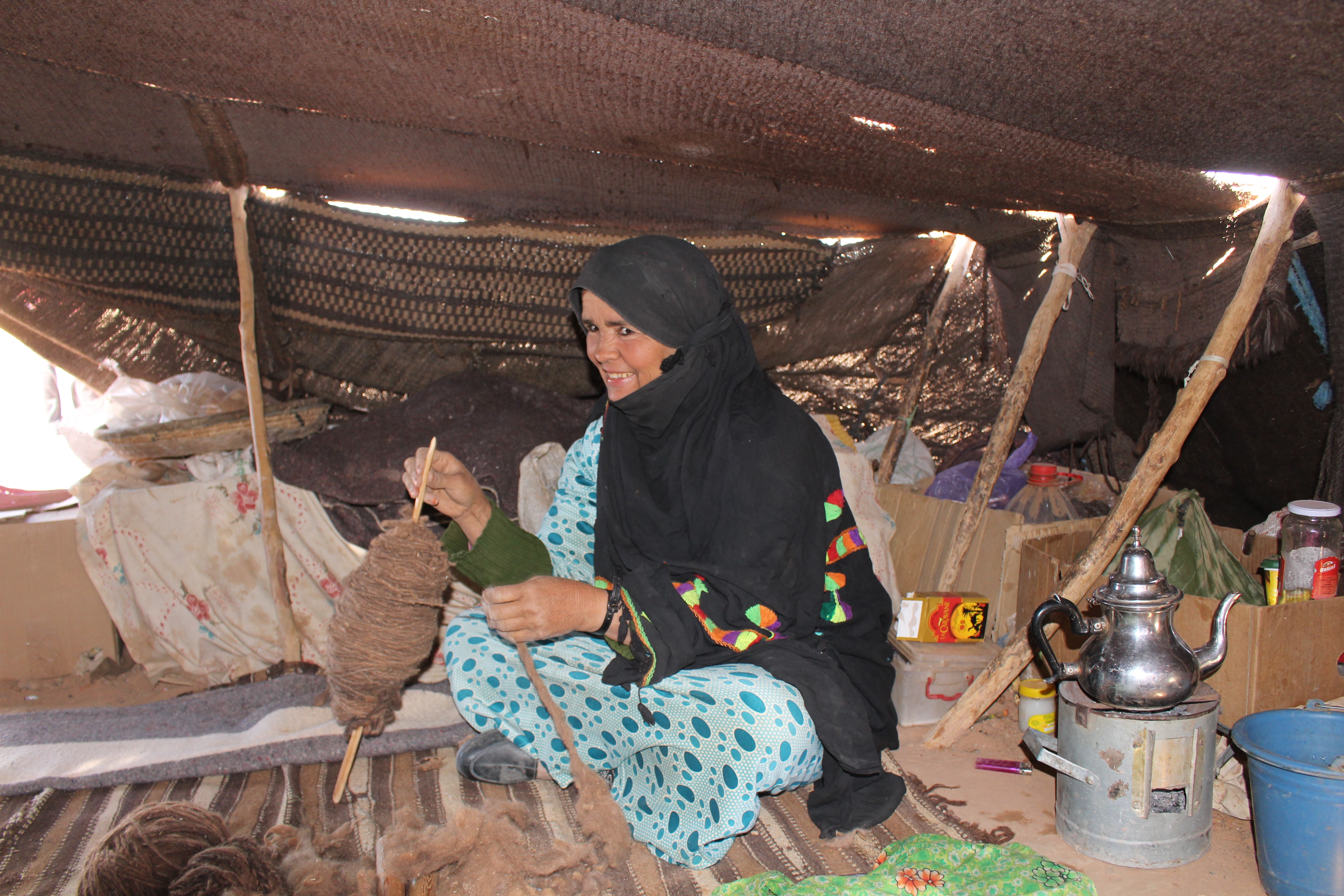
IMG_0888The Berber nomadic family we visited live in the Sahara desert in a tent made of camel hair. We watched while the mother cleaned and spun the camel hair into tread to be used to make clothes and even the roof over their heads. The carmel hair tent keeps it about 20 degrees cooler inside than it is outside – – which in the summer can reach 130 degrees fahrenheit – – and warm during the cold desert nights. (it can get down to 30 degess fahrenheit at night).


We stayed in the Sahara Desert and slept in tents too, but they weren’t made of camel hair. Nor did we have to sleep on the ground as the nomads do. Unlike the nomads, we were able to stand upright in our tents and we slept on fairly comfortable cots. We even had a small light which was solar powered. The nomads use candles for light.


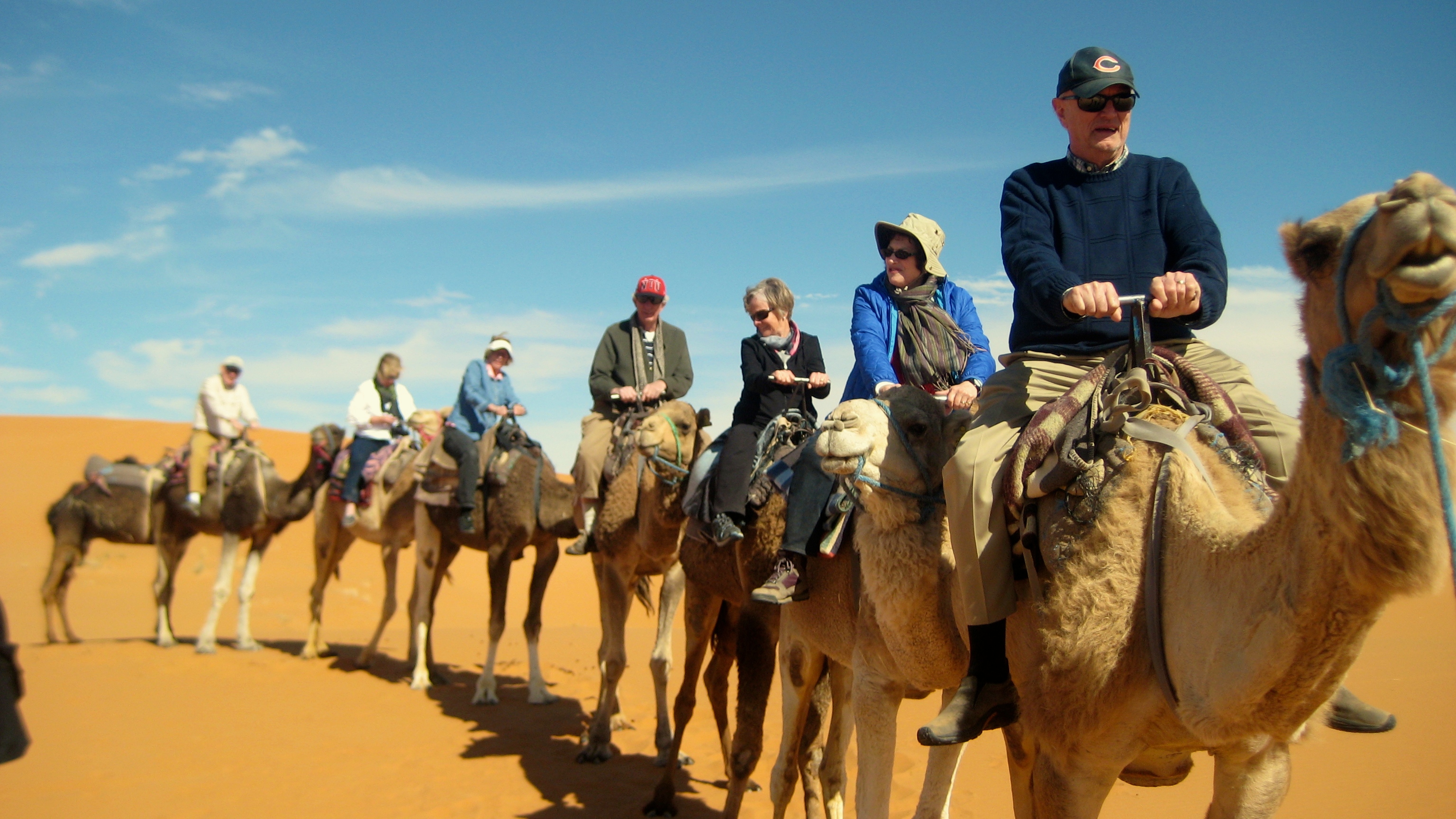
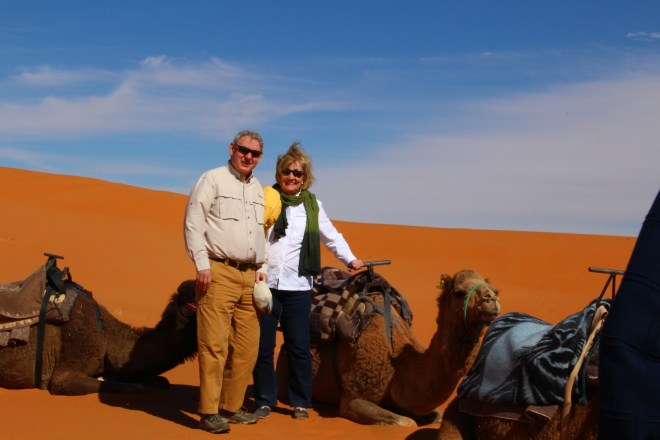
We traveled to our camp site in the desert by jeep and camel. The camels ride was a bit uncomfortable but fun. The jeep ride made us feel like we were in an Indiana Jones movie! In order not to get stuck in the sand, the drivers had to zig-zag all over the dunes.

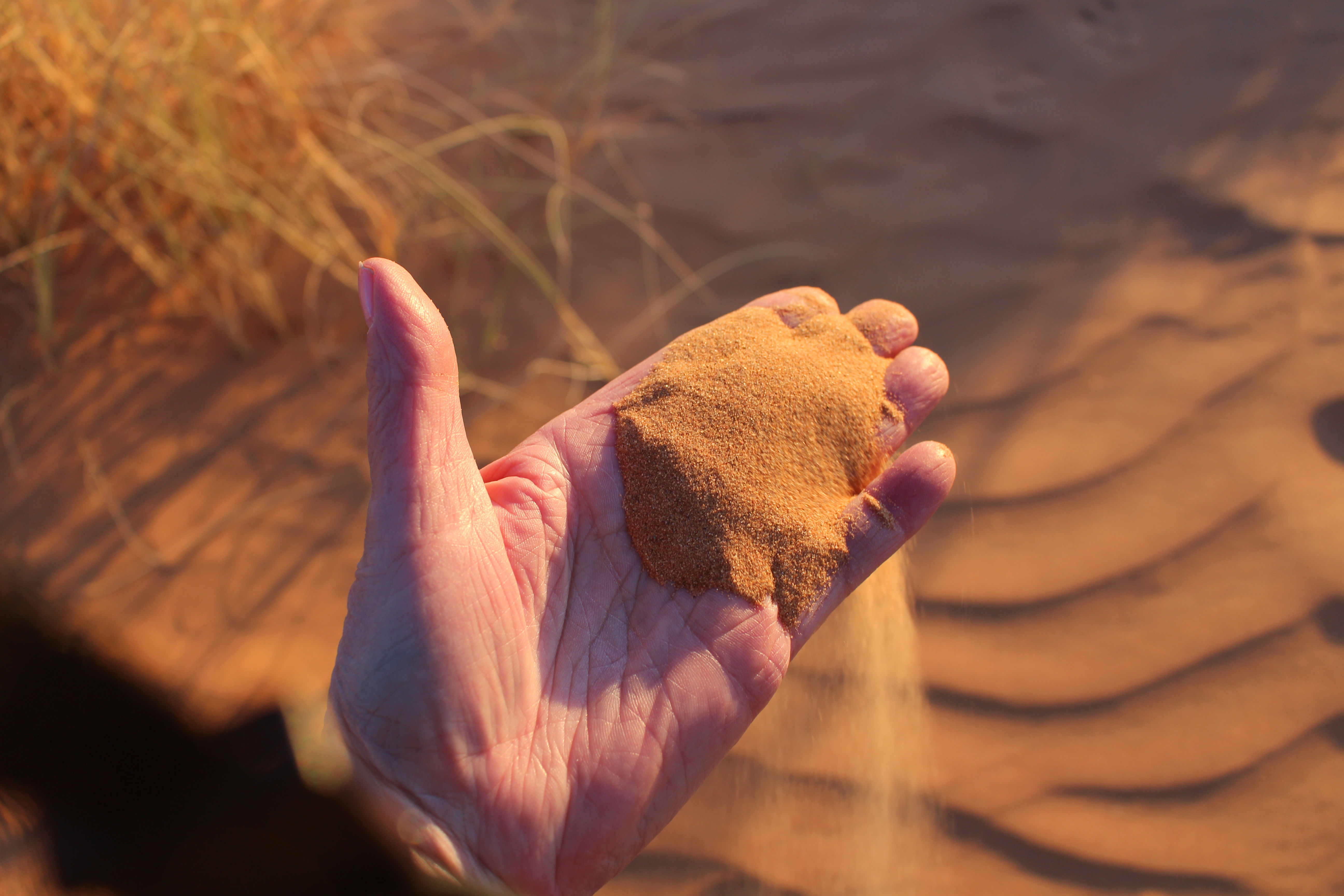
The sand in the Sahara is nothing our Lake Michigan sand… the Sahara sand is silky and a beautiful orange color. IMG_0876 We rose early the first morning in the desert to watch the sun rise and stayed up late every night to be amazed by the number of stars in the sky.

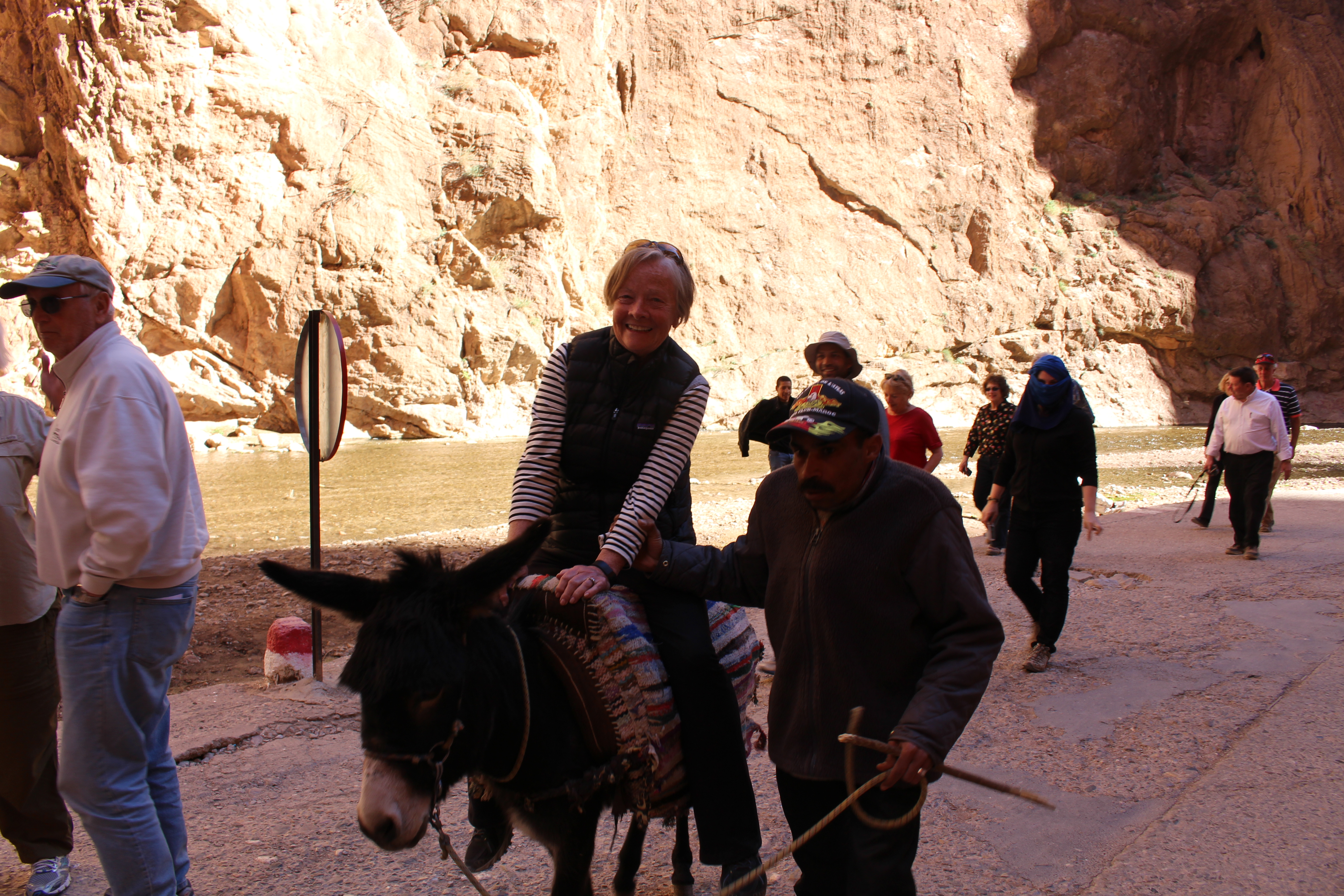
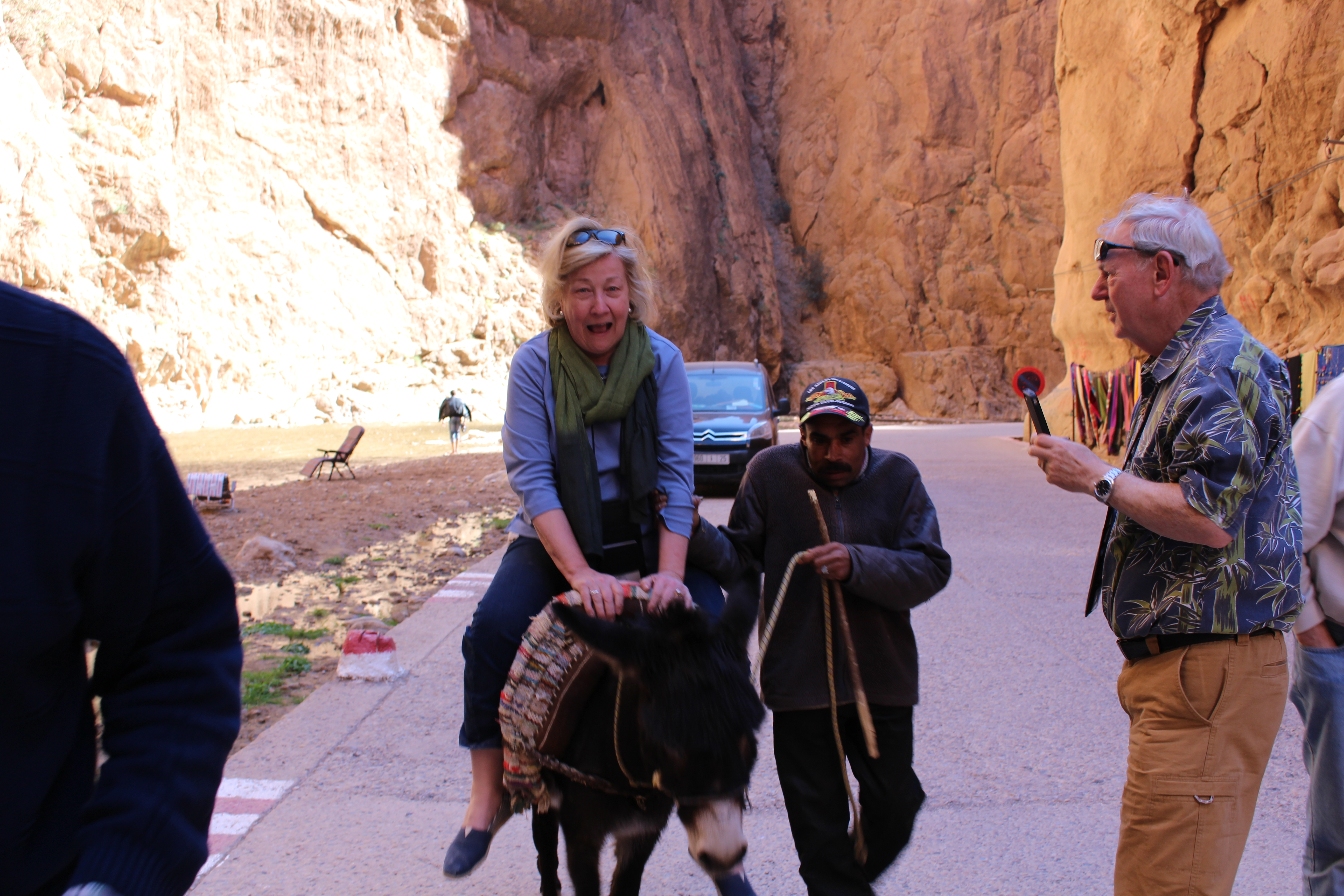
After watching school- age children do so, my sister and I took a chance on riding a mule. Clearly Mary was a lot more comfortable on the back of a mule than I was!

IMG_1049 IMG_1053

We danced . . . . . . we played with monkeys . . . . . and charmed snakes.

The High-Atlas mountains were breathtakingly beautiful.

There was so much to feel and experience in Morocco:

  •  The beauty of the mountains,
  •  Experiencing the Sahara desert–

* The feeling wonderment and awe we experienced walking the orange colored sand-dunes,

* Seeing our footprints in the Sahara sand, (who would have ever imagined walking in the Sahara desert?)

* Watching the sun rise and gazing at the innumerable stars in the sky at night,

  • Riding camels across the dunes,
  • Being welcomed into the home of a nomadic family

* Meandering the narrow lanes of the medians feeling as if we were back centuries ago as we bargained for goods,

* The amazing coastal areas.

But the highlight of our time in this far-off land were our visits and interactions with the Moroccan people. They are a caring, family oriented people who welcome strangers as if they were one of their own.

So, as they say in Arabic, “Yalla!” — meaning “Lets go!” Yalla…. Let’s go to Morocco!!


IMG_0687

4 Year Old Billie

Margaret  – – affectionately known as “Billie”  – – was the last of the children in my father’s family and was the light of their lives, especially my dad’s.  Twenty-three years older than Billie, he adored her and spoiled her.  Then in March of 1927 tragedy struck the Murphy family

My grandparents left four-year-old Billie with older sister Mary’s teenage friend to babysit while they attended a funeral of a close relative.  The older children were either working or in school.  Aunt Doris, only two years older than Billie and her constant playmate, remembers not wanting to go school that day and trying to stay home with Billy.  But her parents prevailed and six-year-old Doris went off the school with her older brother Jimmy.

Doris knew something was horribly wrong when she rounded the corner after school that day and saw a crowd of subdued and somber neighbors in standing in front of their home.  My dad got a call at work and someone finally tracked down grandma and grandpa Murphy at the funeral.

Billie was in the hospital fighting for her life.

There are two stories of what happened to little Billie that day.  The first is that she was trying to make herself a cup of tea and when she reached across the stove to pick up the whistling kettle the sleeve of her dress was ignited by the open flame.  The second, and according to aunt Doris the more probable scenario, is that four-year-old Billie found a package of matches in an upstairs bedroom and did what we all fear a little child might do: she decided to play with them.

What we do know is that her dress caught fire.  Bille frantically ran down the stairs shrieking and aflame.  When the sitter saw her, she panicked and ran outside.  Billie followed  – – – screaming and with her clothes still on fire.  A couple of nearby workmen saw what was happening, ran over and rolled Billie on the ground.

But it was too late.  Despite being rushed to the hospital Billie died at 3:00 am the next day.

Billie had always wanted red slippers.   So my dad, who was totally devastated, ran from store to store in an almost blinding compulsiveness to find her pair of red slippers.  Aunt Doris says he finally found a pair of red shoes in a downtown store.

Billie was waked in their living room and buried in her new red shoes.

My Mother, installment 1

Eileen Kelly Murphy:
My Mom

It was the spring 1927 when my mother discovered she was adopted. Her mother had gone down the street to the dry goods store and while she was gone, a restless Eileen decided to bake. The house they lived in then was the same one I grew up in years later, so in my mind’s eye I can see her in the small kitchen with the morning sun pouring in the east window and shadows dancing on the icebox across the room. She said it was a glorious morning.

My mother must have pulled the recipe box off the icebox and laid it on the table covered with an brightly colored oilskin cloth. Her story is that as she pulled out the recipes something caught her eye, something in an official looking brown envelope.

Maybe that’s they way it happened, but I have my doubts. I think she was, as many that age has been known to do, snooping around my grandparents private papers. Maybe she even suspected something . . . maybe deep down she knew.

However it happened, that brisk spring morning was when she stumbled across the papers that told her she was not really the daughter of Patrick and Hannah Kelly – – – but that she had come from a place called St. Joseph’s Home for the Friendless.

She felt as if a hundred thousand volts of electricity went right through her. Knowing her, I imagine she felt faint. Always the dramatic one, I see her stumbling across the kitchen with the morning sun that moments before was a source of joy and energy now becoming a blinding light, one that she could not tolerate. In my mind’s eye I see her retreat to the tiny bathroom in the center of the house. I see her sit on the commode shaking. What I do not see is her telling her mother what she found.

When Hannah came home, Eileen was back in the kitchen pulling out flour, sugar and everything she needed to project normalcy. Nothing was said. It took years for the “secret” to be discussed between them.

But in that spring of 1927, to Eileen, everything had changed. It was as if her whole idyllic life changed in a single minute. To her, she was no longer the cherished only child of the Kelly’s. Now she perceived that every slight, every discipline she had ever received was because she was not their own, it was because she came from place called St. Joseph’s Home for the Friendless, it was because she was adopted.

My mother became obsessed with finding who she “really” was, where she had come from and finding her “real” parents. Interestingly, her obsession led her to my dad, and eventually, her early marriage to him.


Shortly before finding those traumatic papers, my mom had met my dad. She was only a freshman at Mercy High School when, standing on a corner of 79th and Prairie with her girlfriends, a young man ten years her senior drove up and offered her and the others a ride. They took it.

Art Murphy was Paul Newman-handsome with strikingly blue eyes and a quick Irish wit. He was first-generation Irish, the oldest of eight and knew a pretty girl when he saw one. Eileen was petite, pretty with a stylish short bob and a delicate features. When Art saw Eileen, he knew he wanted to get to know her better.

Because of the age difference, the relationship may have never progressed. But my mother was vulnerable and needy after her unsettling discovery and Art Murphy gave her what she desperately needed: he gave attention.

We aren’t exactly sure about the details of her birth, although we have some hints. But we do know that she and two older sisters were put in an orphanage when she was about six months old. The name of it was St. Joseph’s Home for the Friendless. Who would want to come from a place with a name like that?

I don’t know anything about the conditions of the Home. It could have been a wonderful, caring place although research on such places at that time led me to doubt that it was much more than a warehouse for orphans. But no matter the actual conditions of the home, the name alone is enough to scar someone for life in my opinion.

St. Joseph’s Home for the Friendless was built during the Civil War as a hospital for injured soldiers. So by the time my mother arrived there in 1914 or 1915 it was already pretty much out of date. It was, and still is, a red brick eight-story building located at 735 East 35th Street in Chicago. I’m told the children could see boats on the lake from its windows. But of course my mother would have been too young to see much of anything.

She had no memories of her time there, but later learned from her oldest sister that she was kept in a crib in a nursery with rows of other babies likewise in cribs. Her sister, Loretta, then about five, would sneak past the nuns each day just to see my mom and hold her hand. Loretta had been accustomed to taking care of the baby, then named Anna Belle White, and was traumatized when one day she arrived in the nursery only to see my mother’s crib empty. As Loretta told it many years later, she screamed and cried but the nuns were offered little comfort and no explanation.

The Kelly’s, Patrick and Hannah, were from the west coast of Ireland; he from Clare and she from Limerick. They were good people; they were kind, hard working, stable and loving.

They were childless and took her into their home as their own. They renamed her Eileen Mary Kelly and proceeded to shower her with all the love they had stored up waiting and wanting a baby of their own.

They raised her as their own, never telling her she was not of their flesh and blood. Patrick was a union organizer and Hannah was, like most, if not all women in the early 1900’s, a stay-at-home mother.

At that time, the Kelly’s lived in a neighborhood that is now known in Chicago as “Englewood.” Now it is worn down, poor and overrun with gangs fighting and shooting each other and anyone else who gets in their way. When my grandparents moved there in the beginning of the 20th century, it was mostly farmland and open prairie.. New brick houses, mostly the famous “Chicago bungalows” were beginning to be built for the newly arrived Irish and Italian immigrants. The men were mostly laborers, factory workers, or worked in the nearby stockyards killing cattle.

The Kelly’s weren’t rich. But since they had only one child – – in the days of large families – – they weren’t struggling as much as most in their blue-collar neighborhood. Hence, they were able to give their little girl more than her peers.

For instance, if she got a doll for Christmas it came with a wardrobe of clothes with matching outfits for my mother, all sewn by my grandmother. She had the American Doll phenomenon 75 years before it came on the national scene.

It seemed Eileen had everything. The unconditional love of two good people and all the material things she needed or wanted. Then, one day at the age of 14, in that sun-filled kitchen, the bottom fell out. Nothing was the same after the age of 14 for Eileen Mary Kelly, formerly Anna Belle White.

Discovery of her adaptation deeply and irrevocably changed her life and, eventually, the lives of all who were close to her. For the day Eileen discovered she wasn’t the beloved  biological daughter of the Kelly’s her world shattered.

Thoughts

I’m not keen on heat and humidity but hot summer days can be good.  To sit by the pool and watch grandchildren jump and splash in the water, my head covered with a big straw hat, a cool drink in hand and I know all is right with the world.

It is hard to beat a beautiful, warm Indian summer day. The leaves on the trees are shades of bright orange, red and yellow, the sky is blue, the clouds are puffy and the wind gentle.  The day is perfect.

Winter days, especially in Chicago, can be brutal.  The days are dark and short, the snow blows with a blinding force, temperatures plummet to subzero readings, and the wind can freeze your lungs.  But it is also a time when neighbors help neighbors dig out after a twelve inch snowfall, shovel one another’s sidewalks, help push cars out of drifts, build snowmen and smile as the children make snow angles up and down the block.

Spring is a time when the winter gloom has receded with the snow and my fall-planted tulips are beginning to peek out from the barren patch of dirt in front of my house.   But I think my absolute favorite days are those in the month of May when the bridal wreath bushes running the length of our backyard are bent over with the weight of thousands of delicate tiny white flowers and the yard is fragrant with their heavenly aroma.

The Murphy’s & the Irish President

About fifteen years ago, I took a position as the executive director in a small NGO (non-governmental agency, a non-profit) that was founded and run by one of the Kennedy cousins.  By “the” Kennedy’s I mean one of President Kennedy’s nephews.  During the course of my employment I had occasion to attend a retreat his mother, Jean Kennedy Smith, graciously hosted at her home on Long Island.  So my husband and I  . . .  both of us Irish Catholics from Englewood . . . found ourselves sleeping in a bedroom Rose Kennedy slept in, playing touch football on the lawn, and taking long walks by the ocean with a Kennedy.  It was surreal.

To put my experience in perspective, you have to understand where I grew up.  I came from a predominantly Irish Catholic blue-collar neighborhood.  My father first worked in the stock yards and later as a bus driver then a supervisor for the CTA.  As a supervisor his job was to stand on the corners and time the buses to ensure they were running on schedule.  He did this in all sorts of Chicago weather, 100 degree heat, sub-zero cold, blowing snow, pounding rain.  No matter what the midwest winds thew at him, he was out on the streets of Chicago working to make sure his eight kids had bellies full of food and got a good education.

The other men in our neighborhood did the same.  They were mailmen, pipe-fitters, railway workers.  They worked hard and they worked long hours.  They came home tired and dirty but they always got up and went to church on Sunday.  They joined the Holy Name Society and the Knight of Columbus and made sure their kids attended catholic school, learned their catechism, obeyed their mothers and went to church on Sundays.  Most families were first or second generation Irish.  If second generation, as my parents were, they more often than not, lived with or next to their parents.

Right after his Catholic faith and his family, on my dad’s list of “what’s important” was the Democratic party.   When I began to date and would bring a boy home, it was okay if he wasn’t Irish – –  but God help me if he wasn’t a Democratic.  Further, in the 1950’s my grandparents and parents could still remember the signs that in earlier times could often be seen in store windows: “Irish Need Not Apply.”  Despite the hard-working, family-oriented ethic of the majority of Irish, there had been widespread discrimination against them.

So it was no wonder that when John Fitzgerald Kennedy was nominated for Vice President of the United Stated on the Democratic ticket on a hot August day in 1956, my mother called my brother and me in from playing to get down on our knees and pray.  I was only nine years old and really didn’t understand much about politics and nothing about the nomination process but remember looking at the small black and white television in our living room and seeing a young, handsome man and what seemed like thousands of people cheering.  So I was fervent in my prayers that this Irish Catholic man would win.

Kennedy came close but didn’t get it.  Lucky for him or he would have been on the losing ticket.  But the exposure raised national awareness of this bright, photogenic young senator who would beat all odds to win the presidency four years later.

Many remember the Kennedy/Nixon debate in September 1960  for important reasons: it was the first televised debate and thereby forever changed how politicians are viewed and evaluated, and importantly it helped catapult Kennedy into the presidency. I remember it because I was there.  Well, sort of.  My brother Patrick was a student at Loyola University at the time.  Loyola was a just a few blocks from the CBS-TV station were the debate was held.  So excited were we as a family that an Irish Catholic was running for president that Patrick took my younger brother Jackie (then 11) and me (age 13) to Loyola with him that day so we could walk over to the station and maybe catch a glimpse of this exciting candidate . . one we considered our candidate.

As a thirteen year old the entire day was exciting for me.  Being in a college with my older brother and his friends was an out-of-this-world experience for a high school freshman.  But the best was when we got to the t.v. station and Jack Kennedy arrived in his shiny black car and Patrick pushed me through the crowd.  I remember his hard shove on my back, then hurling past bodies and landing pretty much in Jack Kennedy’s smiling face.   Well, I think he was smiling.  In my mind he was smiling a big beautiful smile.  In retrospect it may have been a grimace due to pain in his injured back.

Patrick also took my five-year old brother, Tommy, and me to Midway earlier that day to see Jack Kennedy when he landed.  That was even better as there weren’t may people there and it was in the days you could actually go onto the field.

Of course we all campaigned for Jack Kennedy, rejoiced when he won, and followed all that he did and achieved as president.  We were proud Americans and proud to be Irish Americans. Along with the rest of the country, we were devastated and wept when he was murdered.  But President Kennedy did more than make us proud to be Irish, he inspired us to do more for our country, to do more for others.  Patrick spent two years volunteering in Africa in the Peace Corp, which was started by Kennedy, and I served in VISTA (Volunteers In Service to America) another Kennedy program.

The era of “Ask not what your country can do for you, but what you can do for your country,” and the heightened awareness of civil rights shaped many of our lives back then.  When I left for VISTA my dad in all earnestness said to me, “I worked all my life to get you kids out of the ghetto, now all you want to do is to go back into it.”

The non-profit Kennedy organization I worked for developed low-cost, high-tech prosthetic devises for landline victims in developing countries.  So years later I still was working in social services.  But I wish my dad was alive to see me strolling with my husband across the Kennedy lawn, or walking along the sea-side with Jean Kennedy Smith or playing touch football with a Kennedy nephew.

Now I don’t consider any of that the highlight of my life.  It was unexpected and I enjoyed it, but far greater things have happened to me – – – including the happiness brought to me by my children and grandchildren, enjoying the company of my siblings as we age, and sharing life with the man I love.

But I do wish my dad was alive to see it.  He would have loved it!

And Then There Was Three

I was nine years old in September of 1955 when my only sister entered the Covent.  That same month four of my six brothers left home to enter various seminaries spread across the country. My two younger brothers and I were left at home with our mother who did not take the loss of her eldest children well.

Looking back with the hindsight of a mother now myself, I can more readily understand her falling apart at the sudden loss of her oldest five children. The house at 7311 S. Marshfield went from one of constant noise: laughing, yelling, door-banging, music-playing by teenagers and young adults to … well … almost nothingness.  I was a painfully quiet girl, Jackie was six and Tommy was only seven months old.   The three of us together couldn’t create the activity of my gone-away older siblings.

I recall the day my sister left.   After we dropped her at the Covent, my mother cried all the way home.  When we walked through the door I thought the tears would subside. But I was wrong. My mother proceeded to walk from room to room and in each room she would prostrate herself on the nearest chair, bed, whatever was handy and sob. Not just cry but sob in big loud globs and scream (yes scream) that Mary … or Joe, or Art … or Ted or Mickey … take your pick … was gone…. her life was over…..  how could she go on without her children?

I was only nine and an immature nine at that.  I followed her and her hysterics from room to room.  I watched as she clung to their left-behind clothes or one of their possessions and sobbed over it.  Looking back, I’m not quite sure why I felt the need to follow her.  Was I trying to comfort her?  Protect her? Or, more likely, was I trying to remind her that I was still there?  Sort of my way of saying:  “Hey mom!  You’ve still got me!!  I didn’t go away. Neither did Jack or Tom.   Don’t I count?  Don’t we count?”

So then I did what my immature brain must have come up with to compete: I cried for my lost siblings and I cried just as much as she did   It worked: now she paid attention to me.  But the attention was “poor Jeffie.  Poor little Jeffie misses her sister so much.”  So she told me I had to pray to God and to the blessed Virgin Mary every day that Mary would leave the convent and come home to us   She would get me up for mass every morning and remind me at night to pray.    It was up to me to bring my sister home.

In this I failed.  My big sister gave more than fifteen years of her life to God and the church.  By the time my she decided that the convent life was no longer for her, I was married with a baby of my own.  And my mother no longer cared.

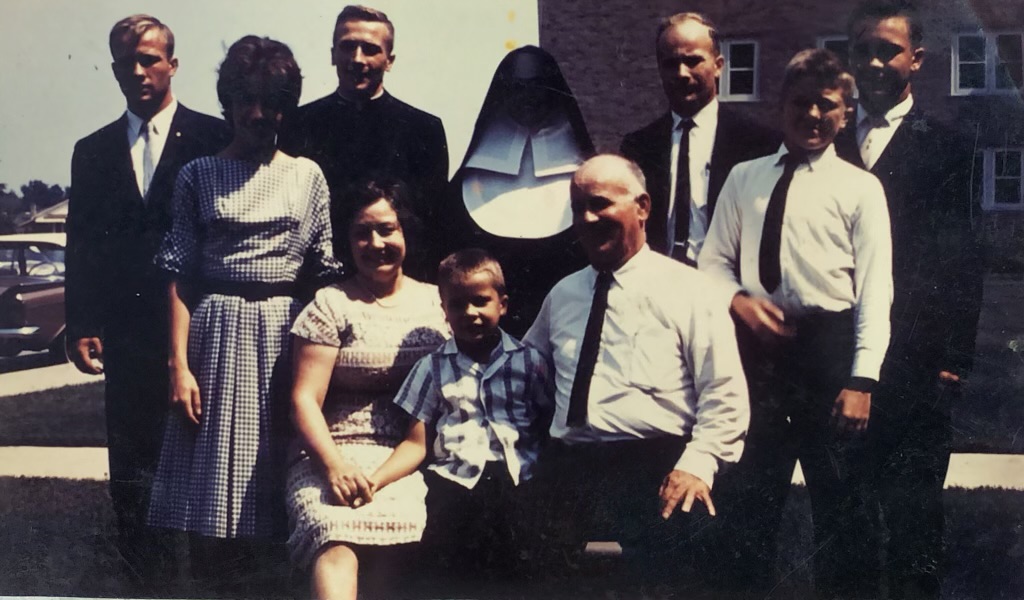
Ted, Jef, Art, Mary, Joe, Mickey / front row: Mom, Tom, Dad / Visiting day at St. Xavier’s

Memories of 9/11/2001

September 2015

To my grandchildren:

As the 14th anniversary of the World Trade Center atrocity approaches, I thought I would share with you the small part I played in our nation’s response to it. At the same time I hope you will learn more about the people directly affected by this despicable act of cowardliness and some of my reaction to it. But before I begin, let me explain how I got happened to get there – – –

I was the founding director of the Victim/Witness Assistance Program at the Cook County State’s Attorney Office under Richard M. Daley in the 1980’s. During that time, I become active in the National Organization for Victim Assistance and eventually served on its Board of Directors.

By 2001, I was no longer with the SAO and had resigned from NOVA’s Board. But after the plane hit the towers on September 11 and watching the devastation it caused, I called NOVA asking if they were involved in the WTC response and if they needed volunteers. They were involved and they were happy to have more volunteers.. That’s how I ended up on a plane to New York in October of 2001. I was happy to be able to volunteer and help with the response to the events of September 11, 2001.

My role was small, but I had the honor of watching and working with the first responders: the firemen and police working on ground zero and the construction workers trying so valiantly to pull bodies from the rubble. And I had the gut-wrenching experience of helping the families and loved ones of those who died. It was an privilege to be a part – although a very small parties – of our country’s response to what happened.

Crisis Intervention Counseling
One of the roles I was assigned was to coordinate the response of the NOVA crisis workers who were coming in from all over the country. I didn’t do the counseling. My role, among other things, was to create the relationships with other agencies and service groups so that our volunteer counselors could provide the needed help.

To be eligible to be a crisis worker and counsel victims, the crisis workers had to have gone through a vigorous training program and been certified in crisis intervention by NOVA. Their professions were varied – they included school principals and teachers, police personnel, counselors, social workers, psychologists, and victim advocates.

These crisis workers were an important part of the work of the the NOVA 9/11 response effort in Manhattan. One important part of my job was to reach out to and provide service to groups requesting Group Crisis Intervention sessions (GCI).

Many of the calls we received were from businesses that were either located in or near the WTC and thus had employees who witnessed first-hand the horror of that day. Other calls come from residents of condo or apartment buildings near the WTC who were beginning to realize they needed help and requested CGI sessions.

I did, however, sometimes screen those who come to us. One of those was a 30-something man who called one day and told me he was attending a meeting in the federal building across the street from the WTC on the morning of 9/11. He said he was gazing dreamily out the window and in his words:

“ . . . . my boss was talking on and on in a monotone voice and I was gazing out the window. . . and suddenly a plane came out of nowhere and I saw it hit one of the towers and it completely disappeared into it. . . . I couldn’t believe it . . . I couldn’t understand it . . . and on top of it my boss kept talking and I couldn’t think. I could hear his voice but I kept looking at the hole in the WTC and the smoke and the bodies flying. Then finally someone yelled to get out so we all got up and started to run and we ran all the way down the stairs to the street. When we got down it was chaos. I ran all the way to the river.”
Another day in the office I received a call from a woman looking for counseling for an entire family whose father was killed in the WTC. He had been a chef in the Windows of the World (which was the restaurant on the top floor of one of the buildings) and left five children behind when he died, ages 4, 7, 10, 16, and 17. The mother of the oldest two children had died years ago and he had remarried. It was his second wife on the line. The first two children had now lost both biological parents. To add to the dreadfulness of the situation, the seventeen year old attended a school near the WTC and was running for his life when he turned to see his father’s building collapse.

Another of my roles was to establish contacts with and offer assistance to businesses and individuals who were not in the WTC but who were directly affected nonetheless. For example, there was a nationally known trading firm whose corporate offices were several blocks away. They, of course were evacuated immediately and many of them witnessed the horror of people jumping. One their top executives now wears gym shoes everywhere in case he has to run away as he did that day.

Ground Zero
Another of my roles was to try to establish a connection with and services for those working at ground zero. I was fortunate that, through contacts made with the fire department, I was able to secure a trailer right next to ground zero. That meant some of our counselors could be in close proximity to the construction workers who worked around the clock pulling remains out of the rubble.

It’s not always easy getting construction workers to talk to a counselor – – -so one of their the superiors suggested I walk around on site and talk with them as they worked so they could get to know me and feel comfortable and maybe I could get some ideas from them. It was a good idea but that meant going onto ground zero. Words cannot describe how I felt. It was hallowed ground. No one was allowed onto ground zero without special clearance. I was awed to be allowed on to that scared place.

It was difficult for me to be there… I think it was difficult for everyone who was there. Despite the heavy equipment and hundreds of workers, it was an eerily quiet, solemn place. There was a reverence about it and all who walked on its ground. There was no fooling around, no loud talking, no swearing, none of the usual noises or raised voices you’d hear at a construction site.

As I walked around I tried to imagine the towers as they were, the thousands of people, the lives lost and it was just overwhelming. Good lord, I just wanted to cry. The sights and smell, especially the smell, will stay with me until the day I die.

To go on ground zero I had to purchase a pair of construction boots. I wore them as I walked on that ground and then put them away. Never wore them again. The dirt from that awful site is still in them today. I want them next to my casket when I die to remind everyone of those who died and those who loved them. And to remind everyone of how we all felt after it happened.

I did talk to some men and women working the site and took their advice. To help get the workers through our doors, they suggested making it appealing by putting in TVs, cots, food, coffee and phones in the trailer for their use. Once the workers were in, the counselors had a better chance of approaching them and helping them talk about the things they saw in their work on ground zero looking for bodies.

The Family Assistance Center
In addition to conducting the GCIs, NOVA also played an important role at the “Family Assistance Center” set up by the state of New Jersey at Liberty State Park. This facility served families and survivors from New Jersey and Pennsylvania and was located directly across the river from ground zero. Another Family Assistance Center for New York families was located in Upper Manhattan.

Liberty State Park was actually an abandoned train station that the state quickly converted into what became a wonderfully organized space designed to provide — in one place — all the services needed by the families of those killed. New Jersey did a remarkable job of making this place into a warm and inviting place for those who hurt so badly. Practically overnight the main building was reconstructed to include:
• an interdenominational chapel,
• a room with numerous computers and telephones that allowed victims to contact loved ones anywhere in the world,
• a dining room with round the clock hot meals,
• counseling,
• quiet rooms for sleeping,
• child care, and
• memory boards all around the premises.

Outside of the main building were trailers that housed agencies that assisted families with all the paperwork they need to get through that terrible time. For example — as terrible as it was for them – the mandatory first step for survivors was to get a death certificate. Without a death certificate a family could not even collect on a life insurance policy they might have much less be eligible for other services. So the first trailer they were directed to was the FEMA trailer. FEMA provided all the necessary paperwork to get a death certificate.

Once they got the death certificate they could begin the process of applying for other benefits such as help with mortgage payments, long-term counseling, emergency food, job placement assistance (for those that now need to work),etc.

Liberty State Park Family Assistance Center also served as one of the locations from which the families of the deceased could leave to visit the World Trade Center site to pay their respects. Visiting ground zero was very important for most families. It was where their loved one died and being there, seeing it up close, first hand, even as horrible as it was, seemed to help get them some small measure of relief.

Only immediate family members were allowed to register for this special visit but they could make requests to include individuals they deem special to the deceased. For example, a roommate of a victim could have been included at the request of the family.

When a family arrived to visit ground zero, they were assigned a special liaison (who also was a trained crisis worker) to accompany them and ensure the day went as smoothly as possible. They were invited for coffee and and then attended a group session in the chapel where a coordinator explained the logistics for the visit and tried to prepare them for what they would see at ground zero. They were provided with hard hats, goggles and masks. The hard hat were mandatory; the other items are used as needed.

Most families brought some sort of memento to leave such as bouquets of flowers, notes, letters or photos. I’ve seen wives and husbands bring copes of their marriage certificates and leave them behind.

Buses took the families to the ferry for the trip to the WTC site. State police and volunteers surrounded them as they entered the site to shield them from the photographers and maintain their privacy. A platform was set up from which the families could view the wreckage and say their prayers and farewells. A section was designated for them to leave their mementos

My first day at Liberty State Park Family Assistance Center was a Saturday and one which will be imprinted in my mind forever. Apparently the some remains of the victims had been collected, cremated and were now being delivered to the Family Assistance Center for distribution to the families the next day. Those of us present were asked to join the Salvation Army in forming an honor guard as the remains were brought in.

It was a cool and windy early morning autumn day and there weren’t many of us on site yet, maybe forty or fifty of us. We spontaneously formed two lines. As I looked around, we were all colors, all ages, both sexes all united in our grief and all struggling to grasp the enormity of the situation. A cold wind was blowing, a flag was waving wildly in the strong wind, and we were singing “God Bless America” as the ashes of nearly 5,000 men and women were being carried past us in several flag draped boxes. Police and fire personnel escorted them with Irish bagpipes leading the way.

As I held my hand over my heart and sang songs I’d probably sung hundreds of times, the words “God bless America” and “does the flag still wave or the land of the free and the home of the brave . . “ took on a new, deeper meaning. I remember looking at the others across from me, tears running down their faces then I realized mine was tear stained too. There may have been ashes in those boxes but what was in our minds, mine at least,were the families of those victims. The faces of the children, the wives and husbands, the mothers and fathers, the sisters and brothers, the best friends, all those gone and all those left behind. I felt the grief, the tears . . . . the unfathomable emptiness.

As we small band of Americans stood together saluting these ordinary people who lost their lives so horrifically, so suddenly and without warning for reasons that didn’t make any sense, I believe we came to understand, in a very profound way, that understanding, acceptance, helping, caring for and loving one another should be our way of life – should take up all our energies. What may have seemed a naïve way to live before 9/11 will – – if we have learned anything – – should be our way of life now.

I spent a lot of time that afternoon looking at the memory boards. They were filled with seven weeks worth of notes, photos and the deepest, feelings and anguish of hundreds of people. I watched as other family members came in and wrote their own notes, stapled photos, and letters to the boards and came to realize that this was really very important to them. I guess it provided them a forum to share the life of their lost loved one and ensure that others know about the real lives he or she led and how much they were loved. Once I realized the importance of these writings to the families, it became almost a mission to read as many as possible. Two stick out: one from a ten year old girl who wrote a neatly scripted letter on sheet of notebook paper. In it she apologized to her father for not saying goodnight and giving him a kiss on September 10th. She promised to always love the Yankees and take care of her little brother. Her dad worked for Cantor Fitzgerald.

The other were long notes I saw being written by a middle aged woman. The woman spent a lot of time writing and crying: then went to get a stapler and attached photos of an attractive young-looking white haired woman. The note from what turned out to be her devastated sister read, in part ”I call your cell everyday to hear your voice . I send you emails I know you’ll never read and I’ll never get a response. I just want you to know how I feel so I write to you . . . I know you’ll be with us in spirit at Amanda’s state concert and Joel’s graduation in June.”

My last night in New York,I walked down to the site of the WTC one last time. Television couldn’t begin to pick up the devastation – – how broken and nasty the twisted metal was nor the sickening was smell in the air. Emotionally it was impossible to grasp how so many ives – – – that were now gone – – – once lived walked on these same streets around the site.

As I walked, I stumbled across an Irish pub a only block away from the ground zero. All of the streets near the site were barricaded, but for some reason that particular street had a small, narrow passage-way leading to the pub so that it could stay open. It was the only sign of life for blocks. As I walked towards it, I could hear music and the raised voices of those inside.

As I got closer listening to the noises of gaiety coming from the pub, I envisioned many of the young people who died on 9/11 filling this same street on evenings after work happy and talking on their way to this very bar. And after all I had seen and experienced during the previous weeks, it was strange to enter the pub and suddenly see so many people laughing and talking and enjoying life. At first it didn’t seem right. It didn’t seem appropriate. It seemed so wrong to be happy in the very shadow of so much death.

But as I stood there for awhile watching, I realized that it was right and it was appropriate to have fun and celebrate with one another.

So dear grandchildren, my advise to you from my experiences after 9/11:

Life is indeed precious and you must value it everyday, every minute. Love and value each other and all those you love. And don’t stop with just those you love. Treat everyone you meet with kindness and respect. Remember to share with one another – –
• Share laughter,
• Share fun,
• Share good times,
• Help in bad times ,
• Wipe each other tears,
• Always, always be there for one another,
• Love one another.

Copyright EMD 2015
Summer in the 50’s

Now days, in many places, neighbors are isolated from one another.  Air conditions, televisions, video games, backyard pools can all keep families away from one another and from their neighbors.  Back in the ’50’s, when I was growing up, we’d always be around each other: we didn’t have much choice. We were a family of eight kids, in addition to our parents, in a three bedroom Chicago bungalow – – before video games, before air conditioners, heck, even before TV – – so there really wasn’t anywhere to go to escape.

If we did escape it was mostly outside, especially in the summertime.  On any warm sunny day you’d find all the kids on the block running around, the old men watering lawns or cutting the grass, the moms hanging out clothes and visiting across hedges and the dads walking to or from the bus stop.

Without TV or video games, we kids found our entertainment with each other.  And there were a lot of kids on our block to do that with (there were eight in our family alone and twelve in the Mair family across the street. And that doesn’t count all the other families with seven or fewer kids).  So we never lacked for anyone to keep us occupied.  We didn’t text or even use the doorbell.  By 9am on a summer’s day you could hear some kid yelling outside a friend’s house a long drawn out, “Yo-o-o- Ju-u-d-d-dy!” on the top of their lungs.  That was the call to come out and play.  If Judy was home she’d come running out.  If not, her mom or dad or sibling wouldn’t bother coming to the door they’d just yell back, “not home” or “can’t come out.”  There was a lot of yelling in our neighborhood.

IMG_0148
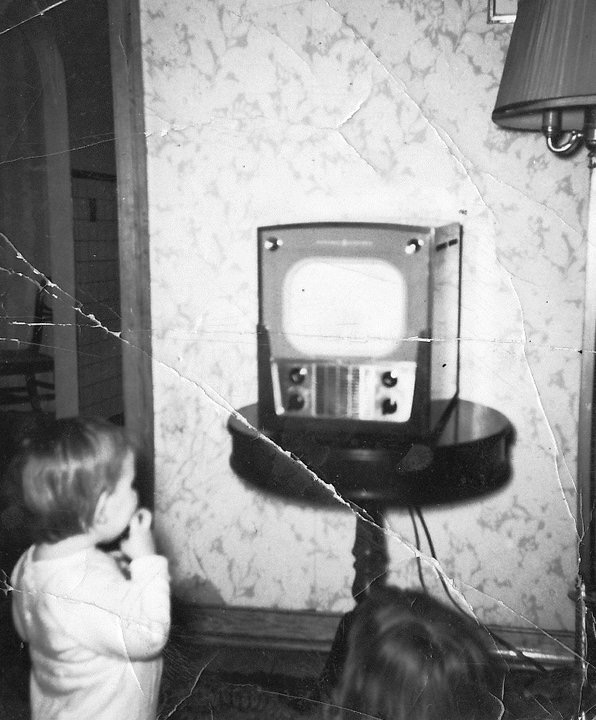
We didn’t have a tv in the ’50’s. This was my grandpa’s tv (he lived above us in the attic flat).

Once out, we kids would sit on the curb and decide what to do. Sometimes we’d walk to Murray Park and play on the swings or we’d play all sorts of imaginative games in the big prairie on Ashland Avenue.  My friend Linda Hinkel and I loved badminton and would play it right in the middle of Marshfield Avenue.  We didn’t have a net so we used the manhole cover as an imaginary net.  I remember one day when we were playing our birdie went down the sewer.  It was our only birdie and we were devastated.  Mr. Mair, who had been sitting on his porch watching the game, got his four-year old son, “Pinky” (Pinky because he had red hair of course) and held the poor child upside down by his ankles several feet into the sewer to retrieve the lost birdie.  Although I thought it would scar him for life, Pinky went on the graduate from Harvard Law School and is now a very successful attorney in Boston.

Another game we liked was softball.  If we weren’t playing in the prairie, we’d play on the four corners of 73rd and Marshfield with an old beat-up softball owned by the Carlin brothers.  The northeast corner would be home plate, the northwest corner first base, and so on.  Since there weren’t many cars back then we could get in quite a few innings without interruption. Those that weren’t up or “in the field” would sit on the curb or on Burke’s front steps to watch, or more often, make catcalls at those up at bat.

Summer evenings were a wonderful back then. We’d always be out after dinner playing hide and seek and catching lightning bugs. By then our dad’s would be home from work and many would be sitting out front in lawn chairs or taking a stroll to get some air.

We were a multigenerational neighborhood … grandparents lived with many of us or we with them.  One of my fondest memories is watching my grandpa Kelly and old Mr. Brown who lived next door (both old country Irishmen) standing out front watering their respective lawns and talking.  I know now that old country Irishmen have the gift of gab and these two men certainly did.  They’d be out there all morning discussing all sorts of world events.  At the same time white-haired Mrs. Brown was usually in the backyard hanging clothes and visiting with my grandma Kelly who would be tending to her beautiful garden.  I especially remember her lush bridal wreath bushes falling over with the weight of their lovely white flowers.

A Bit of History  The first generation of the Kelly and the Brown’s came from the west the Ireland and settled in Chicago at the beginning of the 20th century. They happened to buy homes next door to one another and became friends. The Browns (Pete & Agnes) lived at 7313 and had two daughters; the Kelly’s (Patrick & Hannah)lived at 7311 and had one daughter.

 When Patrick & Hannah’s daughter, Eileen, married Art Murphy and started to have children, the Kelly’s added an attic flat and moved upstairs so the young family could have a nice home in which to raise their family.

When Pete & Agnes’s daughter, also Agnes, got married and started a family her parents did the same: added an attic flat to their home and Agnes and her husband Tom Duffy moved into the first floor.

Agnes & Tom Duffy’s eldest daughter, also Agnes, was born six weeks before me. We grew up together, went to school together, were good friends and share all sorts of memories. We lost touch for awhile (not surprising as she moved to Ireland!) but we have reconnected . . . which was easy to do not only because of our shared memories of 73rd & Marshfield and St. Justin’s, but because I believe we both realize that our lives are intertwined with the stories of our parents and our grandparents.

All in all, looking back, I think the 50’s was a good time to be a kid. A bus trip to the Museum of Science and Industry or Rainbow Beach was a big deal. Or we’d walk several miles – – usually laughing and fooling around the entire way – – to swim lessons at Harper High School or to swim at Gage Park (with a stop at the corner store for penny candy). Or we’d bike to Marquette Park and try to catch minnows with a Dixie cup or just lay in the grass under a tree and daydream. There was a lot of time to daydream and I think that was a good thing