The beginning . . . .

Brave or Foolish

It was 1980. I was working, correct that, I was a full-time volunteer for Richard M. Daley’s campaign for State’s Attorney. I was his Scheduler, which is a fairly important role in a campaign. The Scheduler is responsible for working closely with the Campaign Manager and the candidate to determine the events she/he will attend each day. In Rich’s campaign, because his father had been the longest serving Mayor of Chicago and immensely popular, we received far more invitations than was possible for him to attend. So, I had to decide which ones we’d accept and which ones we needed to send a surrogate to. These decisions were nearly always made based on where we needed the votes.

I had gotten involved in the campaign through my brother. In November of 1979, he had already declared as a candidate for State’s Attorney when Rich Daley called him and asked if he’s stop by his house for a chat after Thanksgiving dinner. In that meeting, Rich told my brother he was intending to run for State’s Attorney and asked him to drop out and throw his support to him. Knowing that he couldn’t match Daley resources and name, he said he would but had one favor: would Rich hire his little sister. You see, I had been one of Ted’s biggest and
hardest workers. I guess he knew I’d be disappointed.

At any rate, I found myself walking into the legendary 11thWard Regular Democratic office on 31st and Halsted the following Monday. It was, as all Ward Offices were back then, basic in the extreme. As I recall, it was an old building and somewhat musty. Immediately upon entering was a good size waiting room with old folding chairs set up and where all those seeking favors would wait for a meeting with the ward committeeman. Separating the chairs from the rest of the office was an old metal railing with a swinging gate. The offices of the Alderman, Committeeman . . and Rich Daley (who was both the Committeeman and State Senator at the time) were well beyond the gate.

Rich asked me a few questions then told me he needed a Scheduler; did I want the job. I did. He sent me to a wonderful woman, his secretary, Gloria to get set up. In fact, Gloria was much more than his secretary, she was his rock. Rich had a tendency to get upset fast, and Gloria knew just how to calm him.

I was put at a long folding table in a large meeting space located to the side of the offices. There I was presented with a telephone and an overflowing file of requests for his appearance. Some requests were in the form of a letter or formal invite, others were notes taken on yellow telephone message slips and still others were mostly illegible notes scratched out by Rich on index cards. I would find out that he carried index cards with him at all times and wrote all sorts of things on them: names and phone numbers of people he met, dates for meetings he’d been invited to, questions he wanted answered. After a day on the campaign trial, most of the index cards would land on my desk for interruption and routing to the correct spot.

I would never have made it with through those first weeks if not for Gloria and her assistant, Laura. I’ve long forgotten their last names but will never forget their kindness and help. They were from “the neighborhood” (Bridgeport in the 11th ward) as was everyone who worked there was until I came along. It wasn’t easy to be accepted if you were from outside the neighborhood. Bridgeport people tended not to trust outsiders – – – i.e. those who didn’t have at least five generations in the neighborhood. Gloria and Laura accepted me and therefore everyone else did too. These friendships were invaluable to me in my work for the Daley’s.

Unfortunately, my stay with Gloria and Laura was brief. The Daley Campaign for Cook County State’s Attorney officially opened its office downtown at 211 West Washington just after the new year. It was a rundown place on the 3rd or 4th floor (I don’t remember which floor, but I do remember the rickety elevator that took us up there). Bill Daley’s (the campaign manager) office was on one side in the front facing Washington Blvd. and Rich’s office was on the other side. They had the only offices with windows. The place was long and narrow with make-shift offices lining the way to the back. Mine was one of these.

The next few months are a blur of activity. Daley was in a hard-fought primary election against Ed Burke. Burke was a sitting alderman who, at that time, had most of the Democratic committeemen behind him. It was a dirty campaign.

After nearly three months of activity, I found myself sitting in the campaign office on election day with nothing to do. The phones had stopped ringing and requests no longer came in. Everything now depended upon the results of the election. If we won, we would go on to the general election against Bernie Carey.

There were only a few of us sitting around when Bill Daley mentioned they needed a poll watcher in a tough precinct on the west side. At that time, the west side of Chicago was composed mainly of really poor African Americans living in dilapidated buildings and public housing. Much of the west side had been burned down in the riots after Dr. Martin Luther King’s assassination twelve years earlier and it was still struggling to rebuild. It was pot-marked with scores of empty lots where stores and houses once stood until burned down in the ’68 riots.

I volunteered to go. I didn’t want to just sit in the office all day. I wanted to be doing something. After warning me that it wouldn’t be easy, Bill Daley had me driven and dropped off at public housing high-rise somewhere on west Madison.

My job, as a poll watcher for Daley, was to watch the voting process to make sure no votes were being stolen and that the election was being conducted in an open and fair manner. I couldn’t interfere or stop the voting process, but I had every right to watch every detail of what was happening, ask for the names of voters and write them down.

The precinct I was in consisted of the entire Public Housing high rise building which was mainly for senior citizens. Not bad, I thought. Safe.

The seniors were being brought down from their apartments in groups of five or six by the local precinct captains. That was okay. Most of them needed help walking anyway. But then I noticed a pattern. Nearly all were accompanied into the voting booth by a precinct captain.

A voter can have someone in the booth with them but only if: 1) they physically need help, 2) special paperwork has been completed with the reason for the needed assistance and 3) the name and relationship of the person helping is recorded. None of that was being done.

So, as was my right as a poll watcher, I objected every time it happened – – which was almost always – – and would write down the name of the voter and the person in the booth with them. I couldn’t stop the process, but I could record it and verbally state my objection to the vote.

After several of my objections, one of the poll-workers gave me a hard-sinister stare and slowly rose from her chair at the table. “This doesn’t look good,” I thought. She was a Black woman about my age, only much taller with broad shoulders. She had the look of someone who had been in more than a few street fights in her life. Despite the many “wrestling” matches I had with my brothers growing up, I was certain she could wipe the floor with me if she choose to do so.

I can still see her in my mind’s eye as she rose up from her seat – – – still giving me what I considered an “evil eye” – – – and walked slowly towards me. She stopped a few short inches from my face. Her malicious looking brown eyes glared into mine like she was trying to penetrate my brain. After what seemed like an eternity, she hissed, “Do you want two broken legs?” Long pause. “Do you want to end up in the River?” I took it as rhetorical questions and thought it prudent to stay silent. I tried to appear calm, cool and collected.

If she intended to scare me, she did. I remember thinking that it was a good thing I had on jeans, so she couldn’t see my legs shaking. I stood bolted to the spot for a few minutes until I knew I could walk without falling over. The first thing I did was to go the phone booths just outside that room and call my nanny, Ann Grogan. Keep the kids in the house, I told her. Watch them and keep them close. Then I called the campaign office. Send out the US attorneys asap, I said.

When the US attorneys arrived, I shared my notes on what I considered to be illegal voting. They checked the records and strongly warned the workers that the rules had to be followed and that they would be back to make sure. They also took copies of my notes as evidence in case they decided to prosecute.

Shortly after they left, I went back to the phones to report back to the campaign office. While I was on the phone with the office, a tall, muscular older white man came in and picked up the phone next to me. I didn’t know who he was at the time, but later found out he was Ed Quigley, the powerful ward committeeman on the west side. After interviewing Quigley in the 60’s, Mike Royko described him as . .

“wearing a silk suit, a silk shirt, a silk tie, a diamond pinky ring, diamond cuff links,
and a jewel studded wristwatch.”

That pretty much summed up the man who was next to me at the phones.

I overheard him forcefully telling someone on the other end of the line “to get this young broad out of his ward” no matter what they had to do. “Put her in the river if you have to,” he yelled. Apparently, he didn’t know the “young broad” was standing right next to him – – shaking like a leaf.

I nervously relayed his conversation to Bill Daley on the other end of the line. He wanted to send a replacement and bring me back to the office. No, I said, I started this and I will finish it. Besides, they know that I know what I am doing. They may be even more afraid of me than I was of them – which was substantial.

He immediately sent out the biggest, tallest, strongest looking man he could find to sit with me for the remainder of the day. That man happened to be the husband of Rich’s secretary in Springfield. I don’t recall his name anymore, but he was a farmer downstate and despite his appearance he was one of the gentlest men I ever met.

As for the voting, once the US attorneys were called in and the ward people realized that I was staying, the voting nearly stopped. My guess is that they figured there was no use bringing the seniors down to vote if they couldn’t control what they did in the voting booth. So, my farmer friend and I spent the rest of the day talking about our kids.

After the polls closed and the votes counted (that precinct had the lowest turnout ever and we won it for Daley!) Bill sent an off-duty police officer to pick us up. He drove his car right up on the sidewalk and as close to the door as he could. As I exited the door, he grabbed me and hustled me into the car. Then pulled away at a high rate of speed. I remember thinking that the campaign must have taken Quigley’s threat even more seriously than I did.

Back at the office, one of the attorney volunteers, Marv Brunstien, who had been in contact with the US Attorney’s office for me, made a medal out of tinfoil which he presented to me for good work, stopping voter fraud, and for surviving the day. I saved that piece of tinfoil for years but no longer know what happened to it.

So you judge. Was I brave or foolish? My guess is a little of both.

Looking back, I was young and idealistic. I desperately wanted a fair and just world where everyone was treated equal. In college I had fought for civil rights and for everyone to be given a fair shot at success. In this instance, the attempt to steal votes insulted my sense of justice and fairness and I was willing to fight against it. It was only a small thing in a much larger picture, but I am happy I did it.
My Time in the State’s Attorney’s Office

Rich Daley won election for State’s Attorney in November 1980 and was sworn into office in December.  I had already told him that I would like to work with him in the State’s Attorney’s Office (SAO) when I got a call from Frank Krusi in January 1981.  By then Bob and I already had separated and I was worried about paying the bills  if I didn’t get a job soon. So when Frank offered me the job of setting up a Victim/Witness Assistance Program (one of Daley’s campaign promises) I immediately said yes.

By the first of February I was at work in the Administration Building adjacent to the Criminal Courts Building at 26th and California.  I was given a desk in a tiny office by the elevators and my only instructions was to develop a program to help crime victims and witnesses served by the State’s Attorney’s Office (SAO).  

After a little research I found there was a lone woman working in the Courthouse located at Belmont and Western who ran what was called “Victim Services.”  Victim Services, started by the League of Women Voters several years earlier, sent out badly copied mimeographed letters with fill-in the blanks for court location and times to victims and witnesses telling them of upcoming court dates.  Becuse the court dates were so often changed or witnesses not needed (for instance they are not needed for a status call) there was another woman who came in late in the afternoon to “call witnesses off”.

My first step was to interview both women.  Rose Perez was the woman at Belmont and Western.  Rose worn her jet-black hair pulled tightly back in a huge Beehive. She wore deep red lipstick, was a tall, large-boned woman who was extraordinarily polite and spoke in a monotoned voice.  Talking to Rose would put you to sleep.  She did exactly has she was told and had no room for creative thinking.  

Next on my list was Ann Lynch who was the woman “calling off witnesses.”  I happened to be sitting in an assistant state’s attorney’s (asa) office when her name came up. So I asked if he knew her.  ”Yes,“  he replied, “Ann is the girl who works on the 13th floor and comes in at 3 o’clock.”

As he described  her as “the girl” I was completely taken back when I finally met Ann. Ann was a white-haired mature woman who left her “girlhood” long before I met her.  

The “Women’s Lib” movement was underway at that time.  Up until that then I had not paid much attention to the instance of the movement’s call for women to be called “women” as opposed to being referred to as “girl.”  After I met Ann I understood.  

Shortly after meeting Ann, I ran into that same asa in the hallway.  I looked at him and said, as pleasantly as I could, “I met Ann Lynch yesterday.  Ann really is not a girl;  in fact, she could be your mother.”  He just looked at me quesitcally – – I hope he thought about it later and had the same enlightenment I did as a result of meeting Ann Lynch.

Back to the story. I soon realized that the badly formatted letters Rose Perez was sending out and Ann Lynch calling people telling them not to come in were far from enough.

As background, the Victim and Witness programs really started with the feminists movement which recognized the need to provide special care to victims of rape and domestic violence. The first victim assistance programs in the United States were rape crisis centers in Washington, D.C., and the San Francisco Bay area.  

Gradually prosecuting offices were beginning to recognize that all victims and witnesses of crime needed more services.  When Rich Daley ran for Cook County State’s Attorny in 1980 it was still a new concept.  So one of his main campaign pledges was to initiate a Victim/Witness Program.  His asking me to take on this job, I thought, demonstrated his confidence in me,

After assessing the services – or lack thereof – in the SAO,  I visited several sexual assault and domestic crisis centers across the country to understand better what services were needed and how best to deliver them. I remember one in particular; it was in Arizona.  I  went out one night with the crisis workers. They were called for domestic violence situation which occurred on a military base. The husband (the offender) had already been removed from the premises. We went in to talk to the woman who reported the attack. 

I watched and listened as the trained crisis worker spoke with her. Now she was denying any violence from her husband. It was all a mistake –  he should come home. But as she sat there, she kept rubbing her arm. I paid a little attention. But the crisis worker eventually said to her, “you’re rubbing your arm can I see it?”  When she reluctantly pulled up her sleeve it revealed nasty black and blue marks all the way up to the shoulder. That’s when she broke down and cried. And the policeman in the room knew he had a case.

Women like the one above – who had been victims of domestic violence or those who had been victims of sexual assault – needed more than to just be told when to come to court.  First and foremost they needed someone to listen, someone to be there for them. Eventually they would need counseling.  Many needed a safe haven or help with their children.  When the time came to face the perpetrator in court they would need someone to hold their hand, someone to tell them what to expect, someone to assure them that they need a not be afraid.

My research complete, I realized my first job was to convince the assistant state’s attorneys that the Victim/Witness (VW) staff would be there to help them not to hinder them.  When an assistant states attorney begins to prosecute a case she doesn’t want anyone near her witnesses except herself.  She doesn’t want their testimony jeopardized in anyway.  That was the first thing I had to understand and the first obstacle I had to overcome.

My job was to convince  them that we were there to work with them to make the victims testimony even better. We would do that job not by talking to witnesses about the case but they helping them emotionally. 

We took a while, but overtime most of the assistant state’s attorneys were won over by the Victim/Witness staff I hired. Staff would talk to the victims and witnesses to understand the issues they had us a result of the crime, and to find solutions for those issues. Sometimes it meant applying for victim compensation through the state. Sometimes it meant counseling.  Sometimes it meant relocation or help finding a new job. Many times it meant just listening.

Finally it all came down to the day they were to testify in court. 

Most people have no contact with the court system, so they have no idea what to expect. The same is true for most of the victims and witnesses who go through the criminal court system.   So one of our first  jobs was to explain the court system and exactly what would happen at each step – – – the Preliminary Hearing, the Arraignment, the various pretrial motions and status hearings and finally the trial – –  bench trail or jury trial.

I also developed special services for children that needed to testify. The big old courtrooms to 26th St. frightened of a lot of adult witnesses. I’m sure it was completely overwhelming to children.  I came up with the idea of Hamilton Hippo. 

Hamilton was a big purple hippo who explained the court system to children in language they could understand.  We had a costume made which one of the advocates would wear. A week before their court date, we would have the child and his or her guardian come in and Hamilton the Hippo would walk around the courtroom with them to familiarize them with their surroundings, so it wouldn’t be so overwhelming to them when they had to testify. 

We had judges volunteer their time to come in and sit on the bench, and talk to the children. Many times the judges would take them up on the bench with them, and let them pound the gavel. As  each child left, we gave them a coloring book in which Hamilton the Hippo would go to court.

Another program I’m really proud of is a program I started for the families of murder victims. It was a support group to help them through probably the most horrible time in their lives. As I did when I was started the V/W program, I did a lot of research. Which meant I attended a lot of established support groups. The most memorable support group was the SOS group. Survivors of Suicide. SOS was run by the archdiocese of Chicago. I attended a meeting at St. John Fisher Parish Hall.

Most of the people at this meeting were parents of young people who had killed themselves. I won’t even get into their stories, but trust me – it was brutal.

I was a single mom at the time and struggling financially. The only car I had was the one issued by the state attorneys office, which was a beat up old car that has been confiscated in a drug bust. After listening to the heart wrenching stories I heard at the meeting, I no longer cared about driving a beat-up car. I was thankful to God for everything I had – – – most especially my three healthy, good children.

I started the support group with the help of two people; Father Gavin Quinn and Nina Helstien. Gavin Quinn, as you all know, I was a classmate of Dave’s in the seminary and an excellent priest, counselor and speaker. He spoke at the first few meetings.

Nina was a rape victim who came through our system and eventually became a very dear friend of mine. Nina was a psychologist who lived in Hyde Park. She woke up one night with a man raping her. Thank God she lived through the attack and was able to call the police. She said they were very sensitive and tactful questioning her. Finally, she looked at them and said “this was not my fault. Somebody did something terrible to me, and it’s his fault not mine. So you don’t need to be careful with your words. I feel no guilt. I feel no shame. Just anger at the person who did this to me.”

I thought that was a pretty healthy reaction. So when it came time to start the support group, I asked Nina if she would lead it. And she did for many years.

I could go on with stories from my SAO days. Like the Friday night I was called back late to testify in a case in which a man set his girlfriend on fire. I had interviewed the woman earlier in the week. She was so badly burned that she could no longer take care of herself. She was an African-American woman who had been at Oak Forest Hospital since the attack. Her face was badly disfigured by the flames and she couldn’t use her hands – her fingers were all fused together.

I was about to include the description of many other cases I worked on, but it was bad enough that I witnessed the terrible things some people do to others. No need to share it with you. Suffice it to say that after nine years of working at 26th in California, I would literally get sick to my stomach every time I walked into the building.

After Rich Dailey left the office to become Chicago’s Mayor in 1989, Cecil Partee became the new State’s Attorney. Cecil was a good man, a good State’s Attorney and he was good to me. I enjoyed working with him. But it was the time to move on.

My Brother Joe, My Hero

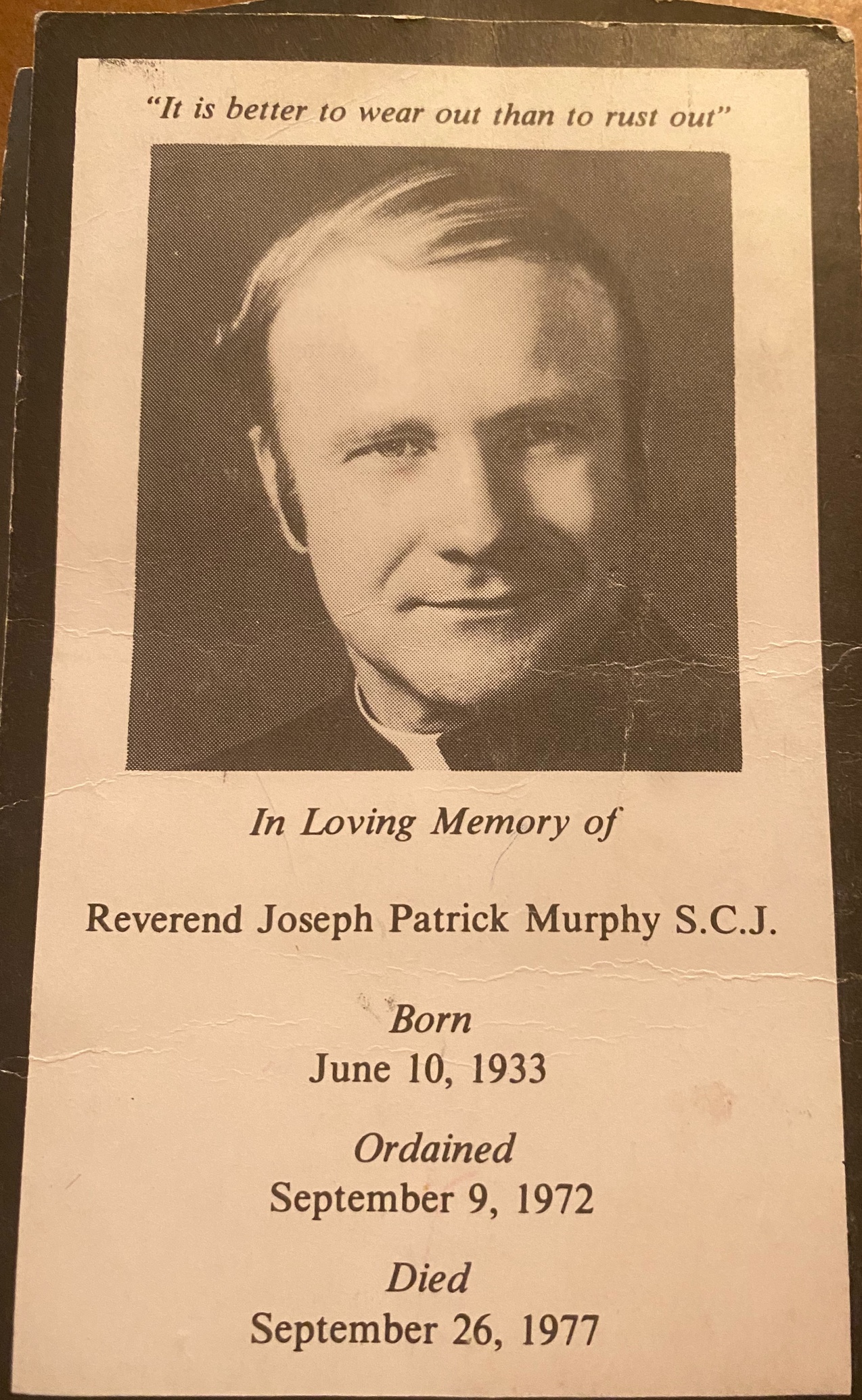
Somewhere along the way, Joe discovered The Sacred Heart Father’s, an order that accepted men with “late vocations.” He entered their seminary in Hales Corners, Wisconsin sometime in the late 1960’s. Ordinated in 1971, he redoubled his commitment to work with the less fortunate, those in need, those neglected by society. 

Sometime in the mid-70’s, Joe accepted a position as the Chaplin at the Indiana State Prison in Michigan City, Indiana. Established in 1860, Indiana State Prison is a maximum-security facility that houses in excess of 2200 men.

Like the damp chapel in Niagara Falls, the old musty prison was no place for a man with really bad asthma. But Joe could not be dissuaded from working there. He actually petitioned the State to live in the prison, but was turned down. Instead he lived at rectory in downtown Michigan City and spent most of every day in the prison working with the inmates. 

Joe’s commitment to those he worked with through the years went way beyond what would be considered the norm. He cared deeply about others, especially those whose whom most of society considers the “misfits” – – the poor, the neglected, the sickly, the mentally ill, the imprisoned. He had a profound belief that each person, no matter what their circumstances, is entitled to dignity and to be given the opportunity to better themselves. Joe worked tirelessly to provide the tools for improvement to each of the individuals with whom he worked.

Importantly to me, Joe was a wonderful big brother. As a girl, I remember riding on the handlebars of his bike and his gentle reminders to study more. As he grew older, he enjoyed classical music but absolutely loved show tunes. He brought my parents their first stereo. One of my fondest memories is of Joe sitting in a rocking chair in the living room rocking and listening to the likes of South Pacific, Oklahoma, My Fair Lady, etc., etc., etc. But his all time favorite was West Side Story, perhaps because it represented his life. When Joe listened to his music so did we. As a result, to this day, I love those old show songs and win every trivia question related to them.

Show tunes weren’t the only thing Joe introduced me to. I had just turned 18 when we visited my Uncle Johnny and Aunt Mary in Younkers, New York. One day Joe took Jackie and me on the train into Manhattan to see the sights. We ended the day at a bar in Greenwich Village. It was the 60’s and he took us down steep stairs into a basement, smoke-filled bar with some great live folk music. He then brought me my first legal drink – a whisky sour.

Shortly before Joe went into the hospital for the final time, Bob and I drove up to Michigan City to take him to dinner. I knew he had been getting worse and was worried about him and wanted to see him. We picked him up at the rectory and drove to Skip’s Steak House on the Red Arrow Highway, a favorite of his. He had what he always had, a rib-eye steak, backed potato, spinach and a dry Rob Roy on the rocks. Well, maybe two Rob Roys. He philosophized about life, about good versus evil and challenged our beliefs. He loved to do that. He was always trying to delve deeper into the meaning of life and the universe. But I could tell he was very, very sick. He struggled to breath all night. He went in the hospital a week later.

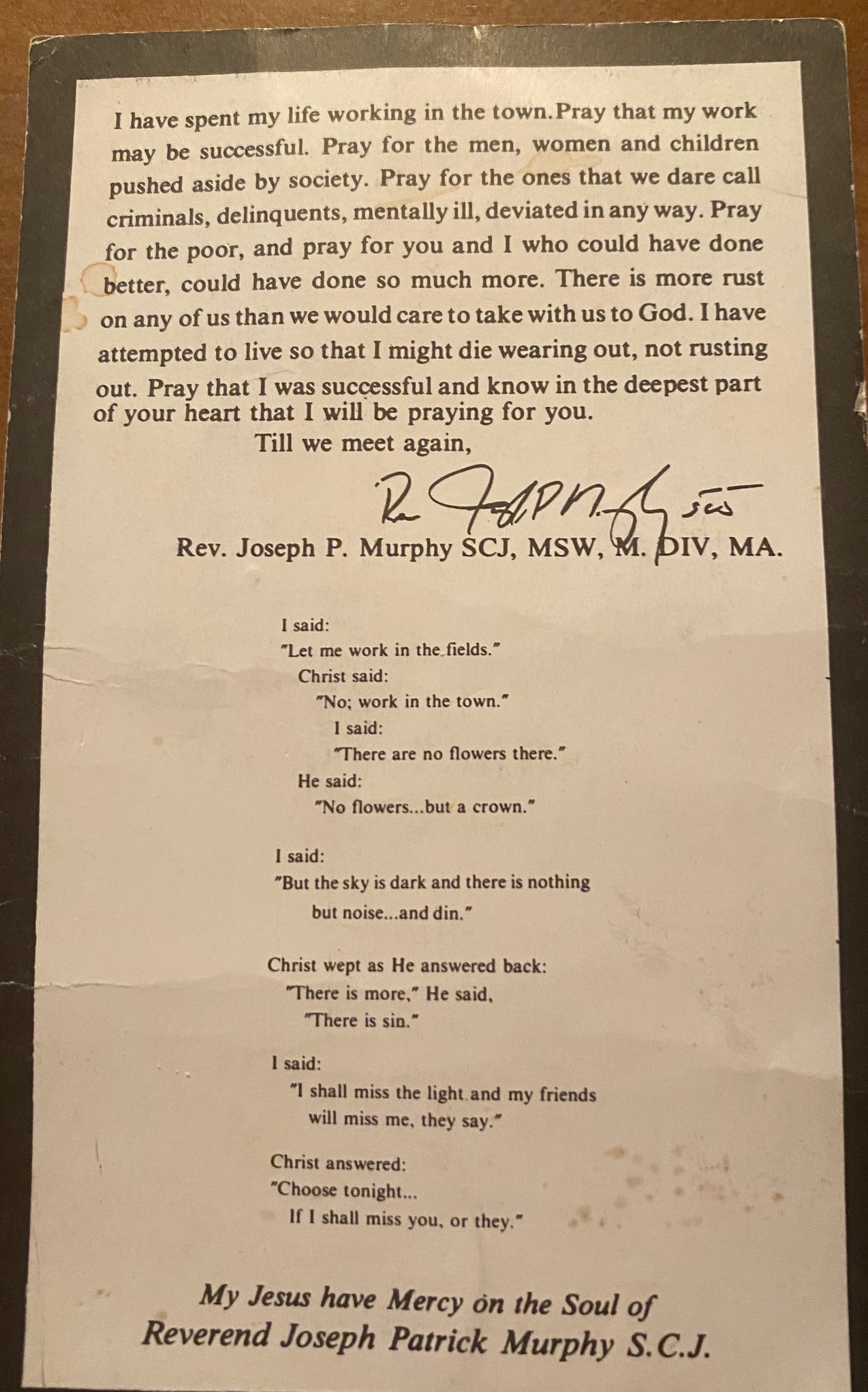
Joe suffered for almost four months before he died. By the time his end approached, we all knew it was inevitable – but it didn’t make it any easier. We all pretty much lived at the hospital most of the summer and were all with him as he took his final breath. Sometime the previous spring, Joe gave Arthur a letter to us that he wanted read after his death. As we stood over his body in tears, Art pulled out the letter and read:

“I have spent my life working in the town. Pray that my work may be successful. Pray for the men, women and children pushed aside by society. Pray for the ones that we dare call criminals, delinquents, mentally ill, deviated in any way. Pray for the poor, and pray for you and I who could have done better, could have done so much more. There is more rust on any of us than we would care to take with us to God. I have attempted to live so that I might die wearing out, not rusting out. Pray that I was successful and know in the deepest part of your heart that I will be praying for you. 
Till we meet again,
Signed, Rev. Joseph P. Murphy, SCJ, MSW, M.Div, MA

I said:
“let me work in the fields.”

Christ said:
“no, work in the town.”

I said:
“there are no flowers there.

He said:
No flowers . . but a crown.”

I said:
“But the sky is dark and there is nothing but noise and din.”

Christ wept as He answered back:
“there is more,” He said, “there is sin.”

I said:
“I shall miss mist ha light and my friends will miss me, they say.”

Christ answered:
“Choose tonight …
    If I shall miss you, or they.”

Joe had a profound effect on me and the way I live my life. I hope those of you reading this brief story of Joe will take the strong message of love, respect and acceptance he sends – – – and live it out in your life.

Eileen Donnersberger, January 29, 2019

jeffie, June 06, 2020

He was and is a beautiful person in every way.

Doris McArdle, June 07, 2020

Doris has thanked Eileen for this story. This story has also been seen by Justin, Dave, Bujee, Mark, Joe, Bart, jeffie, and Linda.

 THANK EILEEN FOR THIS STORY

Chime in with a comment or follow-up question.

 ATTACH A PHOTOADD COMMENT

Your comment will be emailed to Mary S, Justin S, Dave D, Doris M, Bujee, Mark, Michael, Joe, Bart F, Izzie, Bart, Maddie, Alex, Linda G, Nancy, Tom & Maureen W, Bill K, Kay, Barb E, and Eileen D.

FacebookInstagramAbout UsPodcastFAQPrivacyTerms Of ServiceAccessibility

Newsletter

Sign up to receive the latest news and promotions from the Storyworth team!EmailSUBMIT

2093 Philadelphia Pike #1080, Claymont, DE 19703 |

HELLO@STORYWORTH.COM | CONTACT US

© 2012-2023 StoryWorth, Inc.https://js.stripe.com/v3/m-outer-27c67c0d52761104439bb051c7856ab1.html#url=https%3A%2F%2Fwww.storyworth.com%2Fuser%2Feileen-donnersberger%2Fstory%2Fmy-big-brother-joe-part-2&title=My%20Big%20Brother%20Joe%2C%20part%202%20%E2%80%93%20Storyworth&referrer=https%3A%2F%2Fwww.storyworth.com%2Fuser%2Feileen-donnersberger&muid=3db92564-6184-4115-b5f3-e2007d571d7f567182&sid=71a63cbe-62f5-4905-a76a-3b506042da0a39ecf8&version=6&preview=false

More about my time at Ground Zero

It’s chilly, cold and dark by the riverbank. There’s a heavy mist in the air that has swept in from over the Atlantic Ocean, up the Hudson and is now covering us like a shroud. There are maybe fifty of us – – different ages, colors, and backgrounds. We’re a rag-tag looking group; all of us bundled against the rain and cold. The sun is just becoming visible over the horizon bringing with it hope that it would burn off the cold mist. 

It was three weeks ago that the two planes hit the World Trade Center’s (WTC), but it seems like a lifetime. We arrived early; we came to help, or at least try to ease people’s pain as best we could. 

Despite my grey woolen coat covered by a rain slicker, I am chilled to the bone. But I won’t move to a place of warmth. I’m glued to the ground by the riverbank. Behind me, about 20 yards away is an abandoned train station. When I arrived was asked to wait here to help honor those coming across the river on the boat.

Next to me a woman is sobbing. I look around at the others and there’s a big burly man facing the water that catches my eye. He is at least six feet five inches with more than a bit of a gut. Too many beers in his sixty-some years probably. He looks as if he’d be comfortable leaning against a bar back home with men who stop by for a “quick one” after a day of hard, back-breaking work. Written boldly across the back of his jacket are the words, “Semper Fidelis” – a Marine.

He is standing ramrod straight at attention, not moving a muscle in his immense frame. His hand is held high on his face in a perfect salute while silent tears roll slowly down his ruddy cheeks. He’s been standing like that since he arrived and they told him what to expect.

Down by the dock, between two oversized American flags a boat is visible in the distance. It is slowly coming into view as it makes its way across the river. How long can Mr. Marine hold his salute? That boat won’t be here for a while.

After a long, cold wait it finally arrives. A Salvation Army band disembarks first. As soon as the musicians hit dry land, they line up in formation, begin playing, and march slowly towards our little group. This unlikely honor guard begins to raise their voices with the music. … . “God Bless America, Land that I love / Stand beside her and guide her …”

Some of us cover our hearts with our hands; others follow the lead of Mr. Marine and salute as boxes are carried slowly past. The boxes are plain, wooden and rectangular, each covered with an American flag. Inside are the remains of many of the almost 3,000 men and women who fell into ashes with the collapse of the WTC towers.

I arrived in New York from Chicago the previous week. As the director of the Victim/Witness Assistance Program for the Cook County State’s Attorney’s Office, I had served on the board of the National Organization for Victim Assistance (NOVA) which was based in Washington DC. Feeling helpless and desperate to do something other than watch the carnage on TV, three weeks after 9/11 I called NOVA to ask if volunteers were needed at Ground Zero. Five days later I was in New York and found myself a part of the hasty assembled honor-guard.

My first job after arriving in New York was to assist in setting up a respite center for the workers who were digging through the debris trying to find bodies or at least personal items that could bring some solace to families. We set up a trailer right next to the Ground Zero and in it provided hot meals, hot coffee, quiet places to rest or sleep and take showers. Counselors also were available if the workers needed or wanted to talk.

The next day I was asked to go to New Jersey to help at the newly opened Family Assistance Center (FAC) at Liberty State Park across the river from the still smoldering WTCs. Because there was a tremendous need for services and most families had no idea how to access them, the FAC was, in my opinion, a brilliant idea. It brought together all the needed services in one place.
For example, it was soon recognized that families could not collect on life insurance because there were no bodies and therefore no death certificate. So, the first stop for families at the FAC was to obtain a death certificate. A system was set up to verify that an individual had died in the collapsing towers. Access to counseling, financial planning for the those left behind, and a place to remember their loved ones were all provided at the FAC. 

Memory boards were covered in heartbreaking narratives from husbands, wives, mothers, fathers and children. I watched as families wrote on the boards. One little boy, about 10 years old, took quite a while to write as his mother looked on. After they left I read his note to his dad: “Dear Dad, I am sorry I didn’t say good night to you the day before you never came home again. I really wasn’t mad at you, I was just tired. I promise always to love the Yankees.”

As the last box of ashes passes, we silently follow the procession inside. I am walking and lost in my own grief when suddenly I feel an arm slowly wrap around my shoulder. I look up and see the big, comforting frame of Mr. Marine next to me. We are moving forward but are no longer alone. Others are doing the same. everyone is reaching out to someone. It doesn’t matter what part of the country the other is from, no one cares about another’s race, religion or income level. All that matters in the aftermath of that horrific tragedy is that we are together.

Later that same evening, I put on my woolen coat and walked to Ground Zero. There’s a grey mist, almost like a shroud, hanging in the air. The streets are mostly deserted, eerily quiet and the nearby stores darken. Black, twisted, distorted metal randomly rises from the ground, which is covered deep in layers of dust. The smell is nauseating. As I walk, I imagine I see the lost souls . . I see the shadows of the lost walking and talking. I see them waiting impatiently for their morning latte in a little coffee shop and buying the New York Times at a newsstand on the corner. 

I continue to wander the streets trying to understand. It’s impossible – – especially after witnessing the utter grief of the families earlier today.

I spot a pub in the shadows of the fallen towers. It’s on an otherwise deserted street. It’s late and I can hear music and loud voices coming from it. As I get closer I can hear laugher. It’s wrong, I think. It’s not right that they’re having fun, living life when so many are gone. 

I’m drawn to the pub. I get closer and finally enter. Pockets of mostly young men and women looking tired from a day at work, are scattered throughout. Music is playing and there is laughter in the air. This is bizarre… It’s so close to the death of so many. But then, out of the corner of my eye, I catch a glimpse of a young couple as they embrace. Over by the bar I see a group of young men, lock arms and raise their glasses in a toast to one another – and to America.

Maybe I was wrong. Maybe this horrific act can bring us together. Before September 11 we were individuals going about our lives not aware of one another nor what our country means to us. Despite the tragedy, or maybe because of it, we seem to be more open to one another. More willing to help, to be kind, accepting, to appreciate. I think we will be different now. We will truly be one.

After Note
That was nineteen years ago and I’m still trying to process what happened that day and all that led up to it and all that’s happened since. In some ways, I’m more confused today than I was that cold, bleak day watching grief pass me by. I thought that we, as Americans, had come together to overcome our grief and disbelief. I believed that the love, generosity, and acceptance we shared after 9/11 would last. 

In 2001, people from every part of the United States came to help at the Family Assistance Center, at Ground Zero, or anywhere help was needed. Unspeakable tragedy seemed to have brought all Americans together. 

Nineteen years later, however, we are more fractured than we ever have been. 

Instead, of being fearful of the terrorists, many of us have become afraid of whoever/whatever is different … anyone who looks different, has a different religion, different beliefs. Is this to be the legacy of 9/11? Have the terrorists contributed to the divisiveness in our country? Was that – – is that – – their goal?

2020
The most important presidential election ever held is weeks away. Its results will determine the future of the United States. God help us elect a president who respects our democracy, our freedoms, our diversity and our respect for one another.

Eileen Donnersberger, May 16, 2019

My daughter asked, “What Was the Bravest Thing You Ever Did and What Was the Outcome?”

I don’t know if it was the bravest thing I ever did or if it was the most foolish, I’ll let you decide.  But before I get into it, you’ll need a little background information on how I happened to be in the situation.

It was 1980.  I was working, correct that, I was a full-time volunteer for Richard M. Daley’s campaign for State’s Attorney. I was his Scheduler, which is a fairly important role in a campaign. The Scheduler is responsible for working closely with the Campaign Manager and the candidate to determine the events she/he will attend each day.  In Rich’s campaign, because his father had been the longest serving Mayor of Chicago and immensely popular,  we received far more invitations than was possible for him to attend.  So, I had to decide which ones we’d accept and which ones we needed to send a surrogate to.  These decisions were nearly always made based on where we needed the votes.

I had gotten involved in the campaign through my brother.  In November of 1979, Patrick had already declared as a candidate for State’s Attorney when Rich Daley called him and asked if he’s stop by his house for a chat after Thanksgiving dinner.  In that meeting, Rich told my brother he was intending to run for State’s Attorney and asked him to drop out and throw his support to him.  Knowing that he couldn’t match Daley resources and name, he said he would but had one favor: would Rich hire his little sister.  You see, I had been one of Ted’s hardest workers.  I guess he knew I’d be disappointed.

At any rate, I found myself walking into the legendary 11thWard Regular Democratic office on 31stand Halsted the following Monday.  It was, as all Ward Offices tend to me – old and musty. Immediately upon entering was a good size waiting room with old folding chairs set up and where all those seeking favors would wait for a meeting with the ward committeeman.  Separating the chairs from the rest of the office was an old metal railing with a swinging gate.  The offices of the Alderman, Committeeman . . and Rich Daley (who was both the Committeeman and State Senator at the time) were well beyond the gate.

Rich asked me a few questions then told me he needed a Scheduler; did I want the job.  I did. He sent me to a wonderful woman, his secretary, Gloria to get set up.  In fact, Gloria was much more than his secretary, she was his rock.  Rich had a tendency to get upset fast, and Gloria knew just how to calm him.  But I digress.

I was put at a long folding table in a large meeting space located to the side of the offices.  There I was presented with a telephone and an overflowing file of requests for his appearance.  Some requests were in the form of a letter or formal invite, others were notes taken on yellow telephone message slips and still others were mostly illegible notes scratched out by Rich on index cards.  I would find out that he carried index cards with  him at all times and wrote all sorts of things on them: names and phone numbers of people he met, dates for meetings he’d been invited to, questions he wanted answered.  After a day on the campaign trial, most of the index cards would land on my desk for interruption and routing to the correct spot.

I would never have made it with through those first weeks if not for Gloria and her assistant, Laura.  I’ve long forgotten their last names but will never forget their kindness and help. They were from “the neighborhood” (Bridgeport in the 11thward) as was everyone who worked there was until I came along.  It wasn’t easy to be accepted if you were from outside the neighborhood.  Bridgeport people tended not to trust outsiders – – – i.e. those who didn’t have at least five generations in the neighborhood. Gloria and Laura[1]accepted me and therefore everyone else did too.  These friendships were invaluable to me in my work for the Daley’s.

Unfortunately, my stay with Gloria and Laura was brief.  The Daley Campaign for Cook County State’s Attorney officially opened its office downtown at 211[2]West Washington just after the new year. It was a rundown place on the 3rdor 4thfloor (I don’t remember which floor, but I do remember the rickety elevator that took us up there).  Bill Daley’s (the campaign manager) office was on one side in the front facing Washington Blvd. and Rich’s office was on the other side.  They had the only offices with windows.  The place was long and narrow with make-shift offices lining the way to the back.  Mine was one of these.

The next few months are a blur of activity.  Daley was in a hard-fought primary election against Ed Burke.  Burke was a sitting alderman who, at that time, had most of the Democratic committeemen behind him.  It was a dirty campaign.

After nearly three months of activity, I found myself sitting in the campaign office on election day with nothing to do.  The phones had stopped ringing and requests no longer came in.  Everything now depended upon the results of the election. If we won, we would go on to the general election against Bernie Carey.

There were only a few of us sitting around when Bill Daley mentioned they needed a poll watcher in a tough precinct on the west side.  At that time, the west side of Chicago was composed mainly of really poor African Americans living in dilapidated buildings and public housing.  Much of the west side had been burned down in the riots after Dr. Martin Luther King’s assassination twelve years earlier and it was still struggling to rebuild.  It was pot-marked with scores of empty lots where stores and houses once stood until burned down in the ’68 riots.

I volunteered to go.  I didn’t want to just sit in the office all day.  I wanted to be doing something.  After warning me that it wouldn’t be easy, Bill Daley had me driven and dropped off at public housing high-rise somewhere on west Madison.

My job, as a poll watcher for Daley, was to watch the voting process to make sure no votes were being stolen and that the election was being conducted in an open and fair manner.  I couldn’t interfere or stop the voting process, but I had every right to watch every detail of what was happening, ask for the names of voters and write them down.

The precinct I was in consisted of the entire Public Housing high rise building which was mainly for senior citizens. Not bad, I thought.  Safe.

The seniors were being brought down from their apartments in groups of five or six by the local precinct captains.  That was okay.  Most of them needed help walking anyway.  But then I noticed a pattern.  Nearly all were accompanied into the voting booth by a precinct captain.

A voter can have someone in the booth with them but only if: 1) they physically need help, 2) special paperwork has been completed with the reason for the needed assistance and 3) the name and relationship of the person helping is recorded. None of that was being done.

So, as was my right as a poll watcher, I objected every time it happened – –  which was almost always  – – and would write down the name of the voter and the person in the booth with them.  I couldn’t stop the process, but I could record it and verbally state my objection to the vote.

After several of my objections, one of the poll-workers gave me a hard-sinister stare and slowly rose from her chair at the table.    “This doesn’t look good,” I thought.  She was a Black woman about my age, only much taller with broad shoulders. She had the look of someone who had been in more than a few street fights in her life.  Despite the many “wrestling” matches I had with my brothers growing up, I was certain she could wipe the floor with me if she choose to do so.

I can still see her in my mind’s eye as she rose up from her seat  – – – still giving me what I considered an “evil eye” – – – and walked slowly towards me. She stopped a few short inches from my face.   Her malicious looking brown eyes glared into mine like she was trying to penetrate my brain. After what seemed like an eternity, she hissed, “Do you want two broken legs?” Long pause. “Do you want to end up in the River?”  I took it as rhetorical questions and thought it prudent to stay silent.  I tried to appear calm, cool and collected.

If she intended to scare me, she did.  I remember thinking that it was a good thing I had on jeans, so she couldn’t see my legs shaking.  I stood bolted to the spot for a few minutes until I knew I could walk without falling over. The first thing I did was to go the phone booths just outside that room and call my nanny, Ann Grogan.  Keep the kids in the house, I told her.  Watch them and keep them close.  Then I called the campaign office.  Send out the US attorneys asap, I said.

When the US attorneys arrived, I shared my notes on what I considered to be illegal voting.  They checked the records and strongly warned the workers that the rules had to be followed and that they would be back to make sure.  They also took copies of my notes as evidence in case they decided to prosecute.

Shortly after they left, I went back to the phones to report back to the campaign office.  While I was on the phone with the office, a tall, muscular older white man came in and picked up the phone next to me.  I didn’t know who he was at the time, but later found out he was Ed Quigley, the powerful ward committeeman on the west side.  After interviewing Quigley in the 60’s, Mike Royko described him as . .

 “wearing a silk suit, a silk shirt, a silk tie, a diamond pinky ring, diamond cuff links,

and a jewel studded wristwatch.”[3] 

 That pretty much summed up the man who was next to me at the phones.

I overheard him forcefully telling someone on the other end of the line “to get this young broad out of his ward” no matter what they had to do.  “Put her in the river if you have to,” he yelled. Apparently, he didn’t know the “young broad” was standing right next to him – – shaking like a leaf.

I nervously relayed his conversation to Bill Daley on the other end of the line. He wanted to send a replacement and bring me back to the office.  No, I said, I started this and I will finish it.  Besides, they know that I know what I am doing. They may be even more afraid of me than I was of them – which was substantial.

He immediately sent out the biggest, tallest, strongest looking man he could find to sit with me for the remainder of the day.  That man happened to be the husband of Rich’s secretary in Springfield. I don’t recall his name anymore, but he was a farmer downstate and despite his appearance he was one of the gentlest men I ever met.

As for the voting, once the US attorneys were called in and the ward people realized that I was staying, the voting nearly stopped.  My guess is that they figured there was no use bringing the seniors down to vote if they couldn’t control what they did in the voting booth. So, my farmer friend and I spent the rest of the day talking about our kids.

After the polls closed and the votes counted (that precinct had the lowest turnout ever and we won it for Daley!) Bill sent an off-duty police officer to pick us up. He drove his car right up on the sidewalk and as close to the door as he could.  As I exited the door, he grabbed me and hustled me into the car.  Then pulled away at a high rate of speed.  I remember thinking that the campaign must have taken Quigley’s threat even more seriously than I did.

Back at the office, one of the attorney volunteers, Marv Brunstien, who had been in contact with the US Attorney’s office for me, made a medal out of tinfoil which he presented to me for good work, stopping voter fraud, and for surviving the day.  I saved that piece of tinfoil for years but no longer know what happened to it.

So you judge.  Was I brave or foolish?  My guess is a little of both.

Looking back, I was young and idealistic.  I desperately wanted a fair and just world where everyone was treated equal.  In college I had fought for civil rights and for everyone to be given a fair shot at success.  In this instance, the attempt to steal votes insulted my sense of justice and fairness and I was willing to fight against it.  It was only a small thing in a much larger picture, but I am happy I did it.

[1]Sadly, Gloria died of breast cancer not long after my meeting her; I still feel badly that I was never able to express to her my gratitude for her kindness and help.  I later discovered that Laura’s father and my grandfather had been good friends.

[2]This address is approximate.  The building, now gone, was across the street from what was then Illinois Bell headquarters at 212 West Washington.

[3]From his obit published in the Chicago Tribune, October 1988

Memories of 9/11/2001

September 2015
To my grandchildren:

As the 15th anniversary of the World Trade Center atrocity approaches, I thought I would share with you the small part I played in our nation’s response to it. At the same time I hope you will learn more about the people directly affected by this despicable act of cowardliness and some of my reaction to it. But before I begin, let me explain how I got happened to get there – – –

I was the founding director of the Victim/Witness Assistance Program at the Cook County State’s Attorney Office under Richard M. Daley in the 1980’s. During that time, I become active in the National Organization for Victim Assistance and eventually served on its Board of Directors.

By 2001, I was no longer with the SAO and had resigned from NOVA’s Board. But after the plane hit the towers on September 11 and watching the devastation it caused, I called NOVA asking if they were involved in the WTC response and if they needed volunteers. They were involved and they were happy to have more volunteers.. That’s how I ended up on a plane to New York in October of 2001. I was happy to be able to volunteer and help with the response to the events of September 11, 2001.

My role was small, but I had the honor of watching and working with the first responders: the firemen and police working on ground zero and the construction workers trying so valiantly to pull bodies from the rubble. And I had the gut-wrenching experience of helping the families and loved ones of those who died. It was an privilege to be a part – although a very small part – of our country’s response to what happened.

Crisis Intervention Counseling
One of the roles I was assigned was to coordinate the response of the NOVA crisis workers who were coming in from all over the country. I didn’t do the counseling. My role, among other things, was to create the relationships with other agencies and service groups so that our volunteer counselors could provide the needed help.

To be eligible to be a crisis worker and counsel victims, the crisis workers had to have gone through a vigorous training program and been certified in crisis intervention by NOVA. Their professions were varied – they included school principals and teachers, police personnel, counselors, social workers, psychologists, and victim advocates.

These crisis workers were an important part of the work of the the NOVA 9/11 response effort in Manhattan. One important part of my job was to reach out to and provide service to groups requesting Group Crisis Intervention sessions (GCI).

Many of the calls we received were from businesses that were either located in or near the WTC and thus had employees who witnessed first-hand the horror of that day. Other calls come from residents of condo or apartment buildings near the WTC who were beginning to realize they needed help and requested CGI sessions.

I did, however, sometimes screen those who come to us. One of those was a 30-something man who called one day and told me he was attending a meeting in the federal building across the street from the WTC on the morning of 9/11. He said he was gazing dreamily out the window and in his words:

“ . . . . my boss was talking on and on in a monotone voice and I was gazing out the window. . . and suddenly a plane came out of nowhere and I saw it hit one of the towers and it completely disappeared into it. . . . I couldn’t believe it . . . I couldn’t understand it . . . and on top of it my boss kept talking and I couldn’t think. I could hear his voice but I kept looking at the hole in the WTC and the smoke and the bodies flying. Then finally someone yelled to get out so we all got up and started to run and we ran all the way down the stairs to the street. When we got down it was chaos. I ran all the way to the river.”

Another day in the office I received a call from a woman looking for counseling for an entire family whose father was killed in the WTC. He had been a chef in the Windows of the World (which was the restaurant on the top floor of one of the buildings) and left five children behind when he died, ages 4, 7, 10, 16, and 17. The mother of the oldest two children had died years ago and he had remarried. It was his second wife on the line. The first two children had now lost both biological parents. To add to the dreadfulness of the situation, the seventeen year old attended a school near the WTC and was running for his life when he turned to see his father’s building collapse.

Another of my roles was to establish contacts with and offer assistance to businesses and individuals who were not in the WTC but who were directly affected nonetheless. For example, there was a nationally known trading firm whose corporate offices were several blocks away. They, of course were evacuated immediately and many of them witnessed the horror of people jumping. One their top executives now wears gym shoes everywhere in case he has to run away as he did that day.

Ground Zero
Another of my roles was to try to establish a connection with and services for those working at ground zero. I was fortunate that, through contacts made with the fire department, I was able to secure a trailer right next to ground zero. That meant some of our counselors could be in close proximity to the construction workers who worked around the clock pulling remains out of the rubble.

It’s not always easy getting construction workers to talk to a counselor – – -so one of their the superiors suggested I walk around on site and talk with them as they worked so they could get to know me and feel comfortable and maybe I could get some ideas from them. It was a good idea but that meant going onto ground zero. Words cannot describe how I felt. It was hallowed ground. No one was allowed onto ground zero without special clearance. I was awed to be allowed on to that scared place.

It was difficult for me to be there… I think it was difficult for everyone who was there. Despite the heavy equipment and hundreds of workers, it was an eerily quiet, solemn place. There was a reverence about it and all who walked on its ground. There was no fooling around, no loud talking, no swearing, none of the usual noises or raised voices you’d hear at a construction site.

As I walked around I tried to imagine the towers as they were, the thousands of people, the lives lost and it was just overwhelming. Good lord, I just wanted to cry. The sights and smell, especially the smell, will stay with me until the day I die.

To go on ground zero I had to purchase a pair of construction boots. I wore them as I walked on that ground and then put them away. Never wore them again. The dirt from that awful site is still in them today. I want them next to my casket when I die to remind everyone of those who died and those who loved them. And to remind everyone of how we all felt after it happened.

I did talk to some men and women working the site and took their advice. To help get the workers through our doors, they suggested making it appealing by putting in TVs, cots, food, coffee and phones in the trailer for their use. Once the workers were in, the counselors had a better chance of approaching them and helping them talk about the things they saw in their work on ground zero looking for bodies.

The Family Assistance Center
In addition to conducting the GCIs, NOVA also played an important role at the “Family Assistance Center” set up by the state of New Jersey at Liberty State Park. This facility served families and survivors from New Jersey and Pennsylvania and was located directly across the river from ground zero. Another Family Assistance Center for New York families was located in Upper Manhattan.

Liberty State Park was actually an abandoned train station that the state quickly converted into what became a wonderfully organized space designed to provide — in one place — all the services needed by the families of those killed. New Jersey did a remarkable job of making this place into a warm and inviting place for those who hurt so badly. Practically overnight the main building was reconstructed to include:
• an interdenominational chapel,
• a room with numerous computers and telephones that allowed victims to contact loved ones anywhere in the world,
• a dining room with round the clock hot meals,
• counseling,
• quiet rooms for sleeping,
• child care, and
• memory boards all around the premises.

Outside of the main building were trailers that housed agencies that assisted families with all the paperwork they need to get through that terrible time. For example — as terrible as it was for them – the mandatory first step for survivors was to get a death certificate. Without a death certificate a family could not even collect on a life insurance policy they might have much less be eligible for other services. So the first trailer they were directed to was the FEMA trailer. FEMA provided all the necessary paperwork to get a death certificate.

Once they got the death certificate they could begin the process of applying for other benefits such as help with mortgage payments, long-term counseling, emergency food, job placement assistance (for those that now need to work),etc.

Liberty State Park Family Assistance Center also served as one of the locations from which the families of the deceased could leave to visit the World Trade Center site to pay their respects. Visiting ground zero was very important for many families. It was where their loved one died and being there, seeing it up close, first hand, even as horrible as it was, seemed to help get them some small measure of relief.

Only immediate family members were allowed to register for this special visit but they could make requests to include individuals they deem special to the deceased. For example, a roommate of a victim could have been included at the request of the family.

When a family arrived to visit ground zero, they were assigned a special liaison (who also was a trained crisis worker) to accompany them and ensure the day went as smoothly as possible. They were invited for coffee and and then attended a group session in the chapel where a coordinator explained the logistics for the visit and tried to prepare them for what they would see at ground zero. They were provided with hard hats, goggles and masks. The hard hat were mandatory; the other items are used as needed.

Most families brought some sort of memento to leave such as bouquets of flowers, notes, letters or photos. I’ve seen wives and husbands bring copes of their marriage certificates and leave them behind.

Buses took the families to the ferry for the trip to the WTC site. State police and volunteers surrounded them as they entered the site to shield them from the photographers and maintain their privacy. A platform was set up from which the families could view the wreckage and say their prayers and farewells. A section was designated for them to leave their mementos

My first day at Liberty State Park Family Assistance Center was a Saturday and one which will be imprinted in my mind forever. Apparently the some remains of the victims had been collected, cremated and were now being delivered to the Family Assistance Center for distribution to the families the next day. Those of us present were asked to join the Salvation Army in forming an honor guard as the remains were brought in.

It was a cool and windy early morning autumn day and there weren’t many of us on site yet, maybe ten or twenty of us. We spontaneously formed two lines. As I looked around, we were all colors, all ages, both sexes all united in our grief and all struggling to grasp the enormity of the situation. A cold wind was blowing, a flag was waving wildly in the strong wind, and we were singing “God Bless America” as the ashes of nearly 5,000 men and women were being carried past us in several flag draped boxes. Police and fire personnel escorted them with Irish bagpipes leading the way.

As I held my hand over my heart and sang songs I’d probably sung hundreds of times, the words “God bless America” and “does the flag still wave or the land of the free and the home of the brave . . “ took on a new, deeper meaning. I remember looking at the others across from me, tears running down their faces then I realized mine was tear stained too. There may have been ashes in those boxes but what was in our minds, mine at least,were the families of those victims. The faces of the children, the wives and husbands, the mothers and fathers, the sisters and brothers, the best friends, all those gone and all those left behind. I felt the grief, the tears . . . . the unfathomable emptiness.

As we small band of Americans stood together saluting these ordinary people who lost their lives so horrifically, so suddenly and without warning for reasons that didn’t make any sense, I believe we came to understand, in a very profound way, that understanding, acceptance, helping, caring for and loving one another should be our way of life – should take up all our energies. What may have seemed a naïve way to live before 9/11 will – – if we have learned anything – – should be our way of life now.

I spent a lot of time that afternoon looking at the memory boards. They were filled with notes, photos and the deepest, feelings and anguish of hundreds of people. I watched as other family members came in and wrote their own notes, stapled photos, and letters to the boards and came to realize that this was really very important to them. I guess it provided them a forum to share the life of their lost loved one and ensure that others know about the real lives he or she led and how much they were loved. Once I realized the importance of these writings to the families, it became almost a mission to read as many as possible. Two stick out: one from a ten year old girl who wrote a neatly scripted letter on sheet of notebook paper. In it she apologized to her father for not saying goodnight and giving him a kiss on September 10th. She promised to always love the Yankees and take care of her little brother. Her dad worked for Cantor Fitzgerald.

The other were long notes I saw being written by a middle aged woman. The woman spent a lot of time writing and crying: then went to get a stapler and attached photos of an attractive young-looking white haired woman. The note from what turned out to be her devastated sister read, in part ”I call your cell everyday to hear your voice . I send you emails I know you’ll never read and I’ll never get a response. I just want you to know how I feel so I write to you . . . I know you’ll be with us in spirit at Amanda’s state concert and Joel’s graduation in June.”

My last night in New York I walked down to the site of the WTC one last time. Television couldn’t begin to pick up the devastation – – how broken and nasty the twisted metal was nor the sickening was smell in the air. Emotionally it was impossible to grasp how so many lives – – – that were now gone – – – once lived walked on these same streets around the site.

As I walked, I came across an Irish pub an only block away from the ground zero. All of the streets near the site were barricaded, but for some reason that particular street had a small, narrow passage-way leading to the pub so that it could stay open. It was the only sign of life for blocks. As I walked towards it, I could hear music and the raised voices of those inside.

As I got closer listening to the noises of gaiety coming from the pub, I envisioned many of the young people who died on 9/11 filling this same street on evenings after work happy and talking on their way to this very bar. And after all I had seen and experienced during the previous weeks, it was strange to enter the pub and suddenly see so many people laughing and talking and enjoying life. At first it didn’t seem right. It didn’t seem appropriate. It seemed so wrong to be happy in the very shadow of so much death.

But as I stood there for awhile watching, I realized that it was right and it was appropriate to have fun and celebrate with one another.

So dear grandchildren, my advise to you from my experiences after 9/11:

Life is indeed precious and you must value it everyday, every minute. Love and value each other and all those you love. And don’t stop with just those you love. Treat everyone you meet with kindness and respect.

And. – – – Remember to share with one another – –
• Share laughter,
• Share fun,
• Share good times,
• Help in bad times ,
• Wipe each other tears,
Always, always be there for one another,
• Love one another.

.

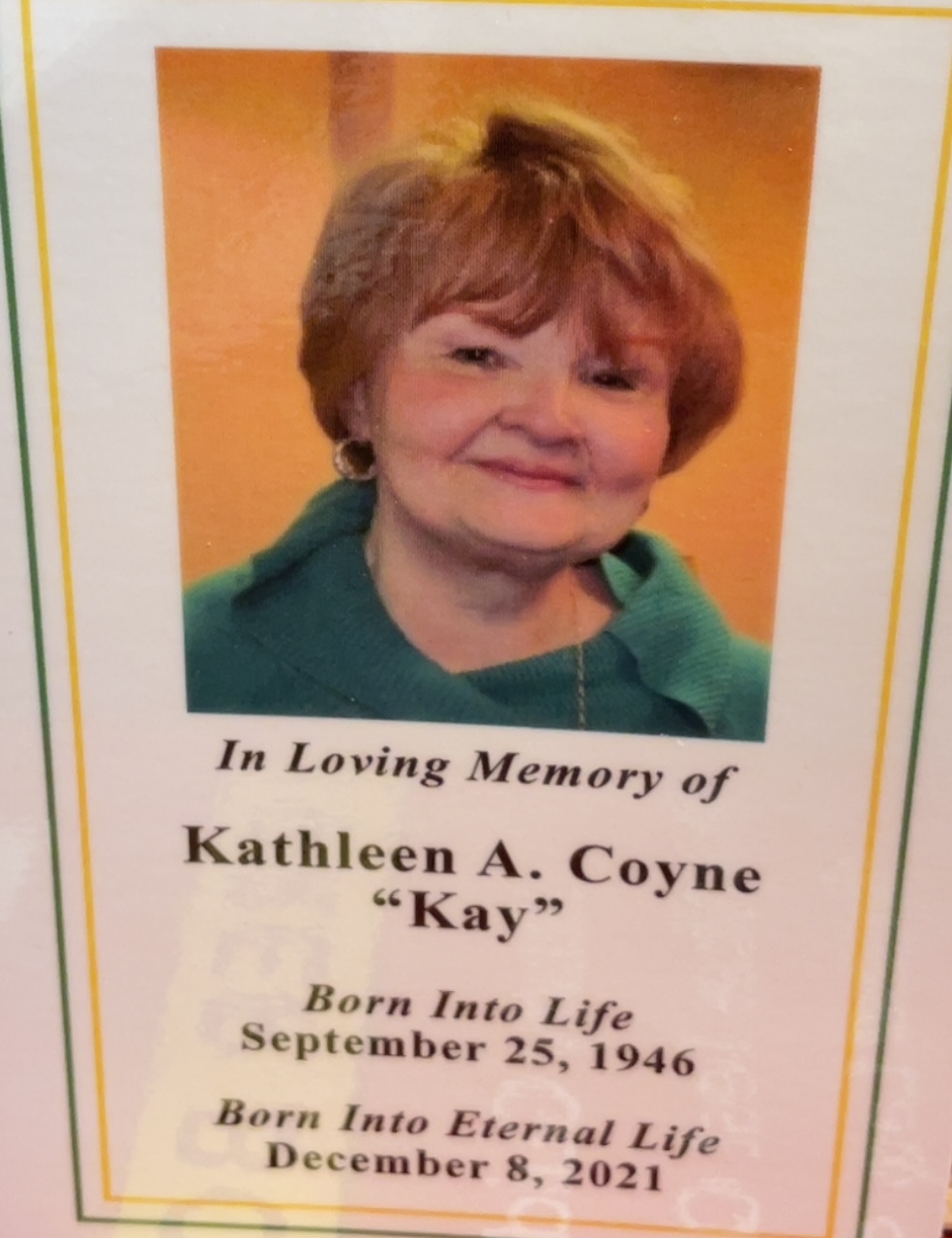
My Best Friend Died Today, December 2021

My best friend died this week. There are no words.

My friend’s death was horrific.  She and her brother were walking across a parking lot when they were hit by a speeding, out of control car. Tom died immediately; Kay was alive when she arrived at Christ Hospital’s Trauma Center.  According to the ER doc, she opened her eyes and uttered the words, “Help me. Please help me.” Her last words.  She died on the operating table of massive internal bleeding.

There are no words.  How does one comprehend your friend of more than 60 years innocently waking to the DMV to have her drivers license renewed and then having her body smashed into by a 1.5 ton mass of steel and iron.

I try not to envision her body laying on the cracked and dirty pavement of that parking lot.  I try not to envision it but it somehow it keeps wanting to play in my head anyway.  Was she conscious?  Did she know what hit her?  Was she in pain?  

Please God, she was not aware and did not feel the pain.

I have known and been best friends with Kay since sophomore year in High School.  Kay and I met and bonded over a speech I gave in Religion class, “A Meditation on the Crucifix” (you have to remember, this was 1962).  I couldn’t tell you why she liked that particular speech, but she stopped me after class to talk and we kept talking for the next 62 years.

Our teenage years were spent with our good friends, Betty, Pat “Duke,” Peggy, and another Pat or PR.  We called ourselves the “Unsinkables” and spent most Saturday nights going to sox-hops at one of the local high schools and ending up at a Pancake House in Evergreen Park drinking coffee, eating cinnamon roles and laughing so loud the manager would ask us to keep it down.  

In college we rode the el together to Loyola University which we attended as commuter students.  We’d study together, complain about our classes.  We’d join Sue, Carol Ann, Mary, Kathy, the 2 Bob’s, Lee, Jon and others at the Red Garter on Saturday nights where we would sing along with a banjo band and drink beer.  We both got jobs as waitresses to pay tuition, Kay at the Merchandise Mart and me at Stouffer’s.  

I married and joined VISTA and she went to work, eventually getting a Masters Degree from Jane Addams School of Social Work.  She dedicated her life to helping others.  I had three children, went through a divorce and remarried.  Kay was my steady rock through it all. 

The last many years we would meet at Fox’s Pizzeria on Western Avenue 3 or 4 times a month.  I felt guilty because it was close to my home but a drive for her, but Kay never minded.  We’d get there around six and often leave close to 10.  What did we talk about?  Everything.  Everything that is except politics.  She was conservative I am an unabashed liberal.  We loved and respected one another enough to leave politics off the table, especially these past five years.  But nothing else was prohibited.  She believed in Psychics, I didn’t.  Until she changed my mind.  I loved to travel and Kay would patiently listen to all my stories.  She took a handwriting analysis class so at least once a month I’d have her read my writing.  We’d share our hopes, our fears, our happinesses and sorrows.  We’d complain about perceived hurts and comfort one another when needed.

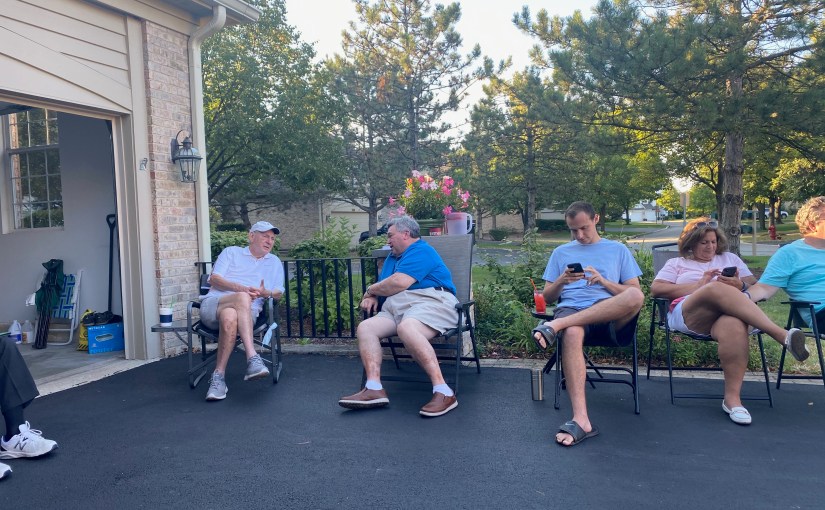
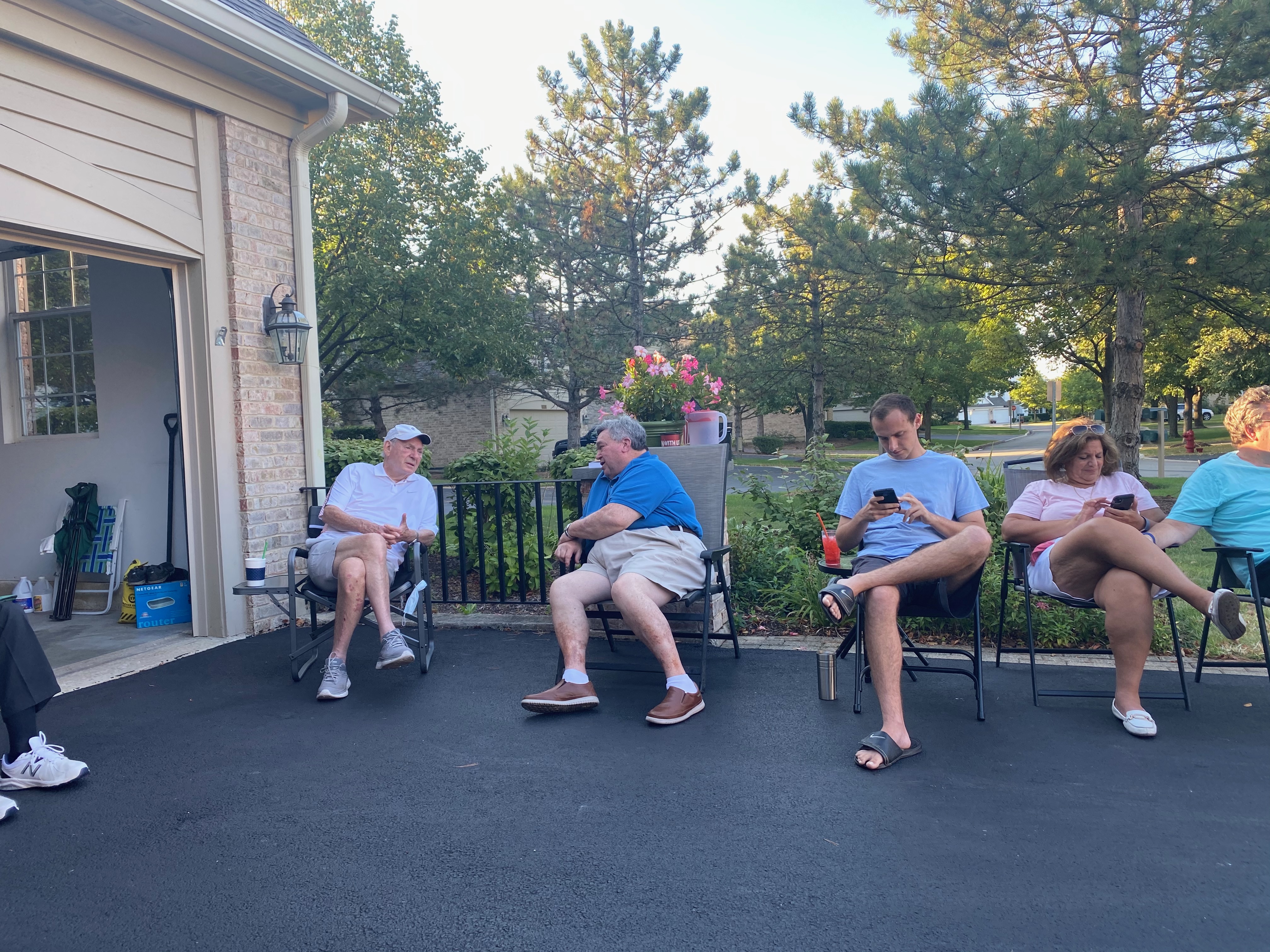
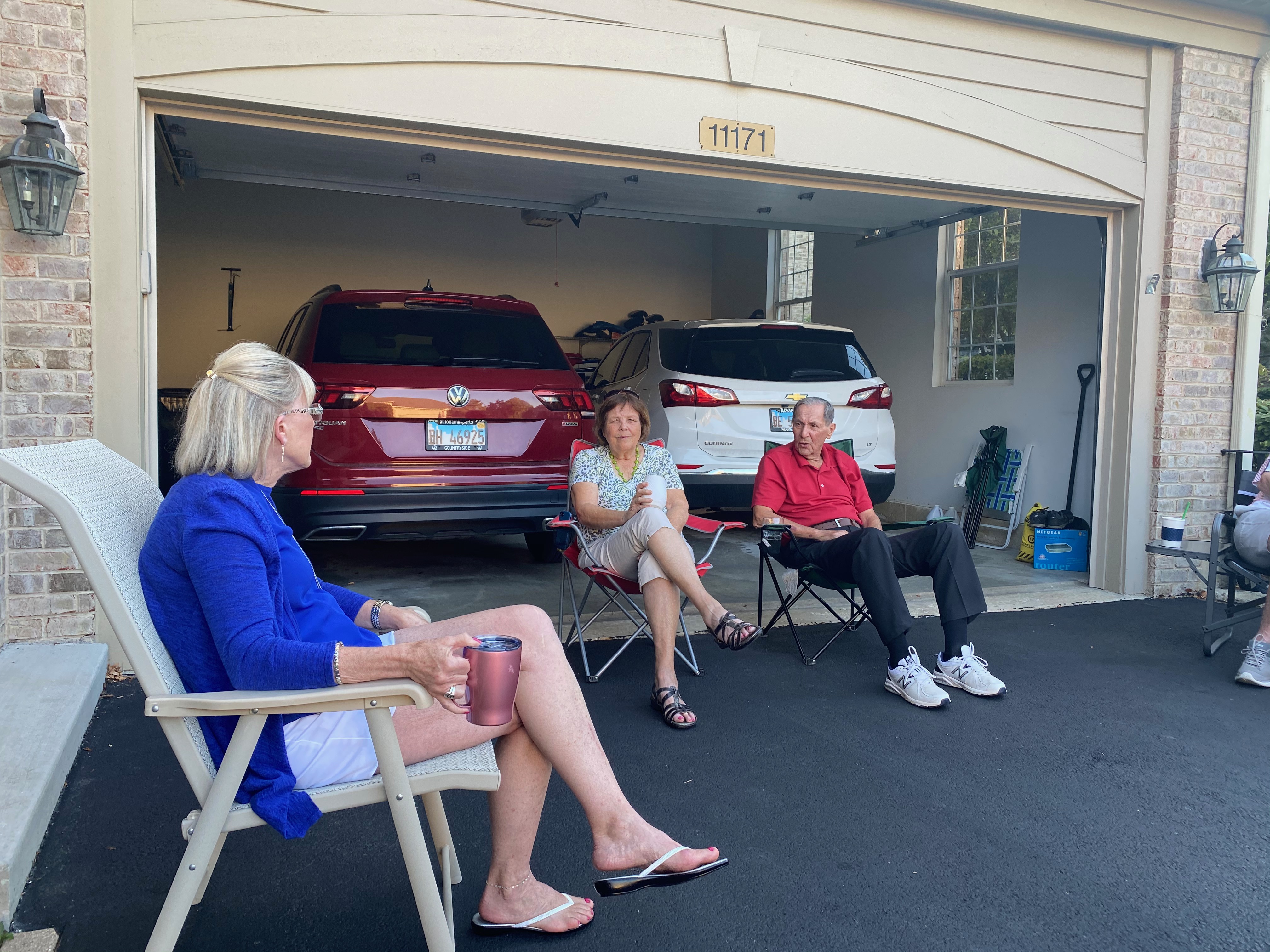
In short, we loved and respected each other.  I now understand how much I needed Kay – – – I like to believe she needed me too.  We kept one another going through all of life’s ups and downs.  She was there for me when my mother died, when my father died and when I lost two of my brothers.  Kay lost her father early but her mother lived to be over 100.  I hope I was as much support for her as she was for me.  Even during Covid, we would visit at our “driveway parties’ always six feet apart and wearing masks.

The circumstances of Kay’s death was shocking – so it was widely reported in the news.  Nearly all the news-reports described Kay and her brother as “elderly.”  “Two elderly siblings were hit by a car Wednesday afternoon and killed.”  

I’ve always taken offense at the use of elderly to describe those of a certain age.  To most, the term “elderly” implies a person is decrepit or has some kind of impairment.  Kay was neither.   She was a vibrant, inquisitive active woman enjoying her life, her family and her multitude of friends.  She could tell you the history of just about any country and summarize books she read years ago.  

Kay was not expendable.  Kay was loved and valued.  

Kay Coyne was my very best friend.  Her passing will leave a gapping whole in my heart and a void in my life that cannot be filled.  It’s only been a few days but I already worry  . . .  What will I do when I want to call Kay to meet for one of our long talks?  I don’t want to think about that; its too painful.  I want Kay here to help me through this pain.  But I know that won’t happen.

Then I remember something I heard long ago.  Maybe Kay said it, I don’t know.  “True friends are always together in spirit.”  

I don’t want you only in spirit, Kay.  I want you here sitting across from me at Fox’s. You with a gin and tonic, tall – me with my Miller Lite. – – together helping each other through life.

Covid 19 Continues

Wednesday, April 1, 2020

Well, I’m still here;-)

Still feeling a little punk, but no temp, no cough.  May it stay that way.

Slowly cleaning and decluttering.  Yesterday I did two kitchen drawers and an upstairs closet. No need to hurry as we will be on lockdown for at least another month.  Now the end date is April 30th, but of course it may be extended.

Saturday, April 4, 2020

Today I’d like to provide you with a flavor of what is life is like during the Coronavirus (Covid-19) pandemic:

+     Stay at home order in effect for 90% of the country

+      Social distancing in effect
 staying at least seven feet away from one another when out of the house

+     Face masks recommended when out of the house 
        > Face masks difficult to get
         > I’ve ordered supplies to start making my own which I will distribute to family and friends

+     Non-essential stores and businesses closed
         > Happily liquor stores are considered “essential”

+    Working from home is the norm
         > Mark, Ev, Bart, Justin and Bujee are all working remotely. Thank God as that means they are still getting paid.

+  Unemployment at record high 

+    Entire Sports seasons cancelled

+      Concerts, tours, and entertainment events cancelled

+     Weddings, family celebrations, holiday gatherings and funerals cancelled or postponed
         > Joe likely will not have an in-person graduation ceremony
         > Mark, Justin and Bujee already had birthday celebrations that had to be cancelled. 
         > Chloe’s 1st birthday celebration is very likely to be postponed. 
         > We are hoping to be out and able to celebrate Michael and Joe’s birthdays.
         > No Easter dinner with family

+     All schools closed and most offering remote learning
         > Lyons Township has online classes for Joe and Michael
         > Regis has online classes for Bart
         > Cherry Creek has online classes for Maddie, Izzie and Alex
         > Mae and David being homeschooled by David and Claire

+  No masses, churches closed

+ No gatherings of 10 or more

+   Parks, trails and entire cities shut down

+     Stores limiting number of people in at one time
         > Therefore long lines form outside 
         > Tape on the floor of grocery stores to help distance from one another

+   Panic buying has resulted in bare shelves
         > Especially for sanitizers, TP, even some popular cereals and mac and cheese

+     Shortage of masks gowns, gloves for our front-line workers such as doctors, nurses, and emergency responders. i.e. firemen, police, etc.
         > This shortage puts them at a very high risk of contracting CoVid19

+  Shortage of ventilators for the critically ill

+  Medical workers afraid to go home to their families
         > Governor and Mayor has selected hotels open for front line workers to stay between shifts

+   Roads are empty

+   Gas stations empty

+      Manufactures retrofitting factories to produce much needs items, such as:
         > Hand sanitizers, face masks, personal protective equipment and, especially, ventilators

+   New terms not previously well known have become part of our everyday language
         > Social distancing
         > PPE – personal protective equipment

+     Daily press conferences from:
         > Governor Pritzker – who is doing an excellent job of obtaining and managing scarce resources and keeping the public informed
         >Mayor Lightfoot – who is demonstrating strong leadership
         > Trump – who demonstrates daily how totality self-centered, ignorant and inept he – and those who work for him – are

One day, God willing, this  all will be behind us.  But how it will change our lives is yet to be seen.  

My hope is that once this is over, we look back on it and realize what we missed during our isolation. 

^  I hope we put an even greater value on the connections we share with others. .  . to our family, to our friends and to our neighbors.   
^ I hope we learn how precious these connections are to us. 
^  I hope we never again lose sight of the love and commitment we have for our families; the deep friendships we share with those we know best and the interconnectedness we have with our neighbors and others around us.

And I pray for a new president. One who will bring civility, intelligence, acceptance, and, yes, love, back to our country.  A president of ALL the people.  One who will lead us in the belief that although we may come from many different backgrounds and have differences of opinion, we are one.

And that hatred and prejudice has no place in the United States of America.

Getting our exercise while practicing “social distancing” @ the Mortan Arboretum.

Covid-19 Hits

My Summer (actually My Six Months) of Staying Put

Retired and living in the Chicago area, we are fortunate to be able to spend some weeks away from the cold and snow each year.  This year we choose the paradise  island of  Hawaii. We met friends, dined out, sat on the beach reading, played in the ocean, floated in the pool, marveled at the tropical flowers and absorbed the magical, serene island atmosphere. 

On February 29th we headed home with the expectation of meeting up again with family and friends. But that was short-lived. By March 11th we were quarantined.  

Our home became our everything.  We rarely ventured out.  We spent the next months reading, watching Prime & Netflix – watching way too much Prime and Netflix –  cleaning drawers and closets and ordering groceries online.  We only glimpsed our children and grandchildren as they left needed supplies on our porch.  Neighbors were as isolated as we. My husband always did his reading in the family room. One day I found him in the living room – – he told me he decided to go on vacation.

Finally the weather began to warm, and neighbors ventured out.  The streets outside our home became congested not with cars, but with people.  People walking, riding bikes, inline skating.  Neighbors who had never spoken waved as they passed one another.  Slowly many stopped to talk – six feet apart and with masks – and became friends.  Nervously, I began to ride my bike, something I hadn’t done in years. I became comfortable and plan to ride longer distances in the Forest Preserves nearby.

Someone suggested cocktails in our shared driveway. Simple rules were set forth: bring your own chairs and drinks and sit at least six feet apart. After months of isolation these gathering felt like a trip abroad.

As the summer progressed, our group of eight grew. More neighbors joined and we even gave ourselves a name – Livin’ on the Edge. (We live on Edge Brook Lane). Neighbors who only nodded at one another before the pandemic, were now celebrating birthdays together.

We watched our honor student grandson jump out of his parent’s car, walk to a tent, get his diploma and jump back in the car. The newest thing: a drive-through graduation.

Tents began appearing outside restaurants.  Tables six feet apart, wait staff with masks, hand sanitizers on tables became the latest way to dine out.

We purchased a big umbrella for our patio which was becoming our go-to place to see our grandchildren. My husband call it “our happy place.”

Our lives were changing. These were not the plans we had envisioned for the last six months.  Our trip to Wisconsin with our son was cancelled, my daughter and her family did manage to come in from Colorado but couldn’t stay in our home as they usually did. Celebration parties and proms were postponed.  Our weekly Mahjong games were no more. We long to travel.

Life did indeed change.   But slowly I realized that we really didn’t “lose” our lives as we knew it.  We added so much to it.  

We love to travel to faraway place and learn about different ways of life  – and I am sure we will again.  But now I‘ve gained a deeper understanding that there is so much right here to learn about, appreciate and enjoy. New friendships have enriched our lives, a heathier way of living rejuvenates us, solitude refreshes us, and relaxed conversations with grandkids on the patio warms our hearts. 

I know also that whatever we, who have not been afflicted with this terrible virus, believe we have lost, it is absolutely nothing compared to pain, suffering – and loss – of those afflicted with it. We pray for them, we wear our masks, practice social distancing, carry and use hand sanitizer to protect ourselves and others from suffering with it.

Living on the Edge neighbors

High School

by Eileen Donnersberger on January 31, 2019.

High School put me way outside of my comfort zone. I’ll explain.

I grow up in a small, working class parish on the Southside of Chicago. No one had much money but it didn’t matter because since none of us did, we didn’t know that some families could afford nice vacations and new clothes. Oh, there were a few families that we considered “rich.” One was the Martin’s who owned the butcher shop. Another was the Neary’s whose father was an insurance agent and only had two children. But for the most part, my friends and I worn hand-me-down clothes and received recycled toys for Christmas.

I never shopped for clothes in a store until college when my girlfriends asked me to go Evergreen Mall with them. I had never been in a department or clothing store. We went to Lerner’s, then a popular women’s clothing store. I remember Kathy Hogan asking me my size. Size? I had no idea what she was referring to. My clothes were hand-me-downs from Eleanor Martin (the daughter of the Butcher) or from the poor box in the parishes in which my sister, a nun, served. I got first pick from the donated clothes. I just tried things on and if they came close to fitting, they were mine.

I purchased two items that day, a brown A-line skirt and a light tan blouse with a wide circular collar and a little, skinny bow down the front. Jackie called it my “brown outfit.” Knowing it was the only decent thing I had, every time I went out, he’d ask, “which brown outfit are you wearing today?” 

One Christmas when I was about nine, I received a doll that I recognized as one of my old ones dressed up in new clothes. I never let on to my parents and remember my dad taking me to the car barns with him that day to pick up his check. “Aren’t you taking your new doll?” he asked as we were about to leave. Sheepishly, I pick it up and followed him out the door. I think I felt cheated then, but later realized how difficult it must have been for them at the time and feel blessed that despite their hardship they tried to make a little girl happy on Christmas Day.

So it was against that backdrop that I set off for Mother McAuley High School. McAuley was not my choice for high school. As in all things back then, it was my mother’s choice. My friends were all going to Mercy High School, but my mother wanted me at McAuley, which was new and attracted a “higher class” girl. In other words, girls from wealthier more educated families.

I went along with it because that’s what I did back then. I did what I was told without a thought of questioning it. My mother wanted me at McAuley so that’s where I went.

The first year was not a good time for me. It was miles from my home (I had to take four buses to get there), I was the only girl from my neighborhood that went there, and most of my new classmates had experiences far different from mine. 

I vividly remember the first day of school standing in line in the cavernous, 50’s-style modern foyer and listening to the girls behind me talking about their summer. Mimi Slackey (to this day I remember her name and what she looked like – short and round) was telling her friends that she had just gotten back with her family from a vacation in Italy and how much fun the plane ride was. 

Italy? Italy?! Really!? The word leaped around in my brain. Did people really GO to Italy? How was that even possible? And on plane? Oh, I’d had trips with my family to places such as Niagara Falls to visit my brothers in the seminary, but they were car trips with six to eight of us stuffed in a car for the three or four day trip to get there (no expressways back then). My mother would pack sandwiches and we’d stop and eat them on the side of the road when we got hungry. A plane ride to Italy was beyond my comprehension. Suddenly I felt very insignificant

Freshman year was long. For the most part I was miserable and felt totally alien from my classmates. I finally did meet a girl on one of my bus rides that I could hang out with. She lived not far from my home and also in more of a working class area. We hung out, but she really was a lot different than me; but I felt fortunate to have someone to eat lunch with and talk to after school.

In retrospect, it was my immaturity combined with my naiveté and shyness that kept me isolated. Back then I was shy – painfully shy. It never would have occurred to me to strike up a conversation with someone I didn’t know or reach out for friendships.

That all changed in sophomore year. Somehow, I was put in a Speech Class (despite my shyness, I loved that class). One assignment was to give a reflection on something. I choose the crucifix (remember it was 1961 and I had been raised indoctrinated in the Catholic Church). At any rate, it was, by all accounts, a powerful monologue on the suffering of Christ. Kay Coyne, who you all know, was in that class and loved the speech. She came up to me after and stated talking and invited me to join her and her friends at their lunch table. (That, as they say, was the beginning of a beautiful friendship).

It was great. There were six other girls who laughed and talked for the full 45 lunch period. They not only made me feel welcome, they made me feel like one of them

We went on the call ourselves the “Unsinkables.” We got into all sorts of trouble at lunch because we were so loud. But I loved it. With them, I joined the Choir (the choir director let me join, but told me to just open my mouth but don’t sing cuz my voice was so bad), the theatre group and the Legion of Mary.

Our group consisted of Kay, Peggy O’Connor, Betty Looney, Pat Ryan, Marilyn Moore, and Pat Duch. Betty got her family car a lot so we would drive around on a Saturdays nights and end up at the Pancake House on 95th Street. We’d and drink coffee, eat cinnamon rolls and laugh until two in the morning.

I still see Kay often, Peggy and Pat Ryan several times a year. Pat Duch died in her 30’s. Her death was quite a shock. Pat was the cherished only child of an older Polish couple. Unknown to Pat, her biological dad died of a heart attack when she was a baby. Her mom remarried and the new husband adapted Pat and raised her as his own. Pat did not find this out until several years before her death. As fate would have it, Pat, like her bio dad, died of a sudden heart attack at a young age.

Betty Looney got married before any of us, became a nurse and we never heard from her again. Attempts to find her have been futile. Marilyn Moore is dead too, although we don’t know when or how. Apparently she went on to become a social worker. 

Kay has her MSW and was a social worker at Oak Forest Hospital for many years. Peggy has her RN and late in life she got a PhD in Nursing. Pat Ryan was a schoolteacher, now retired.

These old friends mean a lot to me. We were young and idealistic together, we thought we would solve all the world’s problems. Then we matured, got educated and began careers. Some of us married and had children. For a while – busy with careers and/or families – we grew apart.

But growing older has its advantages. One of them is to realize the value of old friendships. Now we make an effort to see one another often. And when we gather together today, in many ways we are sixteen again. We laugh hard and still talk about the world’s problems. Only now we know its no longer us who will solve them. It’s our children and grandchildren who must face new world problems. We pray for them and hope they do better than we did.

(One last word on Mother McAuley. It wasn’t my choice, but I am happy that’s where I went. I got an excellent education which was was well rounded – – for in addition to a challenging educational curriculum, it provided a wide range of cultural classes, such as Art Appreciation, Music and Theater. Importantly, the nuns taught critical thinking skills that have helped me all my life.)