My sister called one hot summer’s day in 2014 asked if we’d like to join them on a trip to Morocco. Thinking she meant Monaco I readily agreed. Morocco, it turns out, is a long way from the glitz and glamour of Grace Kelly’s adapted country. But we enjoyed the medinas, the kasbahs, the desert – – and especially the people – – far more than we would have ever anticipated!
Morocco is in North Africa across the Straits of Gibraltar from the Costa del Sol in Spain. A developing country, it is 98% Muslim. Maybe best known as the setting for the movie Casablanca (although the movie itself was shot in Hollywood, not Morocco), it is boarded on the north by the Mediterranean Sea, on the west by the Atlantic Ocean and to the east by Algeria. To the south is an African country called Mauritania.
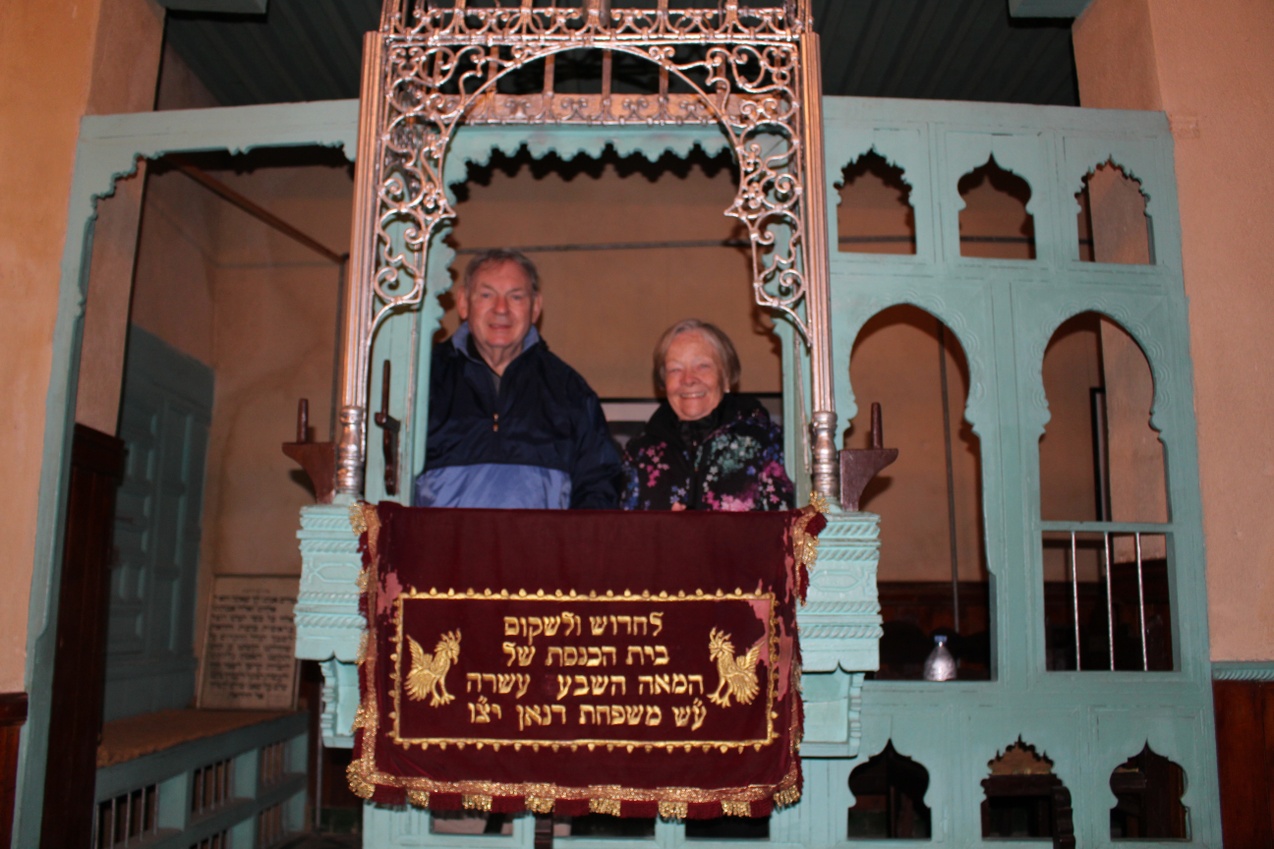
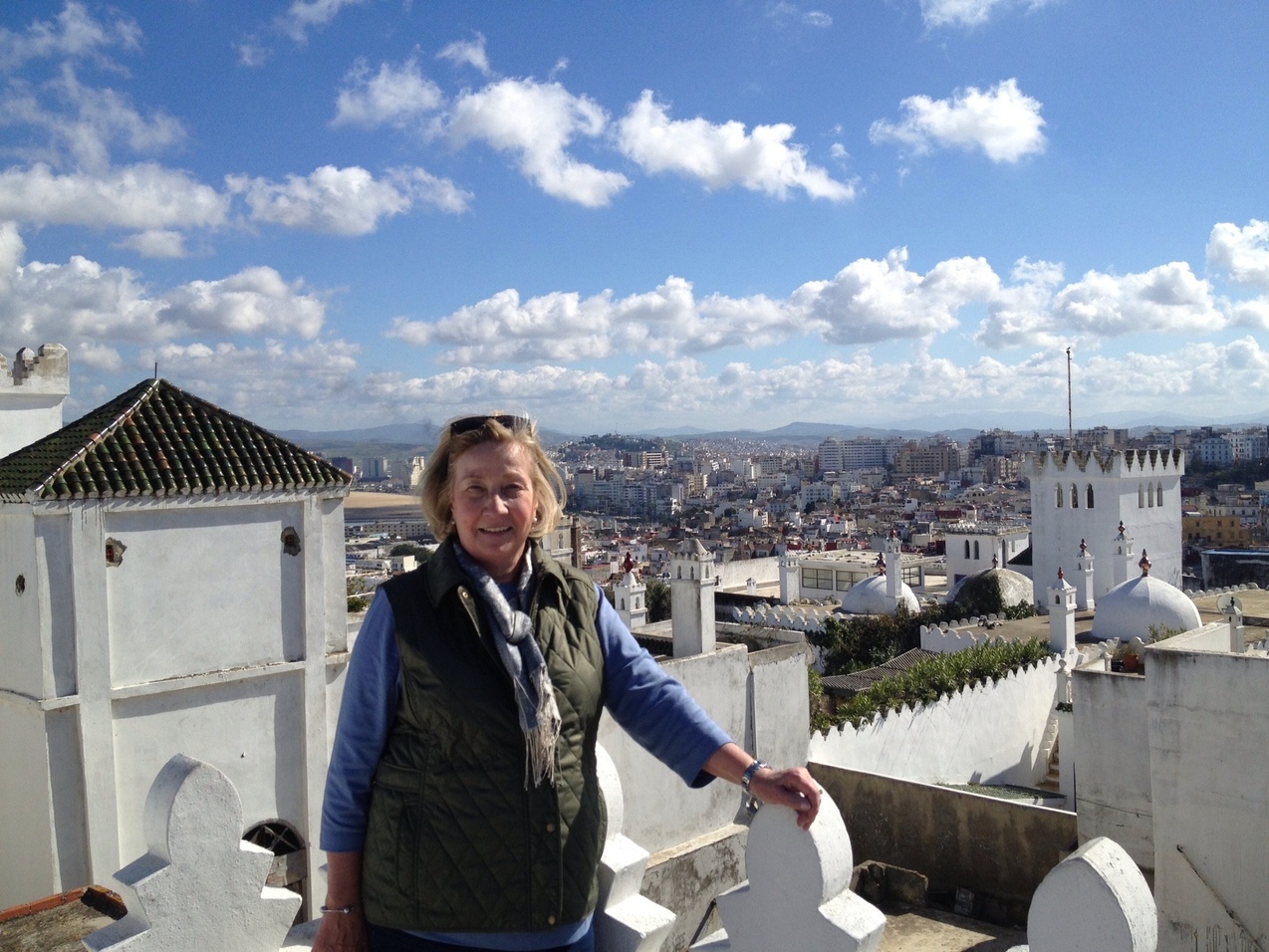
In addition to its beautiful coastal areas, Morocco is characterized by rugged mountain interiors and large portions of the Sahara desert. And we visited them all! Traveling for sixteen days, we spent time wandering the old Medinas and Kasbahs in towns such as Tangier, Fez, Tienghir and Marrakesh.
Medinas, for us city-folks who live in the 21st century, are centuries-old walled sections of a city that contain numerous narrow and maze-like streets… if you could call them streets. They are more like small lanes; once in a Medina it’s easy to get lost and difficult to find your way out unless you have a guide. People still live and work in the Medinas. Kasbah’s are the market areas within the Medinas. With stalls full of goods the Kasbahs are bustling with shoppers.
Since refrigeration is scarce, shopping for food is a daily event for woman. Men own and run most shops. The “shops” are not what we would recognize as a shop or store. Rather they are a series of small stalls on the sides of the narrow lanes which can be owned or rented. Women make their bread daily and most (without ovens of their own) take it to a local baker to be cooked. The baker’s oven is a large hole in the brick wall. He keeps wood burning on the sides so he can slip loaves of bread in the middle.
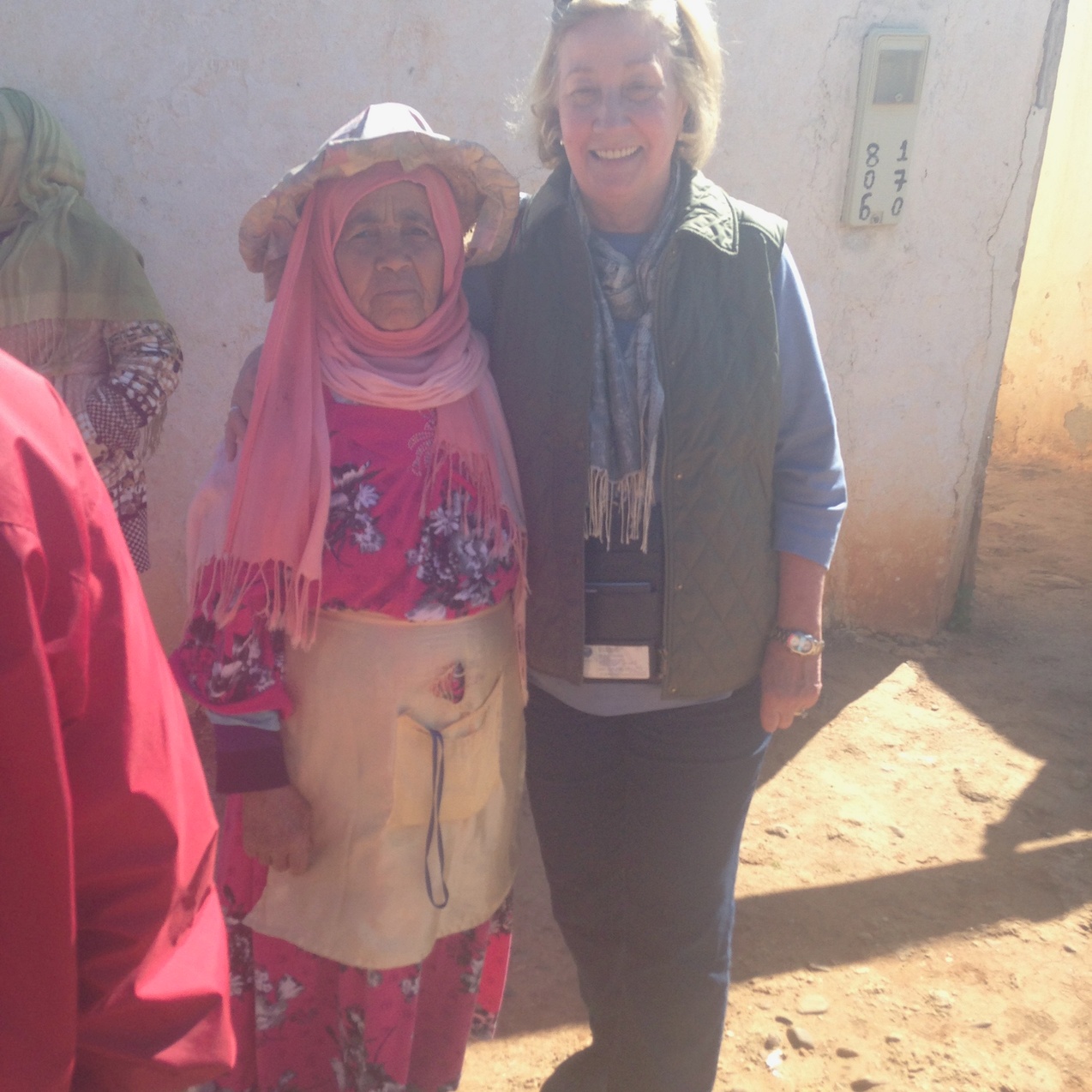
But what impressed us the most, what captured our hearts, our souls and our imaginations, were the people of Morocco. They were warm, welcoming and very, very kind.
For example, we traveled to the mid-Atlas Mountains where met a Berber family. Members of the family were on the side of the road selling chickens and when we stopped to talk with them they invited us into their home.
The older grandma, who was watching the little children, welcomed us with a huge, warm smile. With a great deal of pride she showed us around their humble home and even offered to make scramble eggs for us. After retrieving fresh eggs from the hens she she invited us into her kitchen and enlisted the help of some of our group to help cook the eggs. They didn’t have much by our standards, but what they had they wanted to share.
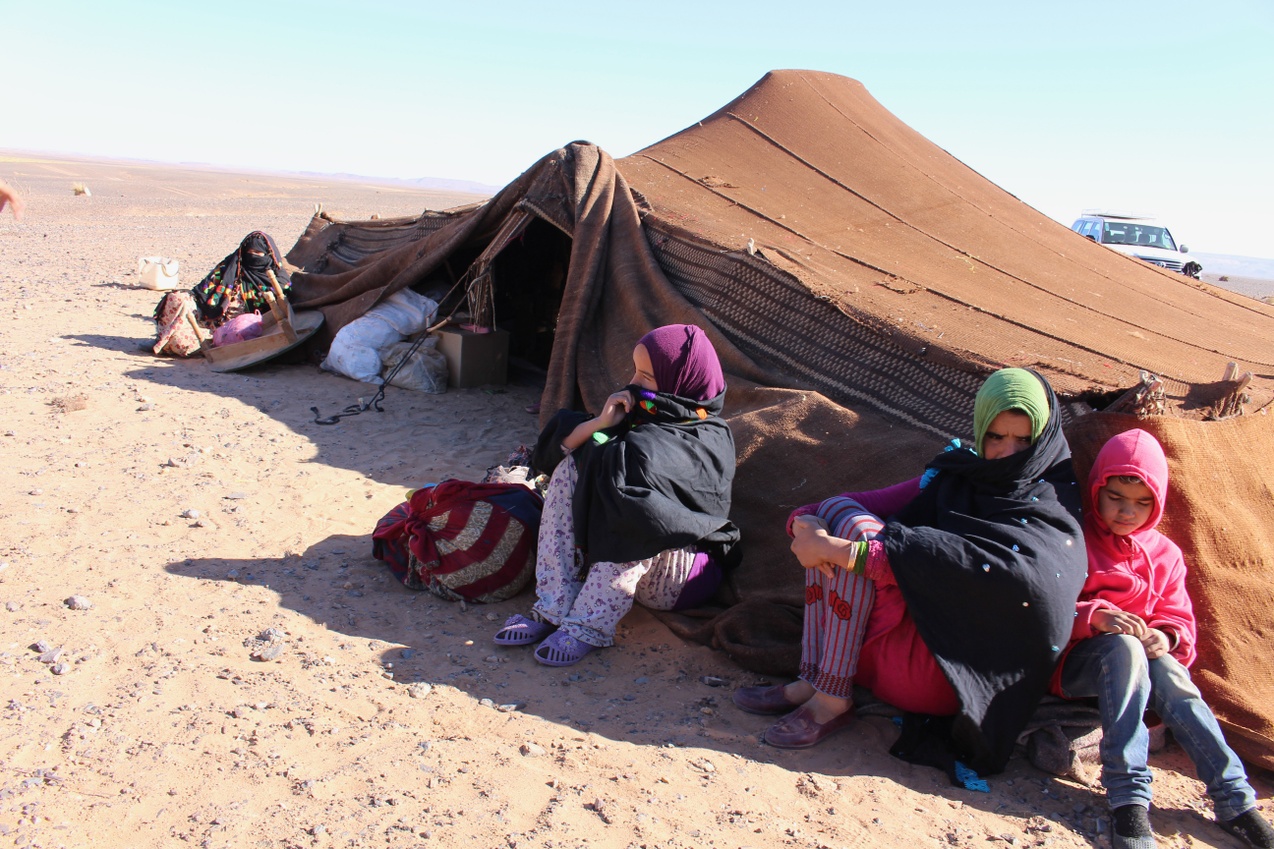
Down the road, our travel guide took us to visit another Berber family; this one a semi-nomadic family. The men were at the market that day while the women tended the children and the animals. The semi- nomadic families relocate twice a year so their homes are a bit more substantial than the nomads who move about every 3 – 4 months. Once again we were invited into their home and through a translator were able to ask them questions. The dwelling they lived in is completely dismantled when they leave and the wooden logs on the ceiling are taken with to use at another location.
For thousands of years, the Berber nomads and semi- nomadic families have been living by moving when the food supply for their animals run out in a given location. Their animals can include goats, sheep, hens, roasters, mules, dogs and camels.
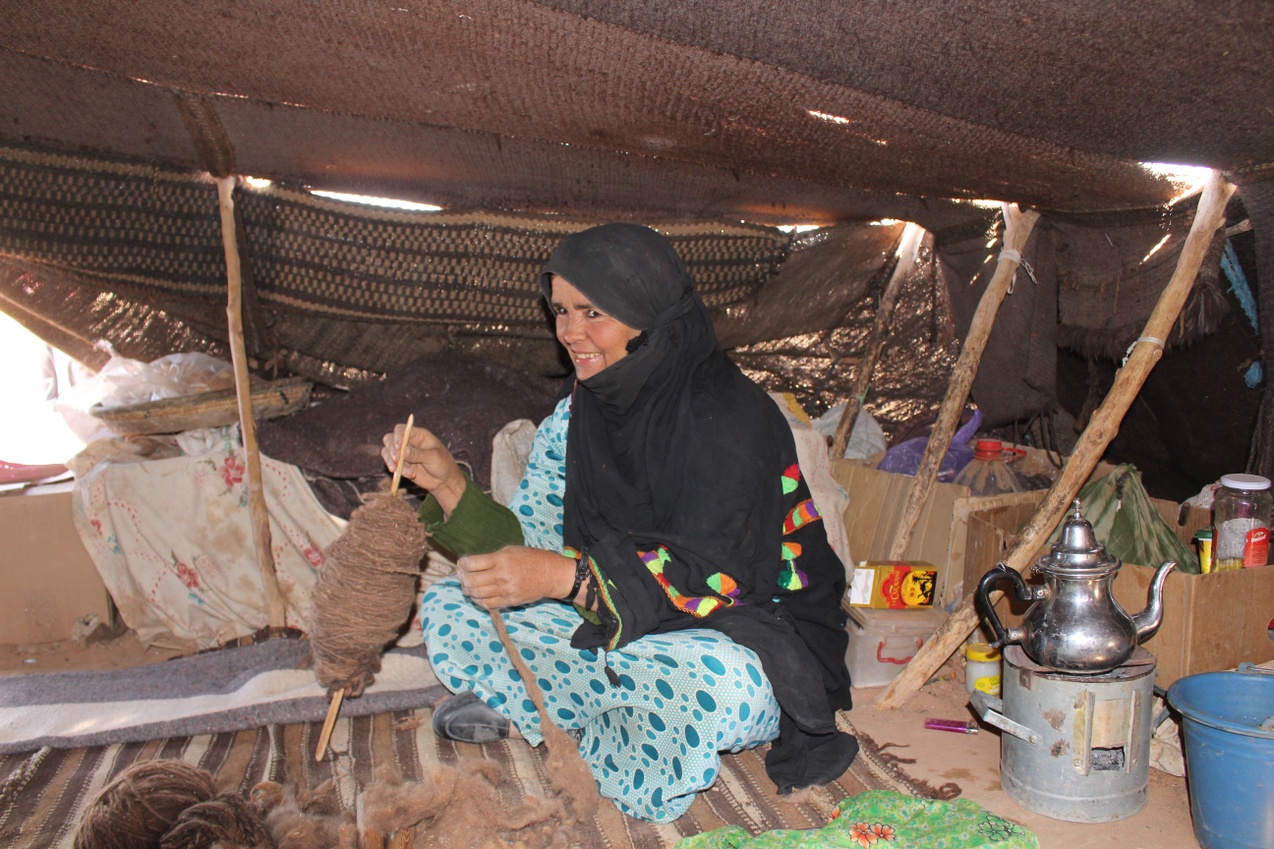
The Berber nomadic family we visited live in the Sahara desert in a tent made of camel hair. We watched while the mother cleaned and spun the camel hair into tread to be used to make clothes and even the roof over their heads. The carmel hair tent keeps it about 20 degrees cooler inside than it is outside – – which in the summer can reach 130 degrees fahrenheit – – and warm during the cold desert nights. (it can get down to 30 degess fahrenheit at night).
We stayed in the Sahara Desert and slept in tents too, but they weren’t made of camel hair. Nor did we have to sleep on the ground as the nomads do. Unlike the nomads, we were able to stand upright in our tents and we slept on fairly comfortable cots. We even had a small light which was solar powered. The nomads use candles for light.
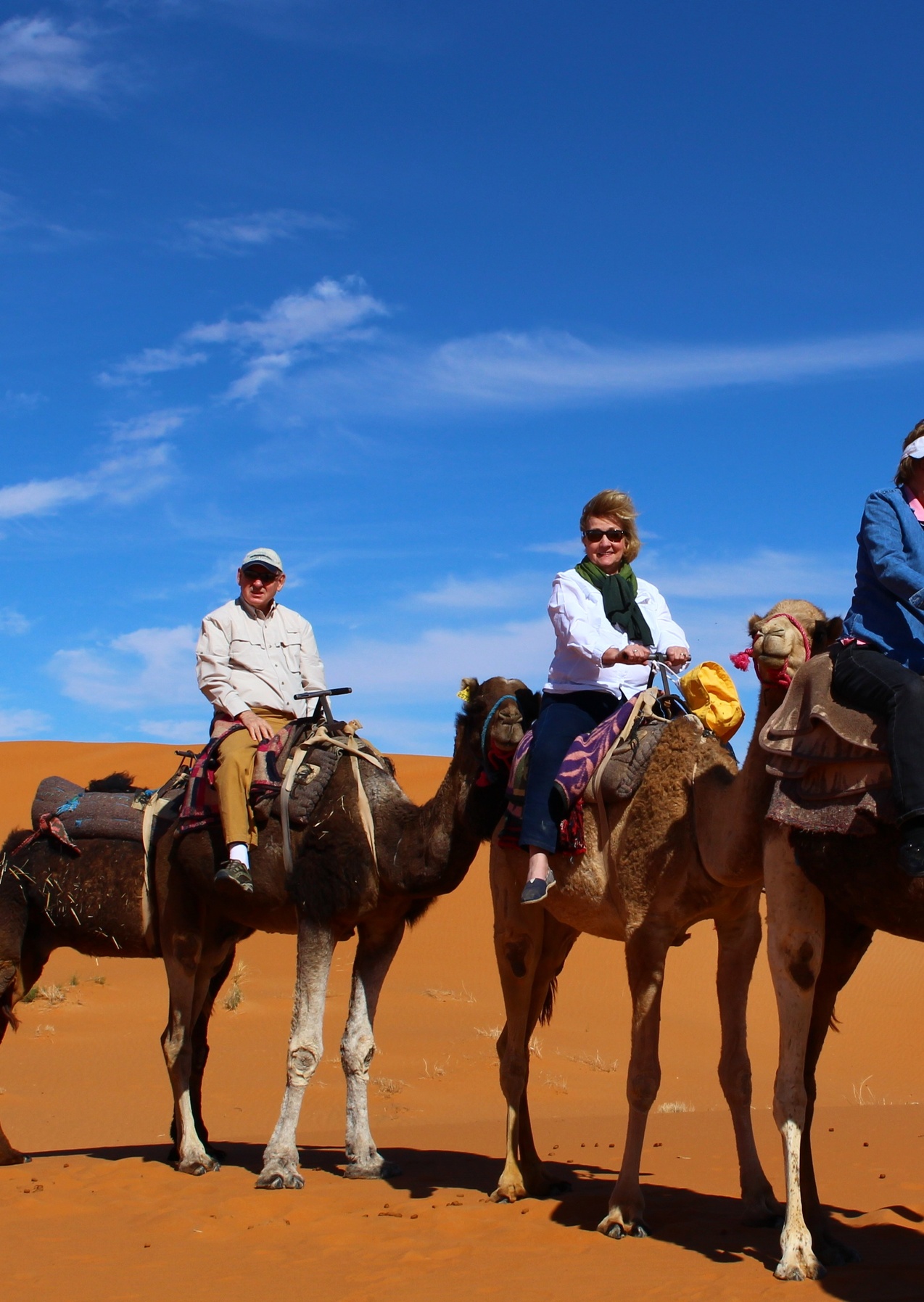
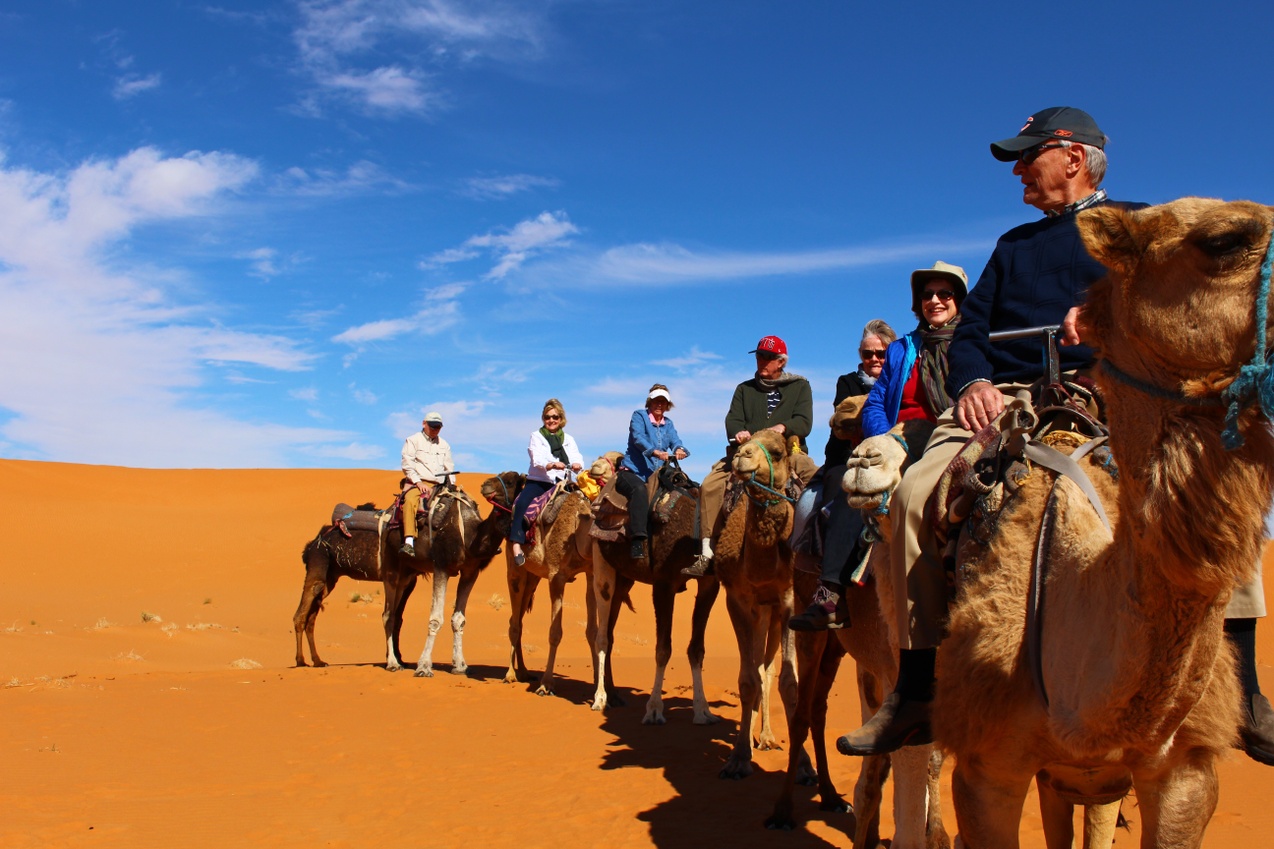
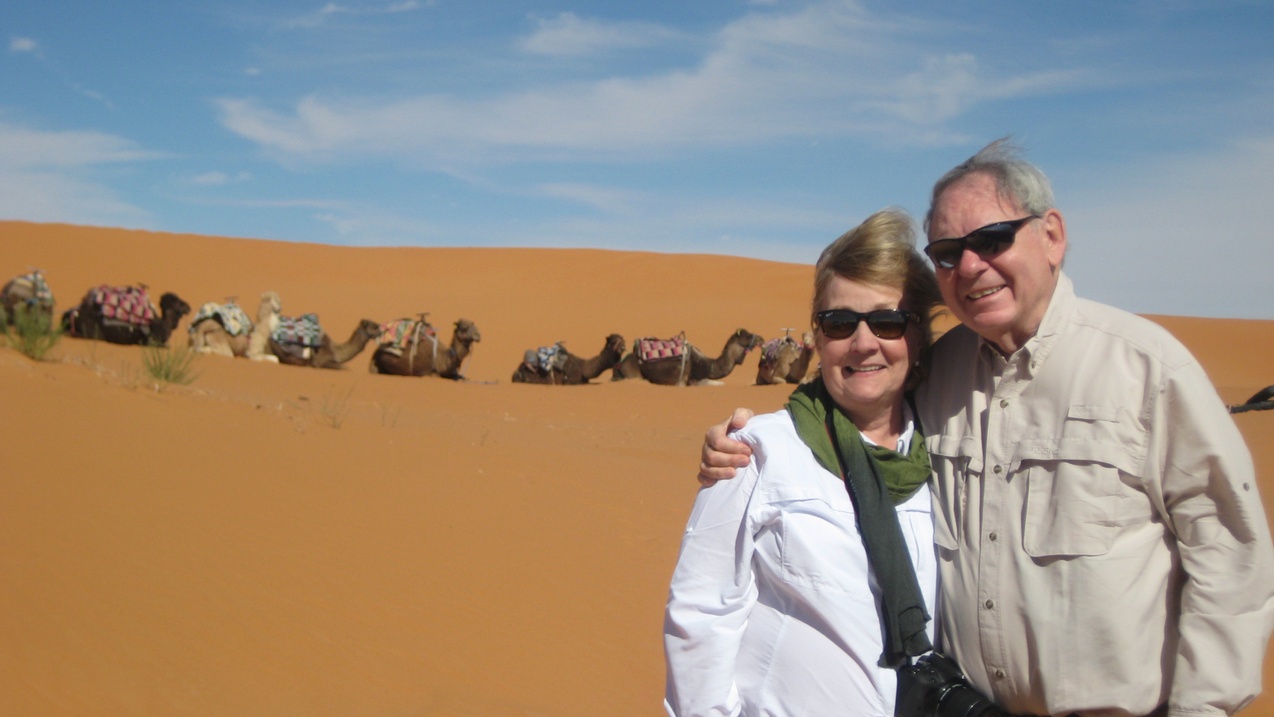
We traveled to our camp site in the desert by jeep and camel. The camels ride was a bit uncomfortable but fun. The jeep ride made us feel like we were in an Indiana Jones movie! In order not to get stuck in the sand, the drivers had to zig-zag all over the dunes.
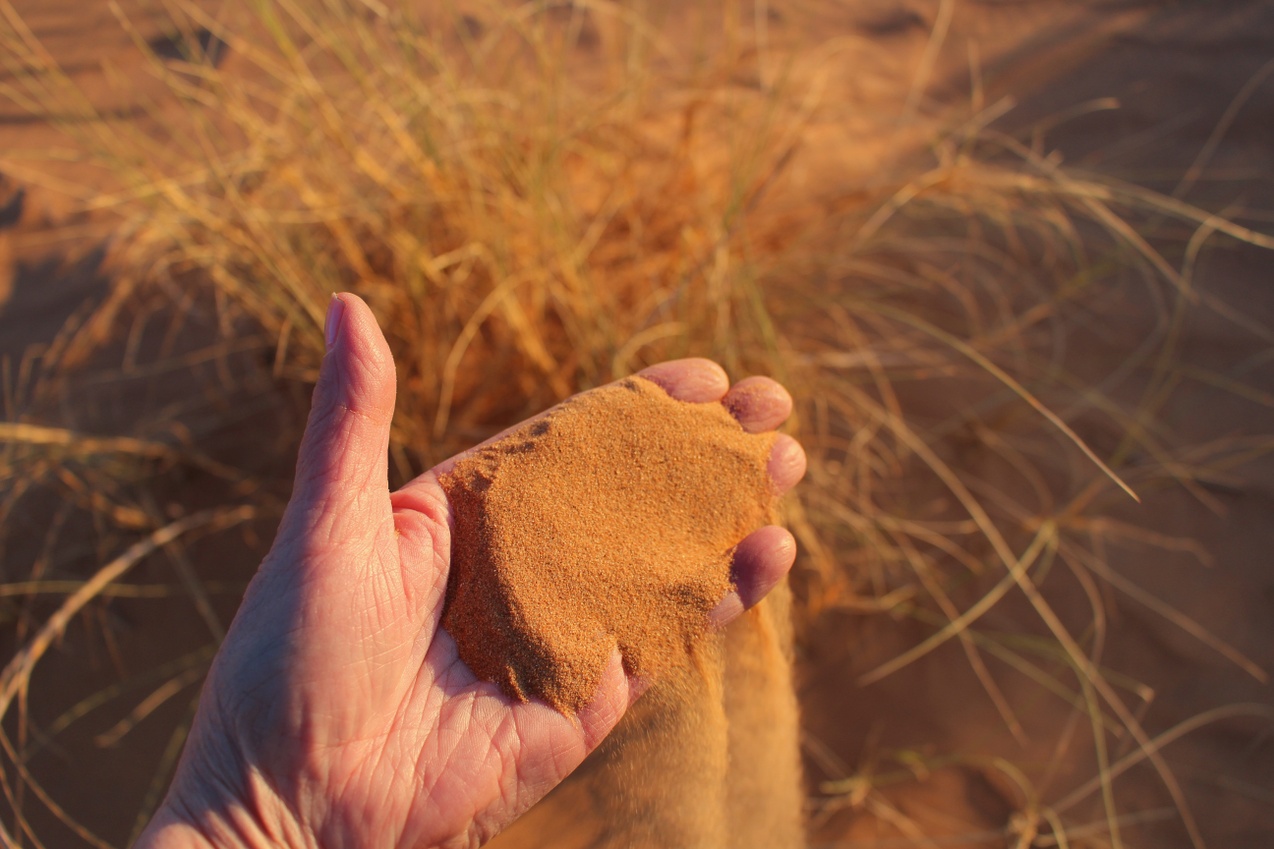
The sand in the Sahara is nothing our Lake Michigan sand… the Sahara sand is silky and a beautiful orange color.
We rose early the first morning in the desert to watch the sun rise and stayed up late every night to be amazed by the number of stars in the sky.
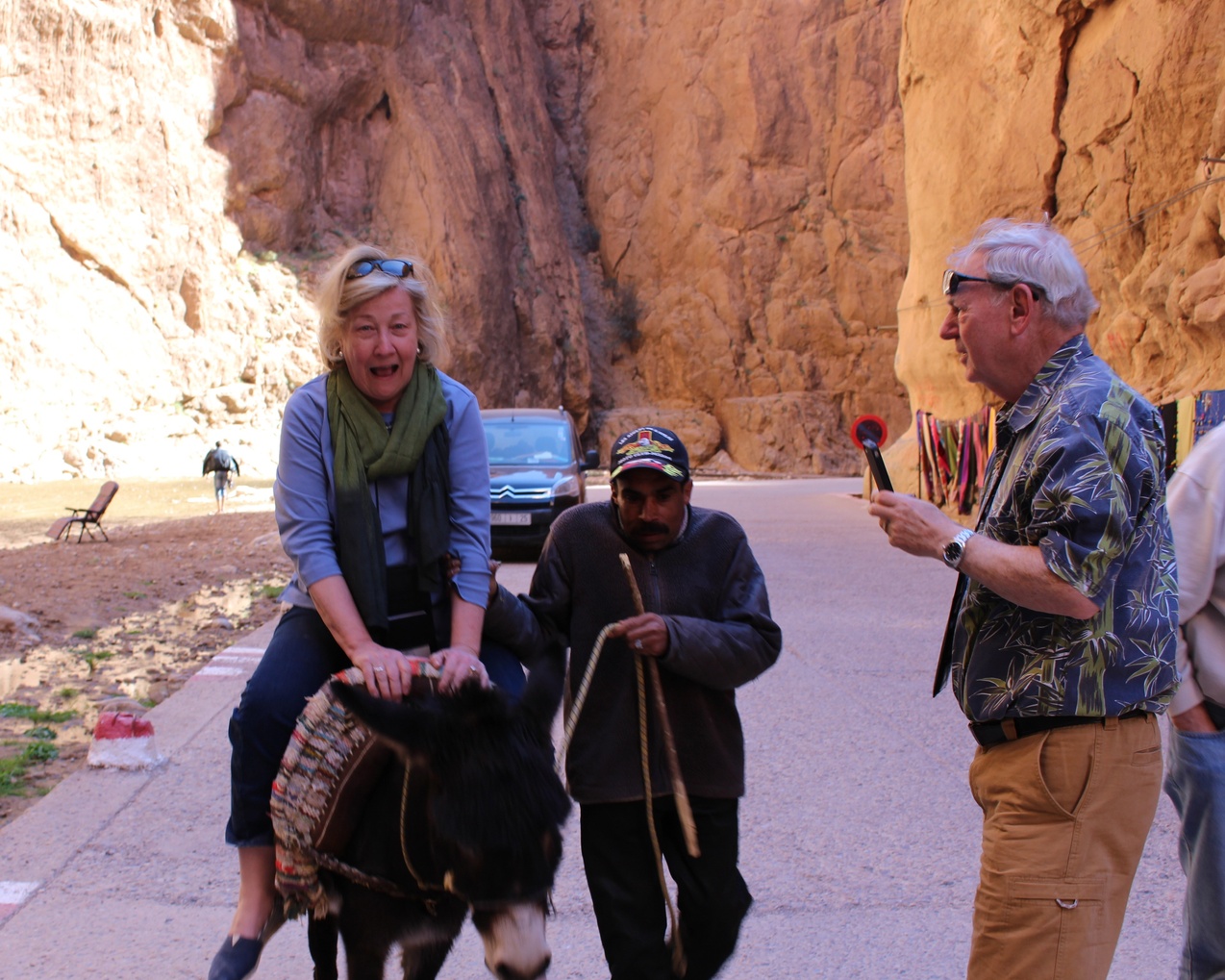
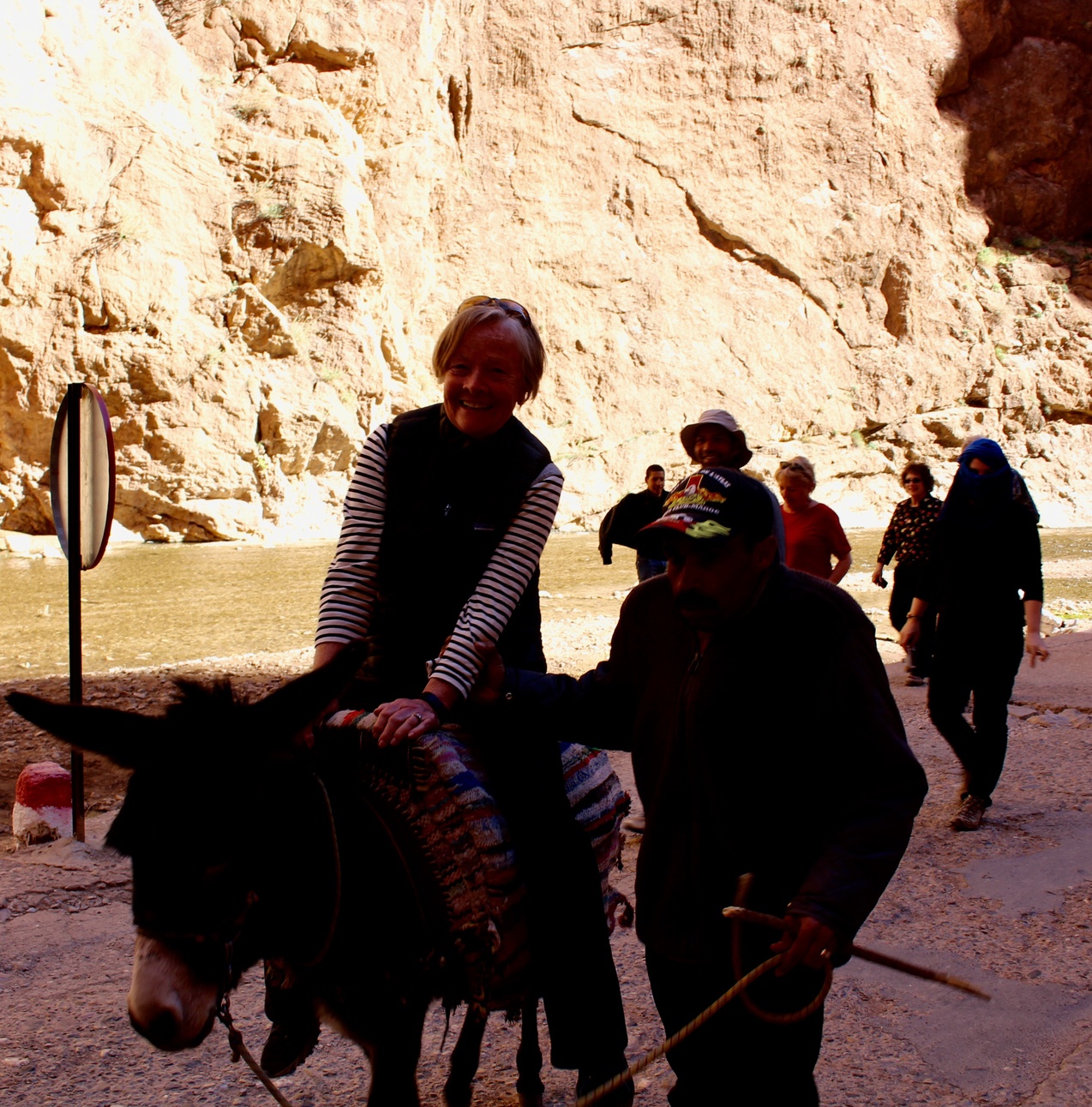
After watching school- age children do so, my sister and I took a chance on riding a mule. Clearly Mary was a lot more comfortable on the back of a mule than I was!
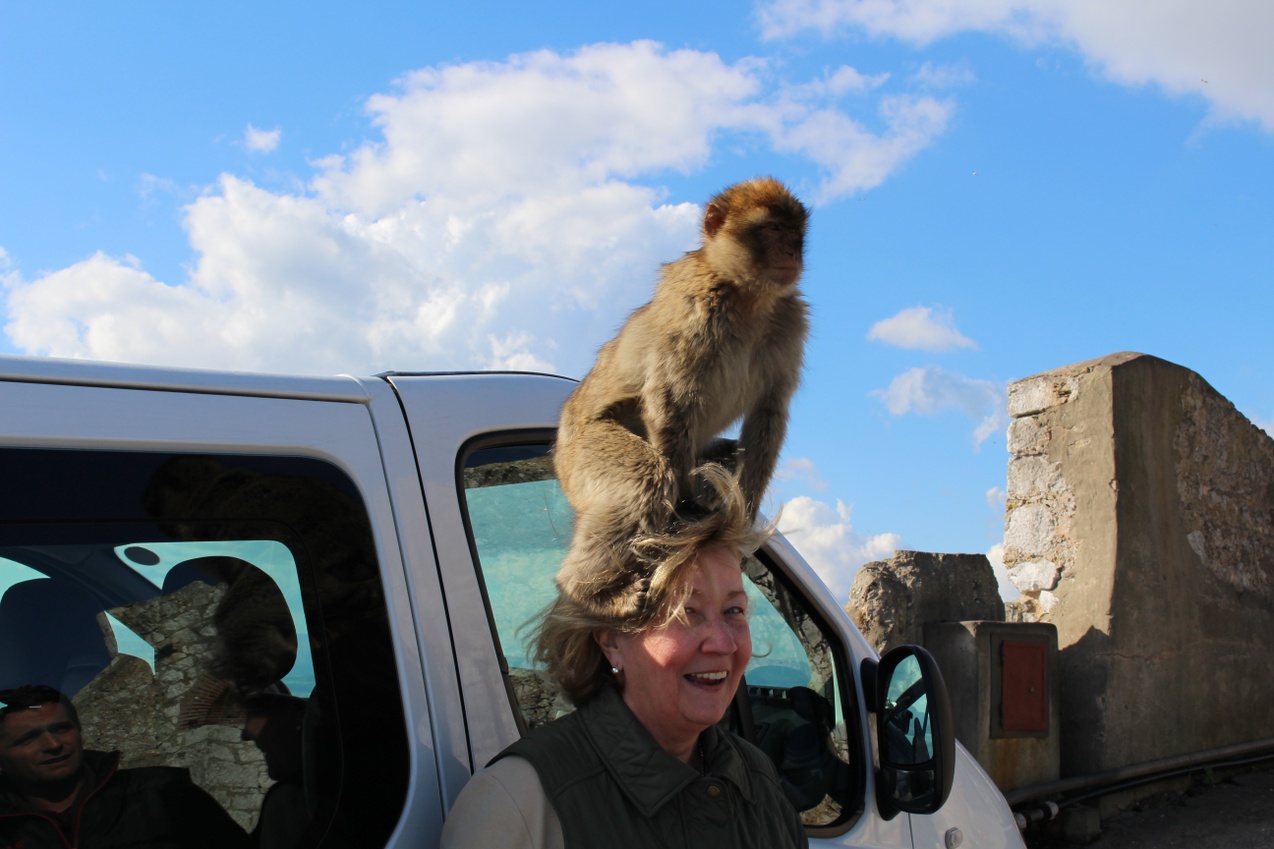
We danced … … we played with monkeys … . . and charmed snakes.
The High-Atlas mountains were breathtakingly beautiful.
There was so much to feel and experience in Morocco: The beauty of the mountains, Experiencing the Sahara desert—
* The feeling wonderment and awe we experienced walking the orange colored sand-dunes,
* Seeing our footprints in the Sahara sand, (who would have ever imagined walking in the Sahara desert?)
* Watching the sun rise and gazing at the innumerable stars in the sky at night,
Riding camels across the dunes,
Being welcomed into the home of a nomadic family
* Meandering the narrow lanes of the medians feeling as if we were back centuries ago as we bargained for goods,
* The amazing coastal areas.
But the highlight of our time in this far-off land were our visits and interactions with the Moroccan people. They are a caring, family oriented people who welcome strangers as if they were one of their own.
So, as they say in Arabic, “Yalla!” —- meaning “Lets go!” Yalla…. Let’s go to Morocco!!
“Birthdays should be a special day,” my brother Jack once said to me. “I believe that whatever you do on your birthday is what you will do the rest of that year.” So, he continued, I always take off work and golf.”
That made no sense to me. He was at point in his life he had to work. He had a family to support, he had a mortgage, he had just purchased a new car and was facing college tuition in a few years for his two daughters. If he was to maintain that life, he’d need a job all year, not golf.
But it did get me thinking about birthdays. What did I do on birthdays past? I surely didn’t golf, but did I remember anything about those days Jack said should be “special?”
So, I began to think.
The earliest memory I have of my birthday celebrations was when I was about six or seven. My memory of it is a bit hazy but I do recall it was in our basement. The basement was unfinished with an unpainted concrete floor, exposed water pipes with the ringer-washing machine off in a corner. I don’t think we had a dryer at that time. My mom would hang the clothes to dry in the back yard in nice weather and in the basement when cold or rainy.
Dominating the space was an old coal-burning furnace that looked to me like an octopus. I later found out that they actually were called Octopus Furnaces because of the huge duct work which stretched from the furnace to various vents in the ceiling. They were gravity driven, meaning the furnace heated the air that would slowly rise up through the duct system (because hot air rises). I think at some point my parents had a fan put in, so the hot air was given a push on its way up.
But, my mother transformed that dreary basement space into something magical. It was close to Halloween, so she hung paper ghosts and witches from the pipes and scattered in between them were orange and black crepe paper ribbons reaching almost the floor. We bobbed for apples in a big old wash tub, played Pin-the-Tail-on-the-Donkey and Musical Chairs. In our Halloween costumes, we ran around the basement dodging the colorful ribbons. Somewhere I still have an old photo of me sitting at the head of the table with my birthday cake in front of me.
Let’s see if I can remember the names of my friends from back then. There was, of course, Agnes Duffy who lived next door and was only six weeks older than me. She was my best friend. Bernadette Clark lived about five houses south of us and was, I think, a year younger. She came from a family of five. Judy, Barbara, and Janet Mair – – all ages within a few years of me give or take – – lived directly across the street and came from a family of 12. Judy and Donna Jolivet, were a year younger and a few years older respectively. The Jolivet’s lived across the street and down the block. They had a frame house with a big front porch. Next to them was an empty lot on which their grandfather grew vegetables and a few fruit trees. I remember climbing the trees on hot summer days to pick the fruit and sitting in the tree eating whatever we picked. After, we’d play Tarzan and jump from the tree the roof of their garage probably ten feet away. It’s amazing none of us fell and broke an arm or worse.
The next birthday I have any clear recollection of is when we lived on 98th and Oakley. I don’t know why this memory sticks out. I remember it was a beautiful day, warm and sunny. My birthdays had always been cold and dark and rainy (remember, this was way before global warming), so a nice November 2nd was unusual. I heard a knock and opened the side door very early in the morning and there stood my dad with a bag full of donuts and big smile on his face. I can still see him lighting up when he saw me and saying, “Happy Birthday to my good girl.” Makes me want to cry thinking about it. Grandpa Murphy was an extraordinary man, loving and giving, and, as icing on the cake, he had a wicked sense of humor.
My 40th Birthday was another stand-out birthday. Dave threw a party for me in our home on Winchester. It was an old-fashioned house party – – -with the dining room table overflowing with food, the laundry tub full of beer, and every corner of in that big house packed with the laugher of family and friends. My mother got Uncle Charlie playing the piano and soon everyone was up dancing and singing. We did a long snake dance throughout the house singing “When the Saints Come Marching In.”
I’m really not big on parties for me, although I love throwing them for others. But I did love that 40th party. Mostly, I think, because there were so many people from all aspects of our lives at the time: the older generation (my mother, Aunt Doris, Ann Grogan, Nancy Sullivan) as well as all my and Dave’s siblings, friends from the neighborhood, from work, from high school and – – of course most importantly – – my children.
Now days, in many places, neighbors are isolated from one another. Air conditions, televisions, video games, backyard pools can all keep families away from one another and from their neighbors. Back in the ‘50’s, when I was growing up, we’d always be around each other: we didn’t have much choice. We were a family of eight kids, in addition to our parents, in a three bedroom Chicago bungalow – – before video games, before air conditioners, heck, even before TV – – so there really wasn’t anywhere to go to escape.
If we did escape it was mostly outside, especially in the summertime. On any warm sunny day you’d find all the kids on the block running around, the old men watering lawns or cutting the grass, the moms hanging out clothes and visiting across hedges and the dads walking to or from the bus stop.
Without TV or video games, we kids found our entertainment – – and it was usually with each other. There were a lot of kids on our block to do that with (there were eight in our family alone and twelve in the Mair family across the street. And that doesn’t count all the other families with seven or fewer kids). So we never lacked for anyone to keep us occupied. We didn’t text or even use the doorbell. By 9am on a summer’s day you could hear some kid yelling outside a friend’s house a long drawn out, “Yo-o-o- Ju-u-d-d-dy!” on the top of their lungs. That was the call to come out and play. If Judy was home she’d come running out. If not, her mom or dad or sibling wouldn’t bother coming to the door they’d just yell back, “not home” or “can’t come out.” There was a lot of yelling in our neighborhood.
Once out, we kids would sit on the curb and decide what to do. Sometimes we’d walk to Murray Park and play on the swings or we’d play all sorts of imaginative games in the big prairie on Ashland Avenue. My friend Linda Hinkle and I loved badminton and would play it right in the middle of Marshfield Avenue. We didn’t have a net so we used the manhole cover as an imaginary net. I remember one day when we were playing our birdie went down the sewer. It was our only birdie and we were devastated. Mr. Mair, who had been sitting on his porch watching the game, got his four-year old son, “Pinky” (Pinky because he had red hair of course) and held the poor child upside down by his ankles several feet into the sewer to retrieve the lost birdie. Although I thought it would scar him for life, Pinky went on the graduate from Harvard Law School and is now a very successful attorney in Boston.
Another game we liked was softball. If we weren’t playing in the prairie, we’d play on the four corners of 73rd and Marshfield with an old beat-up softball owned by the Carlin brothers. The northeast corner would be home plate, the northwest corner first base, and so on. Since there weren’t many cars back then we could get in quite a few innings without interruption. Those that weren’t up or “in the field” would sit on the curb or on Burke’s front steps to watch, or more often, make catcalls at those up at bat.
Summer evenings were a wonderful back then. We’d always be out after dinner playing hide and seek and catching lightning bugs. By then our dad’s would be home from work and many would be sitting out front in lawn chairs or taking a stroll to get some air.
We were a multigenerational neighborhood … grandparents lived with many of us or we with them. One of my fondest memories is watching my grandpa Kelly and old Mr. Brown who lived next door (both old country Irishmen) standing out front watering their respective lawns and talking. I know now that old country Irishmen have the gift of gab and these two men certainly did. They’d be out there all morning discussing all sorts of world events. At the same time white-haired Mrs. Brown was usually in the backyard hanging clothes and visiting with my grandma Kelly who would be tending to her beautiful garden. I especially remember her lush bridal wreath bushes falling over with the weight of their lovely white flowers.
(A Bit of History The first generation of the Kelly’s and the Brown’s came from the west the Ireland and settled in Chicago at the beginning of the 20th century. They happened to buy homes next door to one another and became friends. The Browns (Pete & Agnes) lived at 7313 and had two daughters; the Kelly’s (Patrick & Hannah)lived at 7311 and had one daughter. When Patrick & Hannah’s daughter, Eileen, married Art Murphy and started to have children, the Kelly’s added an attic flat and moved upstairs so the young family could have a nice home in which to raise their family.
When Pete & Agnes’s daughter, also Agnes, got married and started a family her parents did the same: added an attic flat to their home and Agnes and her husband Tom Duffy moved into the first floor.)
Agnes & Tom Duffy’s eldest daughter, also Agnes, was born six weeks before me. We grew up together, went to school together, were good friends and share all sorts of memories. We lost touch for awhile (not surprising as she moved to Ireland!) but we have reconnected … which was easy to do not only because of our shared memories of 73rd& Marshfield and St. Justin’s, but because I believe we both realize that our lives are intertwined with the stories of our parents and our grandparents.
All in all, looking back, I think the 50’s was a good time to be a kid. A bus trip to the Museum of Science and Industry or Rainbow Beach was a big deal. Or we’d walk several miles – – usually laughing and fooling around the entire way – – to swim lessons at Harper High School or to swim at Gage Park (with a stop at the corner store for penny candy). Or we’d bike to Marquette Park and try to catch minnows with a Dixie cup or just lay in the grass under a tree and daydream. There was a lot of time to daydream and I think that was a good thing
“Freud said that life is all about being able to love and to work. And I think it is about those things. But it’s also about play. Play can bring back the past, but even if it doesn’t, play is now; play is fun. More than ever, I have the feeling that all of what we do that counts is just love and work and play.” ― Alan Alda, “Never Have Your Dog Stuffed: And Other Things I’ve Learned”
There are small movies that occasionally wind through my brain… . small little replays of childhood events long ago. . . many of those childhood memories have to do with play.
I remember . .
… . the old, badly torn green army hammock which hung from hooks pounded into two old trees way in the back of our yard. I don’t know where the hammock came from, maybe one of my uncles brought it home from the war. But it seemed that it always was there. On hot summer days with nothing to do, my brother Jackie and I would just sit in it and lazily swing back and forth, dragging our worn-out shoes in the dust which had accumulated beneath it over the years.
My grandparents, who lived in the attic flat above us, were meticulous gardeners and for years our yard was their hobby and their pride. After my mother’s eight kids, however, I’m afraid they must have given up. Our yard was a yard accustomed to rough play and the dust under the old hammock was proof of that. Grandpa Kelly eventually established a small garden in a prairie across the alley and north of us.
The hammock had a mosquito netting which you could zip around and over you. Sometimes, if I wanted to disappear for a while, I’d go out back and zip it around me and lay perfectly still so no one would know I was there. I loved the isolation and quiet of that little self-made cocoon; I’d lay perfectly still and look high above at the leaves swaying in the trees let my mind wander. Sometimes I’d think about the books I’d read. For a long time I was hooked on Tom Dooley’s books. Tom Dooley was a doctor who, after serving in the U.S. Navy, stayed and worked in Vietnam and Laos.
As a girl I was so moved by his bravery and humanitarian efforts to help those in need, I wanted desperately to become and doctor and join him in Southeast Asia to fight disease and poverty. I’d lay in that hammock and imagine myself deep in the jungles of Laos fighting off bugs and dangerous animals to tend to the sick and dying. Eventually my poor grades in subjects like Chemistry burst that daydream and Dr. Dooley had to do without me at his side.
Other times the old hammock was a lively place where Jackie and I would swing each other as high as we could and fight over whose turn it was to use it. Once or twice I sat in it with Johnny M. who lived down the street and on whom I had my first schoolgirl crush. We’d just sit. I don’t think we even talked and certainly didn’t hold hands, but it was wonderful just the same.
I remember, too, the old large trees from which the hammock hung. One was a Maple and the other a Key of Heaven. They were great climbing trees and climb we did. My mother would sometimes sit in a lawn chair and watch while my little brothers, Jackie and Tommy and I climbed. If one of us stopped because we were so high we were afraid, she’d yell that one of the others was higher than we were. “Look where Tommy got to, Jeffie! Isn’t he great?” Thereby implying I was lacking somehow. So I’d go for it… scared or not, I had to go higher.
Another memory is of the day before my First Holy Communion. It was 1955 and I was in third grade at St. Justin’s. My class had spent the entire third grade preparing for this most special day. I had a beautiful white dress, shoes, soxes and veil all laid out and waiting until mass early the next morning.
But this was Saturday and Saturdays were for playing. Especially one of the first bright sunny days of Spring. So my big brother, Mickey, decided he would make a boxcar for me. He found two old planks of wood and nailed rollerskate wheels to the bottom of them, then laid them out parallel to one another and joined them with two more pieces of wood crisscross on the back.
Finally he somehow rigged a back to it with more old wood and I was ready to go. There was no steering mechanism and no brakes but that didn’t bother us. He’d push me as fast as he could down Marshfield Avenue and all I had to do was hang on and not fall off. . Which I managed to do the first few times down the block. But flying down the street on two sliver-filled old planks of wood nailed to old rusty roller skates by a fourteen year old boy was destined to end baldly.
The sidewalk on Marshfield was rough but the many cracks weren’t that bad … until the end of the block right in front of Carlin’s house. Every kid on the block knew to be careful in front of Carlin’s because of the two large bumps in the sidewalk. We’d always slow down on our bikes or risk taking a tumble. I wish I had just taken a tumble.
It was about the fifth time down the street and we were both overly confident in our ability to get that old crate to the end of the block. Mickey pushed extra hard and I went flying down the street and hit those two bumps faster than the old wood and rusty nails could take. The whole thing fell apart and the two planks under me went flying in different directions, leaving me still propelled forward only now I was on the seat of my pants… literally. My behind became my boxcar; I must have gone three feet or more on my butt. When I got up I could hardly walk my rear end felt as if it was on fire.
Not wanting to get Mickey – – or me for that matter – – in trouble I didn’t tell my mom. I went into the bathroom and tried to assess the damage. It was bad: long, rough, angry red scratches were imprinted on my butt. I was nine and didn’t know what to do. Finally my solution was to pad my derriere with extra underwear to ease the pain when I sat. Crazy but it seemed logical to me at the time. And to a certain extent, it worked.
There are so many beautiful photographs of me on my First Communion Day. I look so angelic and innocent. Only I knew that some of those so-called angelic looks smiling out at the camera that day really were a cover for the pain I was feeling in parts too embarrassing for a nine-year-old to meantion
Margaret – – affectionately known as “Billie” – – was the last of the children in my father’s family and was the light of their lives, especially my dad’s. Twenty-three years older than Billie, he adored her and spoiled her. Then in March of 1927 tragedy struck the Murphy family
My grandparents left four-year-old Billie with older sister Mary’s teenage friend to babysit while they attended a funeral of a close relative. The older children were either working or in school. Aunt Doris, only two years older than Billie and her constant playmate, remembers not wanting to go school that day and trying to stay home with Billy. But her parents prevailed and six-year-old Doris went off the school with her older brother Jimmy.
Doris knew something was horribly wrong when she rounded the corner after school that day and saw a crowd of subdued and somber neighbors in standing in front of their home. My dad got a call at work and someone finally tracked down grandma and grandpa Murphy at the funeral.
Billie was in the hospital fighting for her life.
There are two stories of what happened to little Billie that day. The first is that she was trying to make herself a cup of tea and when she reached across the stove to pick up the whistling kettle the sleeve of her dress was ignited by the open flame. The second, and according to aunt Doris the more probable scenario, is that four-year-old Billie found a package of matches in an upstairs bedroom and did what we all fear a little child might do: she decided to play with them.
What we do know is that her dress caught fire. Bille frantically ran down the stairs shrieking and aflame. When the sitter saw her, she panicked and ran outside. Billie followed – – – screaming and with her clothes still on fire. A couple of nearby workmen saw what was happening, ran over and rolled Billie on the ground.
But it was too late. Despite being rushed to the hospital Billie died at 3:00 am the next day.
Billie had always wanted red slippers. So my dad, who was totally devastated, ran from store to store in an almost blinding compulsiveness to find her pair of red slippers. Aunt Doris says he finally found a pair of red shoes in a downtown store.
Billie was waked in their living room and buried in her new red shoes.
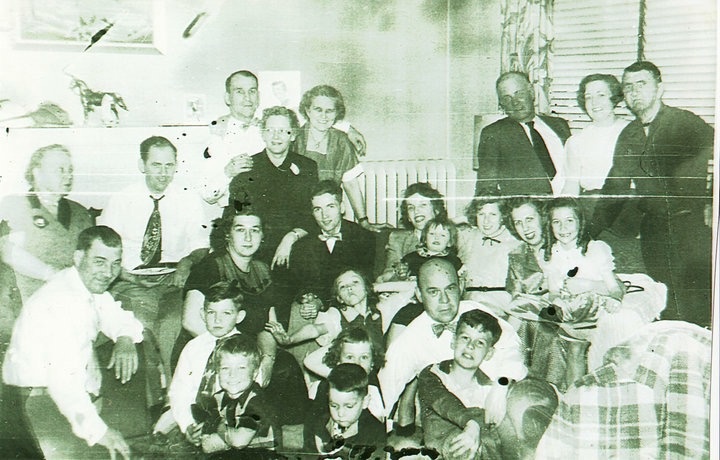
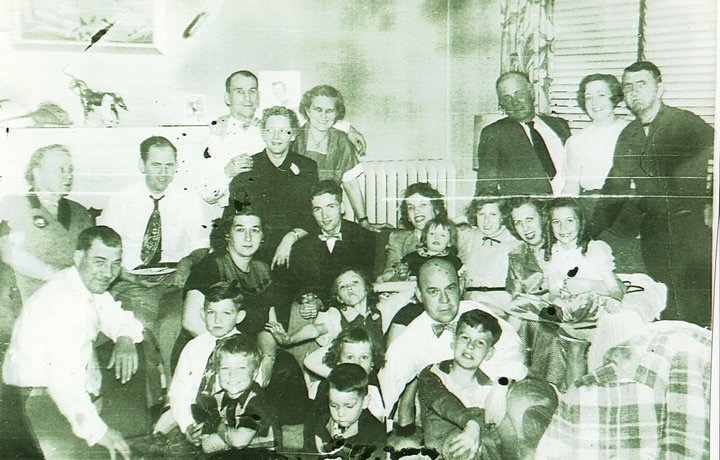
Murphy’s circa 1953. Back: Uncles Ed & Steve, Aunts Vera & Mary, My Dad, My Mom, Grandpa Murphy Middle: Brownie, Marie, Johnny, Aunt Doris, Patty, Aunt Virginia, Me Front: ?, Jackie, Sharon, Nancy, Uncle Johnny, Danny
I started writing these remembrances after my youngest encouraged me to do so. Then my oldest took it a step further by gifting me with a subscription to StoryWorth for Mother’s Day. It is evolving into a series of remembrances of my childhood that I hope describes life in the mid-20th century Chicago.
Little did I realize when I began this journey how old it would make me feel. For although these memories are, and have, been apart of my psyche for more than XX years, until I started to record them they were just that, memories. Once written, though, they come to life and serve to remind me how drastically different the world was for us back then.
Electronic devices are now an intregel part of our lives, world travel is commonplace, instant communication expected. In the quick pace of today, we forget the simplicity of yesterday. At least I did.
Since retiring I’ve been fortunate to have traveled to faraway places. By contrast, my life back then didn’t go much further than the boundaries of my Catholic parish. As I grew a little older it encompassed some, but not all, of the south side. The north side of Chicago was still another planet even in my teens. And while today I can get news instantly on my iPhone from anywhere I happen to be, back then our news came in the twice-a-day delivery of the newspapers or on the radio. Televisions in homes was a novelty and even if you had one, all broadcasting stopped after the 10pm news.
Whether, as some argue, it was better back then, I will leave to each person’s own judgement. What I can say it that the world as I knew it was a whole lot different in the mid-1950’s and a world I wish I could visit once again. Would I want to stay there? I don’t know. I don’t think so. But I sure would like to have the powers to travel back in time to experience it one last time.
Important to me is that for these stories of bygone days serve to provide my children and grandchildren with an understanding of those who came before them. Life was not only a lot different, it was a whole lot more difficult back then – – – especially for those who came before me: my parents and grandparents, aunts and uncles.
It would be nice for those living and succeeding today to understand those who, many years ago, worked long hours in difficult jobs and in many cases experiencing unfair discrimination… but preserving so that the generations to come could have a better life.
And don’t kid yourself: that is exactly what most of our ancestors worked for: they worked so we could have a better life than they did.
As a friend once said, “We stand on their shoulders.’
I started writing these remembrances after my youngest encouraged me to do so. Then my oldest took it a step further by gifting me with a subscription to StoryWorth for Mother’s Day. It is evolving into a series of remembrances of my childhood that I hope describes life in the mid-20th century Chicago.
Little did I realize when I began this journey how old it would make me feel. For although these memories are, and have, been apart of my psyche for more than XX years, until I started to record them they were just that, memories. Once written, though, they come to life and serve to remind me how drastically different the world was for us back then.
Electronic devices are now an intregel part of our lives, world travel is commonplace, instant communication expected. In the quick pace of today, we forget the simplicity of yesterday. At least I did.
Since retiring I’ve been fortunate to have traveled to faraway places. By contrast, my life back then didn’t go much further than the boundaries of my Catholic parish. As I grew a little older it encompassed some, but not all, of the south side. The north side of Chicago was still another planet even in my teens. And while today I can get news instantly on my iPhone from anywhere I happen to be, back then our news came in the twice-a-day delivery of the newspapers or on the radio. Televisions in homes was a novelty and even if you had one, all broadcasting stopped after the 10pm news.
Whether, as some argue, it was better back then, I will leave to each person’s own judgement. What I can say it that the world as I knew it was a whole lot different in the mid-1950’s and a world I wish I could visit once again. Would I want to stay there? I don’t know. I don’t think so. But I sure would like to have the powers to travel back in time to experience it one last time.
Important to me is that for these stories of bygone days serve to provide my children and grandchildren with an understanding of those who came before them. Life was not only a lot different, it was a whole lot more difficult back then – – – especially for those who came before me: my parents and grandparents, aunts and uncles.
It would be nice for those living and succeeding today to understand those who, many years ago, worked long hours in difficult jobs and in many cases experiencing unfair discrimination… but preserving so that the generations to come could have a better life.
And don’t kid yourself: that is exactly what most of our ancestors worked for: they worked so we could have a better life than they did.
As a friend once said of his ancestors, “We stand on their shoulders.’
“How did you feel when your first child was born?” asked my first child.
What could I respond? “Wonderful, bewitched, enchanted, awesome, thrilled, the happiest I’d ever been,” was what she probably wanted to hear.
Was all that true? You bet! But there was more, nothing is that simple. There was a lot that led up to her birth and a few things from after that should be included for a fuller understanding of that hot summer’s day my first child came into the world.
In January of 1970 Mary’s father and I had returned from the South – – South Carolina and Florida to be specific – – where we had volunteered as VISTA volunteers for almost a year. We came home because I was pregnant and wanted to be close to family. We got an apartment on the first floor in a three-flat apartment building at 80th and Marshfield. The neighborhood was, in the parlance of the day, “changing” which made the rent affordable and we didn’t mind the integration taking place. In fact, we welcomed it – – we both had been active in civil rights since high school.
As I hadn’t yet finished college, I went back to Loyola part-time and Bob went to work for the US Office of Economic Opportunity (OEO). We didn’t own a car, so we commuted downtown by taking the Ashland Avenue Bus to the El station at 63rd and Loomis and then caught the El for downtown. The El (short for Elevated tracks for trains) were first built in Chicago in 1892. The streets were becoming clogged with horses, carts and carriages so the Elevated trains were designed to provide faster transportation above all the congestion. Of course, when I took the El the horses, etc. were long gone, but the old wooden structure still stood and provided faster transport to the downtown than almost any other mode.
I loved taking the El. If I wasn’t studying, I’d spend my time reading “Time” magazine or gazing out the window. The El’s route took us through alleys in some of Chicago’s poorest neighborhoods. The old buildings – – whether apartment buildings or single-family homes – – nearly always had wooden back porches, most of which appeared to be on the verge of falling from the buildings to which they were attached. From my vantage point on the train, I’d watch the activity of the families living there unfold mostly in quick glimpses. . . a woman hanging laundry from lines stretched across the length of the porch, old men sitting and smoking a cigarette, children running in and out. On hot days, the doors were always wide open trying to catch a breeze and bring it in the house. There were no air conditioning units in these apartments or homes. The people I spied on from the train were mostly living on the edges of society, barley getting by. I’d sit and wonder about their lives. I certainly did not come from wealth, but I knew these folks were a lot worse off than anyone I knew.
One day, coming back from class, I was sitting on the El daydreaming when some young kid grapped my purse right off my lap and ran out the door just as it was closing. He never touched me, and I wasn’t hurt, but I was considerably shaken. I got off at the next stop to report it. When the old-country Irish policeman took my report and noticed by pregnant belly, he took the time to drive me to my parents’ home. Bob and I went out to get a car that night, and I never took the elevated train again.
Summer came, and it was hot. Like the people living along the El, we had no air conditioning in our apartment. Our bedroom had two doors, one on each side. As the summer progressed and the heat intensified, I’d put a floor fan in each of the doors directed at the bed and I’d lay on it is hoping for relief.
We had a house guest that summer too. Millard Perry, I think was his name. He was a teenager we worked with in Clemson, S.C. while in VISTA. We knew his family well and they had agreed it would be a good idea for him to live with us for a couple of months and get to know the big city and earn some money. We got him a job in one of the poverty programs so prelavent at the time. Because our neighborhood was still mostly white, Millard, who was African American, had to cross to the east side of Ashland (where the Blacks lived) to hang out. Millard, who I think may have been related to Refrigerator Perry, went home in late July. I spent the remaining weeks of my pregnancy laying on the bed in front of those fans hoping relief from the heat.
I woke in the early morning hours of August 12th with pains in my back that seemed to come and go at regular intervals. No one had told me labor could start with back pain, so I went about my business. I had a scheduled appointment with my doctor that morning, so I dressed and drove downtown with Bob. We parked at OEO which was located around 1400 south Wabash. I started a leisurely walk to the Dr. Towne’s office in the Pittsfield building on Washington Blvd.
As I passed DePaul University, I stopped in the chapel to say a prayer for a healthy baby and for a safe delivery. On my way out, I stopped in their bookstore and brought a book. I also purchased a poster which I hung in the baby’s room after she was born. It showed two little girls hugging – on black, one white. I don’t remember what it said, probably something inspirational, but the message was clear from the photo. I hoped to raise my children with that message: it was a message of love and equality for all.
The pains in my back were getting more frequent now and I began to suspect the pains may be connected to my pregnancy. Could I be in labor, I wondered on my walk to the Pittsfield Building. I was. As soon as I told Dr. Towne of the back pains, she frowned, examined me and told me to have my husband pick me up asap and get to the hospital.
I sat at her desk in the small examining room and dialed Bob’s number at work. I remember waiting for them to get him out of a meeting and looking out the window overlooking Marshall Field’s and the streets below. It was getting close to noon and the street was clogged with shoppers and office workers going to lunch. I remember thinking that labor wasn’t going to be easy and wishing I could make this all go away. I’d rather be joining someone below for lunch. I wanted the baby, but not the labor.
Bob’s voice on the other end of the phone brought me back to reality. He soon picked me up, and being young and stupid, we flew right past Mercy Hospital and went all the way home to pick up my bag. Somehow, in our minds, I couldn’t go through labor and delivery with that packed bag.
We were fortunate. We arrived back at the hospital about 1:30 pm, four hours before I delivered. In those days there were no epidurals. I begged the doctor for gas, but she wouldn’t administer it until I was on the delivery table. By then, having gone through labor for four hours and knowing the baby was coming, I didn’t want it. I wanted to be awake to welcome my baby.
She had other ideas, and in those days, the doctor’s ideas prevailed. I remember being on the table and looking at a big clock on the wall, it read 5:39. Then the gas mask hit my face and nothing. When I awoke, still on the delivery table, they told me I had a beautiful baby girl – – at 5:40! They put that darned mask on me for one minute before my beautiful Mary Eileen came into my life!
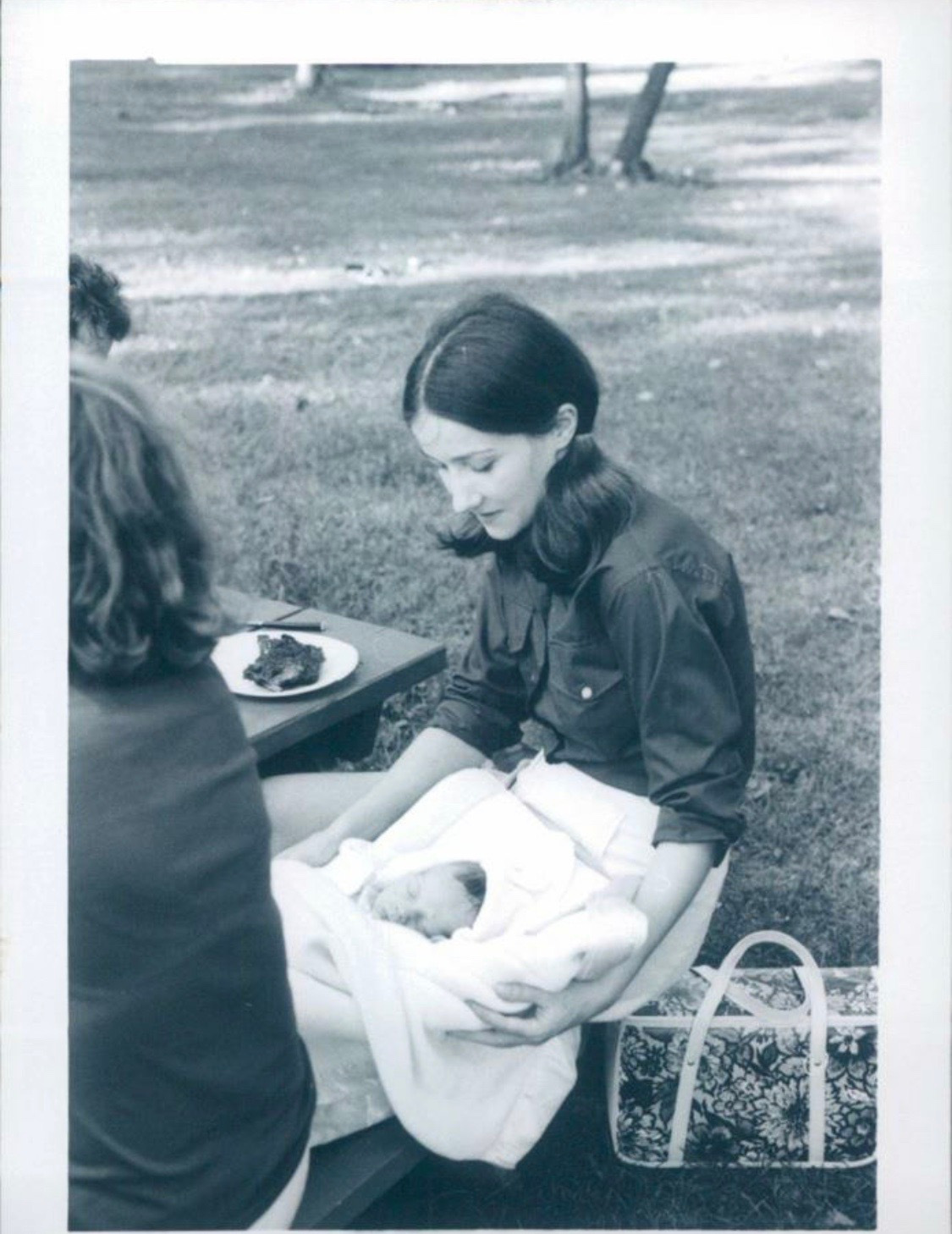
Mary Eileen and proud mother
Then someone handed me this tiny, pink baby wrapped up tight in blanket and my world changed forever. I was in love like never before. She was the most beautiful thing I had ever seen. I was bursting with happiness and awe for this little life I held in my arms.
I felt wonderful, bewitched, enchanted, awesome, thrilled – – and the happiest I’d ever been.
When I was 35 years old, age wasn’t something that was real to me. There were old people and then there was everyone else; I was among the latter group. It never occurred to me that I would be old someday. It wasn’t that I thought I would die young, it just that being old wasn’t going to happen.
I think of this now that, to the outside world, at the age of 71 some would consider me old. Take the news, for example, the other day, a newscaster was descripting a 71-year-old women who had been attacked in her home as “an elderly woman.” I was insulted. Why did they feel the need to put that adjective in the sentence? Why elderly? Why not just “a woman” or just “a 71-year-old woman”? Remember when Gabby Gilford was attacked by a gunman? Guess what? The gunman was stopped by a 70-year-old woman! Does that sound “elderly?”
It’s not growing old that bothers me. It’s the labels too often put on us. It’s the irrelevance by which we are too often treated. To many people, old means weak, feeble-minded, out of touch. Someone to be avoided. I remember pushing my mother in a wheelchair when she was in her 80’s. It was difficult going in and out of store doors, yet no one stopped to help. I recall thinking that if I had a baby stroller lots of people would have stopped to hold the doors and then smile at the baby. No one smiled at my mom. They acted as if she wasn’t’ there.
Like most people my age I don’t think of myself as old. I am still me, still the same inside. New ideas intrigue me, developing new interests excite me, I am interested in learning new things, keeping up with current trends and the latest political news.
Thankfully I have been blessed with a longer life than some of my friends, and I hope that I have many more years in front of me. But unlike my younger self – – and many who are now young – – I have grown to understand that the number of years on this earth does not define who I am. My actions define me.
I was a part of the baby boomers, raised in the 60’s. We shook up the world, challenged the status quo and looked for new ways to improve lives. We sat in circles with flowers in our hair and sang songs such as “We shall overcome” and “Where Have all the Flowers Gone.”
It may take me a little longer to get up off the floor, my knees aren’t as strong as they once were, and my hair may be grey, but I still hear those songs in my head. And they still challenge me. Challenge me to listen and to learn and to keep on contributing. Because, to me, the definition of “old” or “elderly” is to give up. And age doesn’t have a monopoly on that.
When I started this blog, I promised you – – my children and grandchildren – -remembrances of my growing up in the mid-twentieth century Chicago. But after having spent last evening with my father’s youngest, and only surviving sister, Aunt Doris, I’d like for you to understand more about their generation as well.
My dad was one of eight children of William and Mary Ann, nee Nichols, Murphy. At least that’s how they raised him from the age of about 14 on. In fact, my dad, Art Murphy, was Mary Ann Nichols’s son by a previous relationship as were four of his siblings.
Mary Ann was a young Irish immigrant . . . one of the multitude of immigrants coming into this country at that time. Originally she settled in Cedar Rapids, Iowa with her family, but eventually they made their way to Chicago.
According to my cousin, Patrick McArdle, who conducted research, Mary Ann’s parents were:
Samuel J. Nichols (born Sept 25, 1858) and
Mary Menary (born 1857).
They were married in Dramore, in County Down, Ireland which is in the north not far from Belfast.
Samuel J. Nichols’ father also was named Samuel; his mother’s maiden name was Lizzie Shea.
Mary Ann and Samuel had three children in Ireland;
Samuel J. born July 4,1880
Alexander born 1882
Mary Ann born April 1, 1884 – died January 9, 1954 in Chicago. At the time of Mary Ann’s birth, the family lived at 411 Gallows St. in Dramore, County Down.
Samuel traveled to the US around 1870 but returned to Ireland.
In approximately 1888 the whole family immigrated to the US and settled in Cedar Rapids Iowa. Prior to emigrating he worked on a boat for a while and then trained as a pork cutter, an occupation he continued in the US. In Cedar Rapids they had two more children Elizabeth and Patrick J. Nichols.
Sometime between 1900 and 1904 the family moved from Cedar Rapids to Chicago.
Mary (Menary) Nichols died in Chicago (at 929 w. 35th) on July 12, 1904 at age 46. She died in her sleep while napping on the couch.[1]
Samuel J. Nichols died at age 56 on July 22, 1915.[2] Samuel died from Pulmonary Tuberculosis. Both Sam and Mary Nichols are buried in Mt. Olivet Cemetery on 111th Street in Chicago. Samuel J. Nichols had been the president of the Holy Name Society for his local church in Chicago.
Meanwhile, Mary Ann Nichols married Michael Crean on Feb 24, 1904. Crean was born in New York in 1875 but both his parents were born in Ireland. He was cattle butcher in a packing house. Mary Ann and Michael had a tremulous relationship. According to court documents he was abusive to both his wife and the children. They finally were divorced in the summer of 1915. At the time of the divorce, he was serving 6 months in jail for attempting to kill Mary with a butcher knife – as she described it to the divorce court. At that time, they were living at 645 W. 38th St. in Chicago. They had been at that address since 1909.
Mary Ann had five children between 1904 and 1914:
Arthur Joseph (my father): Born Feb 7, 1904 – Died Mar 5, 1975
Stephen J.: Born 1907 – Died 1978
John D.: Born 1908 or ’09 – Died July 11, 1965
Mary: Born 1910 – Died October 20, 1944.
Edward: Born October 25, 1914 – Died January 16, 1992.
In late 1915, three of the children (Arthur, Stephen & John) left for St. Mary’s Training School for Boys in DesPlaines. Between late 1915 and 1918 Mary Ann, her daughter Mary and baby boy, Edward, lived at 2217 w. 47th St. and 2635 S. Lowe St. in Chicago. The three boys returned to Mary Ann on Feb 15th 1918. At this time, she was earning a living by washing clothes for $1.00 a day.
Mary Ann (Crean) Harres married William James Murphy in a civil ceremony on Sept. 16, 1918. At the time of the marriage they lived at 7239 S. Cottage Grove in Chicago and they would have three children:
James: Born Nov. 14, 1919 – Died 1998(?)
Doris: Born Feb. 17, 1921
Margaret (Billy): Born 1923 – Died March 27, 1927.
My note on the above: Patrick obtained the above information from public records. But it doesn’t tell the whole story. Although my grandmother was married to Michael Crean from 1904 through 1915, they were not together for most of the time and the paternity of the oldest five of her children (including my dad) is uncertain. And, in my opinion, not relevant today. In addition to an abusive relationship with Crean, she lived in a time of extreme poverty, discrimination and few, if any, options for women, especial uneducated immigrant women. As the story of her life unfolds you will find that she was a good and generous woman who loved her children with her whole heart and soul. Mary Ann Nichols Murphy more than proved her herself by the way she lived her life and with the love she shared so freely with so many as the years went by.
In summary, my grandmother came to the America at the age of four, lived in Cedar Rapids until her late teens and then, with her family, relocated to near the Union Stock Yards in Chicago. The neighborhood (Bridgeport) was predominately immigrant and mostly Irish. Other immigrant nationalities lived in nearby neighborhoods and most of the men worked in the stockyards.
The 375-acre Union Stock Yard had 2,300 separate livestock pens, room to accommodate 75,000 hogs, 21,000 cattle and 22,000 sheep at any one time. Slaughtering of animals went on 24 hours a day. Upton Sinclair, in The Jungle, describes in horrible detail the illegal and unsanitary working conditions endured by the men and women working in the stockyards. And those appalling conditions overflowed to the neighborhoods around them.
Thus it was at about the age of sixteen my grandma moved to Chicago to live in a dirt-poor, rough and tumble, and smelly neighborhood (and believe me, the stockyards smelled! The excrement of the living animals and the blood and guts of all the animals slaughtered permeated the ground and found its way into the air for miles around. Even when I was growing up and the stockyards were long gone, the smell driving through Bridgeport was beyond nauseating). The men who lived there worked long hours under harsh, horrible conditions and many of them drowned their pain and frustrations (and much of their earnings) in one of the many neighborhood taverns.
This was the world into which my grandmother was thrust; by contrast girls of that age today are worrying about getting a driver’s license or what to wear to their sophomore dance. So I don’t pretend to understand – – nor can I understand – – – what hardships led her to have five children in ten years with various partners. What I do understand is that it was not an easy time for anyone in those days and under those circumstances. But for a young immigrant girl it must have seemed hopeless.
My guess is that when Mary Ann finally had the courage to divorce her abusive husband and was left with five mouths to fed (taking in laundry for $1 a day), her already execrable life became much worse. I believe the three boys were placed in St. Mary’s Training School for Boys (now called Maryville) because Mary Ann had no options. She was a single woman with no steady work. Taking in laundry would hardly be enough to support herself much less five children (remember, there was no such thing as welfare at that time.) My dad, the oldest, would have been only eleven years old when they left her.
St. Mary’s was founded 30 years before Mary Ann’s children arrived there. It was an 800-acre farm that was supposed to give boys who were either orphaned or living in poverty a safe, clean place to live, learn a trade and get an education. But no matter how well intentioned, it was still an institution that took children away from their known world (no matter how bad that might have been) and suddenly threw them into a regimented life with little human affection to help ease their pain.
It was clear my Uncle Steve hated it. Johnny didn’t talk much about it. And as difficult as it must have been for my dad, he saw it as an opportunity to help his little brothers. He was assigned to work in the bakery which meant he had to get up early (3 am) to help prepare the bread and rolls for the day’s meals. (Remember, my dad was only between the ages of 11 and 14 while he was there.) But rather than complain about getting up early to bake, he always said he grateful that he worked in the bakery because he was able to snatch a few extra rolls each day for this young siblings.
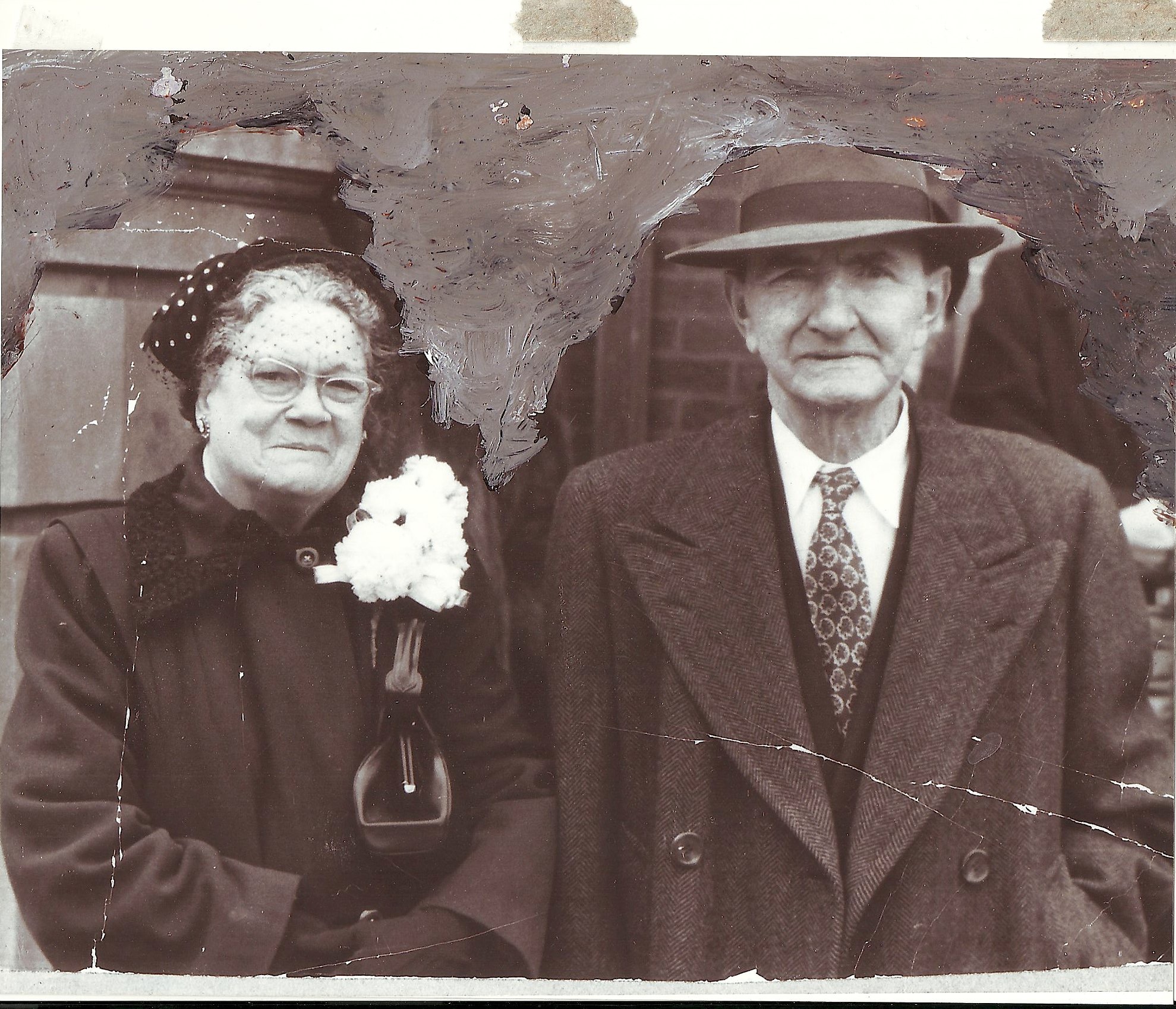
Grandma & Grandpa Murphy
Through it all, Mary Ann remained tough. She worked hard (still under terrible conditions) to be reunited with her oldest children. Shortly after the boys returned home, Mary Ann married William Murphy who settled in to became a father to her oldest five children. They went on the have three more children, Jimmy, Doris and Billie, however, tragically Billie was killed in a fire when only four years old.
There were many things special about Mary Ann and William Murphy but the one that stands out to me is the way in which they raised the children. No differences were made between the oldest of Mary Ann’s children and the youngest three she had with William. Indeed, my Aunt Doris says that she was completely unaware that all eight of them weren’t full siblings until she was a grown woman. That was quite a gift William Murphy gave to Art, Steve, Johnny, Mary and Edward. He gave them a home and a loving father.
Another stand-out trait of the Murphy’s was their humor. Every one of the eight children had a razor sharp sense of humor and an ability to laugh at themselves. No matter what life obstacles they faced – – – and they faced plenty – – – they faced it with humor.
As strapped as they were for cash, Mary Ann and William never hesitated to take in someone in need. In the height of the Depression, when Mary Ann’s oldest daughter died of a heart condition, the Murphy’s took in her baby girl, Dolores, and raised her as their own.
Earlier, when one of Mary Ann’s nieces was orphaned and sent to live with an abusive family in Joliet, all it took was one letter from Marie to Mary Ann telling her of her misery. Mary Ann scrapped together what little cash they had, boarded a train to Joliet, retrieved Marie from the miserable home and brought her back to Chicago to join the family – – – and become one more mouth to feed. But that didn’t matter to Mary Ann. Her priorities were solid: family comes first and no matter what the obstacles, they are loved and cared for.
I still remember visits to grandma and grandpa Murphy’s. Most Sunday afternoons, we would take two buses to get to their house: Ashland north to 55th street and 55th street west to Francisco, then walk north past the alley to their apartment building. Sundays were a time when all the Murphy siblings gathered there. It was often overflowing with kids running around while the adults played cards. But what I remember the most, other than the overwhelming smell of cigarette smoke, was the good natured banter and laughter of the adults.
My favorite thing to do at grandma and grandpa’s house was to accompany my grandpa to the tavern next door. I loved it in there. We’d walk in the door on a hot summer’s day into a different universe, or so it seemed to me. We’d leave the blinding, hot summer sun and enter into a dark, smoky, mysterious cavern of a place with a few men sitting at a long well-worn wooden bar with the hum of overhead fans as the background noise. It was so dark I could hardly make out their faces. Most would ignore the pig-tailed little girl with her grandfather, but the bartender always invited me to sit on a bar stool and offer me a penny pretzel from the big jar on the counter. I remember sitting in that dark, cool place making the pretzel last as long as I could while grandpa had his beer.
Another Murphy story is one I don’t remember it because it happened before I was born, but my older siblings tell me a story about one of Uncle Steve’s visit to our house. My parents happened to be out, but Steve decided to stay, have drink, and entertain my older siblings by demonstrating how he could spit beer between the gap in his front teeth and hit the wallpaper exactly where he called it. My mother probably was none too happy when she returned and saw the damage to the newly hung wallpaper, but my sister and brothers thought it was the funniest thing they had ever seen. We still laugh about it 70 years later.
On a hot summer’s night in the 1940’s, my mom and dad went to visit his cousin Marie and her husband Brownie. When they stepped into their 2nd floor apartment (which was over a liquor store)on 69th Street) all the lights were slowly flashing on and off. Mom and dad sat down but no one mentioned the flashing lights. Marie and Brownie acted as if all was normal. After a while, my mom couldn’t stop herself and asked Marie why the lights were flashing. Marie matter-of-factly explained that the electricity had been cut off, so they simply took an extension cord and plugged it into one of the missing lights blub sockets in neon sign for the liquor store which hung outside their window. The fact that the sign flashed on and off – – and thus so did their lights – – didn’t seem to bother them in the least. After returning home, my dad mused on how they read the newspaper, he guessed they had to blink in unison with the flashing lights.
I remember, too, the day my grandma Murphy died. I was eight years old and my cousins, the McArdle’s (Aunt Doris’ family) came over the play. Doris, and her husband Turk, had finally saved enough to buy a small house in Evergreen Park and it was the day of their closing. So the kids stayed with us. It was always fun to have the cousins come over; there were, I believe, five of them at the time and between them and us we ran wild. But in the middle of the chaos, the old pay phone on the wall rang. I watched as my dad answered it. Then I watched as he went limp and made it to the couch before breaking down in tears. My grandma Murphy – his beloved mother – had died. Doris and Turk returned a short time later and the day that started as one of happiness for them, suddenly turned dark.
I remember that as the adults sat in the small living room, talking in low voices between their tears, my cousin, Sharon and I went out on the back stairs. They were wooden stairs that led down to the sidewalk and, in the other direction, up to my Grandpa Kelly’s attic flat on the second floor. Sharon and I sat down on one of the steps leading up to grandpa’s and through the railing looked up at the night sky. We were silent, each in our own thoughts. The next thing I remember is watching as a white smoky substance appeared far away in the night sky. It swirled around itself and was moving ever so slowly upwards. As I watched, it occurred to me that it was grandma’s soul ascending into heaven and that she was saying goodbye to us as she left.
My grandma Murphy, Mary Ann Nichols Murphy, who had been brought from Ireland to America at a young age by her family who had been, I am sure, filled with hopes of a better life, and who had endured some of the worst poverty and discrimination imaginable, died a respected, church-going, and most of all, beloved and cherished wife, mother and grandmother. Her strength and determination to keep going, never give up, stay committed to family and keep on loving are traits I hope and pray have been passed on to me and my generation. God willing, we pass it on to Mary Ann’s great and great-great grandchildren. In that way we pay tribute to this fine, admirable woman – – – who, I am proud to say, is my grandmother – – – and she lives on.


 Growing up in Chicago in the '50's