My Grandma Murphy
When I started this blog, I promised you – – my children and grandchildren – -remembrances of my growing up in the mid-twentieth century Chicago. But after having spent last evening with my father’s youngest, and only surviving sister, Aunt Doris, I’d like for you to understand more about their generation as well.
My dad was one of eight children of William and Mary Ann, nee Nichols, Murphy. At least that’s how they raised him from the age of about 14 on. In fact, my dad, Art Murphy, was Mary Ann Nichols’s son by a previous relationship as were four of his siblings.
Mary Ann was a young Irish immigrant . . . one of the multitude of immigrants coming into this country at that time. Originally she settled in Cedar Rapids, Iowa with her family, but eventually they made their way to Chicago.
According to my cousin, Patrick McArdle, who conducted research, Mary Ann’s parents were:
- Samuel J. Nichols (born Sept 25, 1858) and
- Mary Menary (born 1857).
- They were married in Dramore, in County Down, Ireland which is in the north not far from Belfast.
- Samuel J. Nichols’ father also was named Samuel; his mother’s maiden name was Lizzie Shea.
Mary Ann and Samuel had three children in Ireland;
- Samuel J. born July 4,1880
- Alexander born 1882
- Mary Ann born April 1, 1884 – died January 9, 1954 in Chicago. At the time of Mary Ann’s birth, the family lived at 411 Gallows St. in Dramore, County Down.
Samuel traveled to the US around 1870 but returned to Ireland.
In approximately 1888 the whole family immigrated to the US and settled in Cedar Rapids Iowa. Prior to emigrating he worked on a boat for a while and then trained as a pork cutter, an occupation he continued in the US. In Cedar Rapids they had two more children Elizabeth and Patrick J. Nichols.
Sometime between 1900 and 1904 the family moved from Cedar Rapids to Chicago.
- Mary (Menary) Nichols died in Chicago (at 929 w. 35th) on July 12, 1904 at age 46. She died in her sleep while napping on the couch.[1]
- Samuel J. Nichols died at age 56 on July 22, 1915.[2] Samuel died from Pulmonary Tuberculosis. Both Sam and Mary Nichols are buried in Mt. Olivet Cemetery on 111th Street in Chicago. Samuel J. Nichols had been the president of the Holy Name Society for his local church in Chicago.
Meanwhile, Mary Ann Nichols married Michael Crean on Feb 24, 1904. Crean was born in New York in 1875 but both his parents were born in Ireland. He was cattle butcher in a packing house. Mary Ann and Michael had a tremulous relationship. According to court documents he was abusive to both his wife and the children. They finally were divorced in the summer of 1915. At the time of the divorce, he was serving 6 months in jail for attempting to kill Mary with a butcher knife – as she described it to the divorce court. At that time, they were living at 645 W. 38th St. in Chicago. They had been at that address since 1909.
Mary Ann had five children between 1904 and 1914:
- Arthur Joseph (my father): Born Feb 7, 1904 – Died Mar 5, 1975
- Stephen J.: Born 1907 – Died 1978
- John D.: Born 1908 or ’09 – Died July 11, 1965
- Mary: Born 1910 – Died October 20, 1944.
- Edward: Born October 25, 1914 – Died January 16, 1992.
In late 1915, three of the children (Arthur, Stephen & John) left for St. Mary’s Training School for Boys in DesPlaines. Between late 1915 and 1918 Mary Ann, her daughter Mary and baby boy, Edward, lived at 2217 w. 47th St. and 2635 S. Lowe St. in Chicago. The three boys returned to Mary Ann on Feb 15th 1918. At this time, she was earning a living by washing clothes for $1.00 a day.
Mary Ann (Crean) Harres married William James Murphy in a civil ceremony on Sept. 16, 1918. At the time of the marriage they lived at 7239 S. Cottage Grove in Chicago and they would have three children:
- James: Born Nov. 14, 1919 – Died 1998(?)
- Doris: Born Feb. 17, 1921
- Margaret (Billy): Born 1923 – Died March 27, 1927.
My note on the above: Patrick obtained the above information from public records. But it doesn’t tell the whole story. Although my grandmother was married to Michael Crean from 1904 through 1915, they were not together for most of the time and the paternity of the oldest five of her children (including my dad) is uncertain. And, in my opinion, not relevant today. In addition to an abusive relationship with Crean, she lived in a time of extreme poverty, discrimination and few, if any, options for women, especial uneducated immigrant women. As the story of her life unfolds you will find that she was a good and generous woman who loved her children with her whole heart and soul. Mary Ann Nichols Murphy more than proved her herself by the way she lived her life and with the love she shared so freely with so many as the years went by.
In summary, my grandmother came to the America at the age of four, lived in Cedar Rapids until her late teens and then, with her family, relocated to near the Union Stock Yards in Chicago. The neighborhood (Bridgeport) was predominately immigrant and mostly Irish. Other immigrant nationalities lived in nearby neighborhoods and most of the men worked in the stockyards.
The 375-acre Union Stock Yard had 2,300 separate livestock pens, room to accommodate 75,000 hogs, 21,000 cattle and 22,000 sheep at any one time. Slaughtering of animals went on 24 hours a day. Upton Sinclair, in The Jungle, describes in horrible detail the illegal and unsanitary working conditions endured by the men and women working in the stockyards. And those appalling conditions overflowed to the neighborhoods around them.
Thus it was at about the age of sixteen my grandma moved to Chicago to live in a dirt-poor, rough and tumble, and smelly neighborhood (and believe me, the stockyards smelled! The excrement of the living animals and the blood and guts of all the animals slaughtered permeated the ground and found its way into the air for miles around. Even when I was growing up and the stockyards were long gone, the smell driving through Bridgeport was beyond nauseating). The men who lived there worked long hours under harsh, horrible conditions and many of them drowned their pain and frustrations (and much of their earnings) in one of the many neighborhood taverns.
This was the world into which my grandmother was thrust; by contrast girls of that age today are worrying about getting a driver’s license or what to wear to their sophomore dance. So I don’t pretend to understand – – nor can I understand – – – what hardships led her to have five children in ten years with various partners. What I do understand is that it was not an easy time for anyone in those days and under those circumstances. But for a young immigrant girl it must have seemed hopeless.
My guess is that when Mary Ann finally had the courage to divorce her abusive husband and was left with five mouths to fed (taking in laundry for $1 a day), her already execrable life became much worse. I believe the three boys were placed in St. Mary’s Training School for Boys (now called Maryville) because Mary Ann had no options. She was a single woman with no steady work. Taking in laundry would hardly be enough to support herself much less five children (remember, there was no such thing as welfare at that time.) My dad, the oldest, would have been only eleven years old when they left her.
St. Mary’s was founded 30 years before Mary Ann’s children arrived there. It was an 800-acre farm that was supposed to give boys who were either orphaned or living in poverty a safe, clean place to live, learn a trade and get an education. But no matter how well intentioned, it was still an institution that took children away from their known world (no matter how bad that might have been) and suddenly threw them into a regimented life with little human affection to help ease their pain.
It was clear my Uncle Steve hated it. Johnny didn’t talk much about it. And as difficult as it must have been for my dad, he saw it as an opportunity to help his little brothers. He was assigned to work in the bakery which meant he had to get up early (3 am) to help prepare the bread and rolls for the day’s meals. (Remember, my dad was only between the ages of 11 and 14 while he was there.) But rather than complain about getting up early to bake, he always said he grateful that he worked in the bakery because he was able to snatch a few extra rolls each day for this young siblings.
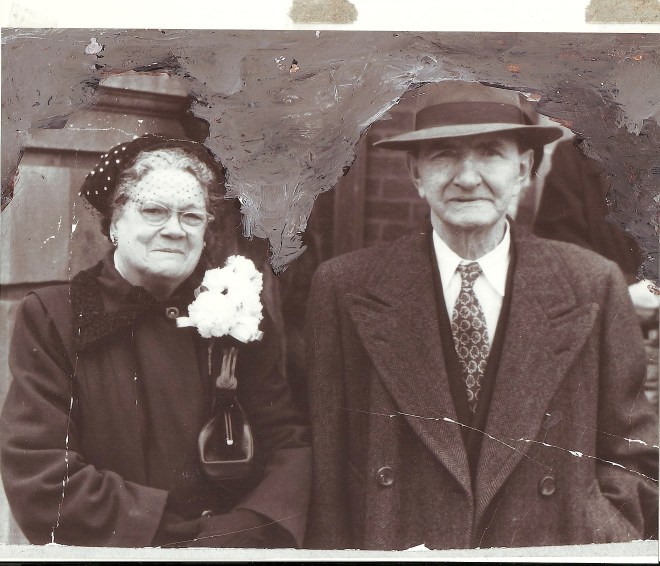
Through it all, Mary Ann remained tough. She worked hard (still under terrible conditions) to be reunited with her oldest children. Shortly after the boys returned home, Mary Ann married William Murphy who settled in to became a father to her oldest five children. They went on the have three more children, Jimmy, Doris and Billie, however, tragically Billie was killed in a fire when only four years old.
There were many things special about Mary Ann and William Murphy but the one that stands out to me is the way in which they raised the children. No differences were made between the oldest of Mary Ann’s children and the youngest three she had with William. Indeed, my Aunt Doris says that she was completely unaware that all eight of them weren’t full siblings until she was a grown woman. That was quite a gift William Murphy gave to Art, Steve, Johnny, Mary and Edward. He gave them a home and a loving father.
Another stand-out trait of the Murphy’s was their humor. Every one of the eight children had a razor sharp sense of humor and an ability to laugh at themselves. No matter what life obstacles they faced – – – and they faced plenty – – – they faced it with humor.
As strapped as they were for cash, Mary Ann and William never hesitated to take in someone in need. In the height of the Depression, when Mary Ann’s oldest daughter died of a heart condition, the Murphy’s took in her baby girl, Dolores, and raised her as their own.
Earlier, when one of Mary Ann’s nieces was orphaned and sent to live with an abusive family in Joliet, all it took was one letter from Marie to Mary Ann telling her of her misery. Mary Ann scrapped together what little cash they had, boarded a train to Joliet, retrieved Marie from the miserable home and brought her back to Chicago to join the family – – – and become one more mouth to feed. But that didn’t matter to Mary Ann. Her priorities were solid: family comes first and no matter what the obstacles, they are loved and cared for.
I still remember visits to grandma and grandpa Murphy’s. Most Sunday afternoons, we would take two buses to get to their house: Ashland north to 55th street and 55th street west to Francisco, then walk north past the alley to their apartment building. Sundays were a time when all the Murphy siblings gathered there. It was often overflowing with kids running around while the adults played cards. But what I remember the most, other than the overwhelming smell of cigarette smoke, was the good natured banter and laughter of the adults.
My favorite thing to do at grandma and grandpa’s house was to accompany my grandpa to the tavern next door. I loved it in there. We’d walk in the door on a hot summer’s day into a different universe, or so it seemed to me. We’d leave the blinding, hot summer sun and enter into a dark, smoky, mysterious cavern of a place with a few men sitting at a long well-worn wooden bar with the hum of overhead fans as the background noise. It was so dark I could hardly make out their faces. Most would ignore the pig-tailed little girl with her grandfather, but the bartender always invited me to sit on a bar stool and offer me a penny pretzel from the big jar on the counter. I remember sitting in that dark, cool place making the pretzel last as long as I could while grandpa had his beer.
Another Murphy story is one I don’t remember it because it happened before I was born, but my older siblings tell me a story about one of Uncle Steve’s visit to our house. My parents happened to be out, but Steve decided to stay, have drink, and entertain my older siblings by demonstrating how he could spit beer between the gap in his front teeth and hit the wallpaper exactly where he called it. My mother probably was none too happy when she returned and saw the damage to the newly hung wallpaper, but my sister and brothers thought it was the funniest thing they had ever seen. We still laugh about it 70 years later.
On a hot summer’s night in the 1940’s, my mom and dad went to visit his cousin Marie and her husband Brownie. When they stepped into their 2nd floor apartment (which was over a liquor store)on 69th Street) all the lights were slowly flashing on and off. Mom and dad sat down but no one mentioned the flashing lights. Marie and Brownie acted as if all was normal. After a while, my mom couldn’t stop herself and asked Marie why the lights were flashing. Marie matter-of-factly explained that the electricity had been cut off, so they simply took an extension cord and plugged it into one of the missing lights blub sockets in neon sign for the liquor store which hung outside their window. The fact that the sign flashed on and off – – and thus so did their lights – – didn’t seem to bother them in the least. After returning home, my dad mused on how they read the newspaper, he guessed they had to blink in unison with the flashing lights.
I remember, too, the day my grandma Murphy died. I was eight years old and my cousins, the McArdle’s (Aunt Doris’ family) came over the play. Doris, and her husband Turk, had finally saved enough to buy a small house in Evergreen Park and it was the day of their closing. So the kids stayed with us. It was always fun to have the cousins come over; there were, I believe, five of them at the time and between them and us we ran wild. But in the middle of the chaos, the old pay phone on the wall rang. I watched as my dad answered it. Then I watched as he went limp and made it to the couch before breaking down in tears. My grandma Murphy – his beloved mother – had died. Doris and Turk returned a short time later and the day that started as one of happiness for them, suddenly turned dark.
I remember that as the adults sat in the small living room, talking in low voices between their tears, my cousin, Sharon and I went out on the back stairs. They were wooden stairs that led down to the sidewalk and, in the other direction, up to my Grandpa Kelly’s attic flat on the second floor. Sharon and I sat down on one of the steps leading up to grandpa’s and through the railing looked up at the night sky. We were silent, each in our own thoughts. The next thing I remember is watching as a white smoky substance appeared far away in the night sky. It swirled around itself and was moving ever so slowly upwards. As I watched, it occurred to me that it was grandma’s soul ascending into heaven and that she was saying goodbye to us as she left.
My grandma Murphy, Mary Ann Nichols Murphy, who had been brought from Ireland to America at a young age by her family who had been, I am sure, filled with hopes of a better life, and who had endured some of the worst poverty and discrimination imaginable, died a respected, church-going, and most of all, beloved and cherished wife, mother and grandmother. Her strength and determination to keep going, never give up, stay committed to family and keep on loving are traits I hope and pray have been passed on to me and my generation. God willing, we pass it on to Mary Ann’s great and great-great grandchildren. In that way we pay tribute to this fine, admirable woman – – – who, I am proud to say, is my grandmother – – – and she lives on.
[1] Death certificate #00011846
[2] Death certificate #00013751

 Growing up in Chicago in the '50's
Well done! Enjoyable, like your Facebook.
LikeLike